Thursday, 25 April 2024

Unraveling the Impact: How the Pandemic Affected FE Exam Candidates

Unraveling the Impact: How the Pandemic Affected FE Exam Candidates
In early 2020, the world was locked down due to a nightmarish virus: COVID-19. As the virus spread rapidly across the globe, it brought about significant disruptions across a multitude of sectors, including education. Among those heavily impacted were aspiring engineers preparing for the Fundamentals of Engineering (FE) exam, a critical milestone for their professional journey. This blog aims to dive deeper into the ways in which the pandemic affected all FE exam candidates, explore the challenges they faced, and highlight the remarkable resilience they displayed in adapting to these difficult circumstances.
1. The Shift to Remote Learning: Challenges and Opportunities

The Shift to Remote Learning: Challenges and Opportunities
When the pandemic struck, schools and universities were forced to lock up their doors, causing a rapid shift from traditional, in-person learning to remote education. For FE exam candidates, this meant embracing online lectures, virtual study groups, and digital resources as the new norm. While initially, this new digital environment offered plenty of conveniences, such as schedule flexibility and greater accessibility, it also came with a set of new challenges.
The abrupt shift to remote learning forced all candidates to adapt to a different learning style. Some individuals were able to thrive in the virtual environment, finding it more conducive to their own study habits. However, there were others who struggled to adapt, facing technical difficulties or struggling to maintain focus without the structure of a physical classroom.
Social distancing exasperated the issue, forbidding friends, colleagues, and all other established study groups from gathering personally. The lack of face-to-face interactions with peers and instructors also deprived candidates of valuable opportunities for immediate feedback and collaboration.
2. Disrupted Study Routines: Maintaining Focus Amidst Chaos

Disrupted Study Routines: Maintaining Focus Amidst Chaos
An effective study routine is fundamental for success in all exams, and the pandemic wreaked havoc on candidates' established study habits. Many found themselves engulfed by the many distractions found at home, making it incredibly challenging for many to maintain their concentration and discipline during their dedicated study sessions. The lines between personal and academic spaces blurred, increasing the likelihood of procrastinating and reducing productivity.
Additionally, the pandemic imposed additional responsibilities and greater stress on some candidates. For instance, those living with high-risk family members or roommates were required to become caretakers during the pandemic, drastically reducing any available study time. Others were faced with immense financial strain due to unexpected job losses or economic uncertainties, forcing them to put greater effort into searching and taking on more work alongside their exam preparations.
3. Limited Access to Resources: Overcoming Obstacles

Limited Access to Resources: Overcoming Obstacles
Access to study materials and other testing resources has always been essential for FE exam preparation; however, the pandemic also created new sets of obstacles in this area. Closures of libraries and educational institutions limited candidates' access to physical textbooks, study guides, and study groups. Unfortunately, those who were plagued with internet connectivity issues or financial constraints faced even greater difficulties in terms of access to online resources, exacerbating their already-strained exam prep.
As a show of many candidates’ sheer determination, ingenuity, and ability to adapt to new situations, many sought alternative resources and utilized the tools that were already readily available to them. Collaborating through online platforms, sharing study materials, participating in virtual study groups, and engaging in webinars hosted by experienced professionals; all these actions showcased their determination to overcome any obstacles, highlighting their commitment to succeeding in their career aspirations.
4. Canceled or Delayed Exams: Coping with Uncertainty

Canceled or Delayed Exams: Coping with Uncertainty
Uncertainty spread throughout the pandemic, forcing testing centers all around the world to suspend or reschedule FE exams to prioritize public health and safety. These abrupt cancelations added significant strain and frustration for those candidates who had diligently prepared for their scheduled exam dates, only to be told that their chosen exam had been postponed indefinitely.
In response to these sudden changes, candidates had to recalibrate their study timelines and adjust their preparation strategies. While this may have been undoubtedly challenging, many turned this period into an opportunity for further refinement in their exam preparation, using this newfound time to solidify their understanding, refine their problem-solving skills, and conduct further mock exams to enhance their exam readiness.
5. Emotional Toll and Mental Health Challenges: Nurturing Well-being

Emotional Toll and Mental Health Challenges: Nurturing Well-being
The pandemic's prolonged duration and uncertainty brought an immense emotional toll on the world, including FE exam candidates. Stress and anxiety relating to health concerns, economic insecurity, and social isolation affected many candidates' mental well-being, making it all the more difficult to focus on studying and preparing for the exam.
To combat anxiety and mental stress, it was important to have strong support systems in place. Family, friends, and peers played an integral role in providing emotional support and encouragement. Online communities emerged as a vital resource, offering a platform for candidates to connect, share experiences, and find solace in knowing they were not alone in facing these struggles.
Conclusion
The COVID-19 pandemic and global lockdown undoubtedly brought along many challenges for aspiring engineers preparing for the FE exam. Shifting to remote learning, disrupting study routines, limiting access to resources, isolating everyone, and postponing exams posed significant hurdles for everyone. Additionally, the emotional toll and mental health challenges further compounded the difficulties faced by future examinees. However, these obstacles were not faced without resistance.
Resilience and adaptability were highlighted in the face of adversity during COVID-19 and were nothing short of inspiring. Despite the setbacks, FE exam candidates were able to demonstrate determination and resourcefulness by embracing remote learning, seeking alternative study resources, and adjusting their preparation strategies for this new world. As we continue forward, it is crucial to recognize the hardships faced by FE exam candidates during the pandemic and provide the necessary support and resources to combat future hindrances that we may face in the future.
While the pandemic may have hurt FE exam candidates, it has also shown the strength of their spirit and their unwavering commitment as engineers. As the world gradually recovers from this crisis, let us celebrate the resilience of these aspiring engineers and support their journey towards a brighter and more promising future. Are you on the path to becoming a professional engineer? School of PE’s FE and PE exam courses are just what you need! Learn more about our comprehensive course options now!
About the Author: Khoa Tran

Khoa Tran is an electrical engineer working at the Los Angeles Department of Water and Power and is currently pursuing his master's in electrical Power from the University of Southern California. He is fluent in both Vietnamese and English and is interested in outdoor activities and exploring new things.

Thursday, 18 April 2024

It All Adds Up: Mathematics on the FE Electrical Exam Pt. 2

It All Adds Up: Mathematics on the FE Electrical Exam Pt. 2
Welcome back to our introduction to mathematics! Continuing from where we left off, we will explore calculus, ordinary differential equations, linear algebra, and vector analysis.
Calculus
A. Derivative
The derivative of a function determines the immediate rate of change. Visually, it represents the slope depicted by the original function.
The basic rules of derivative include: derivative of sum, derivative of product, and derivative of quotient. The derivative of the sum is straightforward; you just need to take the derivative of each term. When it comes to multiplication, we have the product rule (Eqn 1).
dy/dx = u dv/dx + v du/dx      (1)
And the quotient rule (Eqn 2) to use for the division.
dy/dx = (v du/dx-u dv/dx)/v2    (2) 
The chain rule is a formula for finding the derivative of the composite of 2 functions. The chain rule helps to differentiate composite functions (find the derivative of a composite function). Generally, there is an “inside function” and an “outside function” that are both differentiable (Orloff, 2023).
(d[(f(u)])/dx = (d[f(u)]) /du  du/dx   (3) or 
f(g(x))' = f'(g(x))*g'(x)   (4)
B. Integral
The integral, or antiderivative, permits the calculation of the area under a curve or between curves.
Basic techniques for integrals:
1. Look for ways to simplify the integral with algebra before integrating.
2. Refer to the indefinite integrals on page 49 of the FE reference handbook.
3. Plug in the initial value and solve for the constant.
When integrals are more complicated, other methods of integration that can be used are:
1. Integration by Parts
2. Substitution
I. Integration by Parts
Integration by parts evaluates integrals of products of functions. It is based on the product rule of differentiation, which states that the derivative of the product of two functions is equal to the first function times the derivative of the second function, plus the second function times the derivative of the first function (Strang & Herman, 2022).
∫ u dv = uv - ∫ v du   (5) 
II. Substitution
U-substitution, also known as “Integration by Substitution” or “The Reverse Chain Rule”, is a method to simplify and evaluate integrals by use of substitution. To begin, ensure the integral is written in its standard form:
∫ f(g(x))g'(x) dx,   (6)
Then substitute in the variable “u.”
 ∫ f(u) du   (7) 
This replacement reduces a complicated expression into a simpler form that can be more easily evaluated.
The U-substitution is as follows (Mathematics LibreTexts, 2020):
1. Identify an expression within the integrand which appears to be a derivative of some function.
2. Choose a new variable "u" to represent the chosen expression. Do not forget to include the corresponding differential "du" to the derivative of "u" with respect to the original.
3. Rewrite the entire integral and substituting in the new variable "u", effectively replacing the complicated expression with "u".
4. Evaluate the new integral with respect to "u" using standard integration techniques, which may involve simpler rules or known integral formulas.
5. Finally, substitute the original variable back into the result by replacing "u" with the expression chosen in step 2.
Ordinary Differential Equation
A differential equation is a mathematical equation that involves an unknown function and its derivatives. It describes the relationship between the function and its rates of change. In essence, a differential equation expresses how the function's behavior changes based on its current state and the values of its derivatives (Herman, 2018).
The FE Reference Handbook provides a comprehensive collection of equation forms necessary for solving first-order and second-order homogeneous differential equations. These invaluable resources can be found on pages 52 and 53 of the handbook. To further enhance your understanding and proficiency, you can explore additional illustrative examples by following this link.
Matrix Operations
Matrix operations refer to various mathematical operations performed on matrices, which are rectangular arrays of numbers. Matrix operations allow for the manipulation, combination, and transformation of matrices, enabling the analysis of systems of linear equations, geometric transformations, and other mathematical applications.
In this section, I will not go too in-depth since you can use a calculator to manipulate matrices in the FE exam. You can visit this link to do matrix multiplication and this link on how to find the inverse and adjoint of a matrix.
Vector Analysis
A vector embodies the essence of a physical property, possessing not only its size but also its orientation. Its portrayal in three-dimensional space is accomplished by its x, y, and z constituents (Corral, 2023), often denoted as
F = ax i + ay j + az k   (8)
where:
ax, ay, az are the component magnitudes in the x, y, and z directions.
i,j,k are the unit vectors establishing coordinate direction for the vector.
The magnitude of vector F is calculated as:
F = √(〖ax2 +〖ay2 +〖az2 )   (9)
A wide array of operations can be performed with vectors, benefiting from their linear nature, which ensures clear and precise outcomes.
Among the operations involving vectors are addition, subtraction, and multiplication, which are essentially akin to basic algebraic procedures. Scalar multiplication entails the multiplication of a scalar by a vector. The dot product, on the other hand, determines the angle between two vectors.
A. Vector Addition and Subtraction
Vector addition is the process of combining two or more vectors to obtain a resultant vector. Vector subtraction involves a reversal in direction, achieved by adding negative vectors. A negative vector possesses an equal magnitude to that of a positive addition vector but points in the opposite direction.
A ± B = (ax ± bx)i + (ay ± by)j + (az ± bz)k   (10)
B. Vector Dot Product
Also known as the scalar product, it is the operation that yields a scalar value by taking the sum of the products of the corresponding components of two vectors (Corral, 2023).
A∙B = (ax bx) + (ay by) + (az bz)   (11) (this produces a scalar)
or
A∙B = |A||B|cosθ = B∙A (12) (this produces the projection)
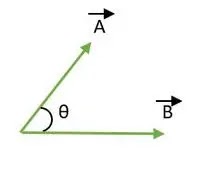
By rearranging the equation, the dot product can be utilized to ascertain the angle between two vectors, as illustrated in Figure 1. This rearrangement involves employing the cosine of the angle equation for the dot product.
cos θ = (A∙B) / |A||B|   (13)
Figure 1
Figure 1
C. Vector Cross Product
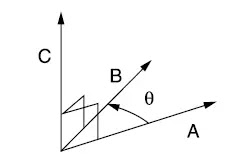
 The cross product yields a third vector, adhering to the principles of the right-hand rule, which resides orthogonal to the plane encompassing the initial two vectors. As vector A gracefully intertwines with vector B, it imparts the orientation of vector C, unfolding a trajectory perpendicular to their shared plane (Figure 2) (Corral, 2023).

Figure 2
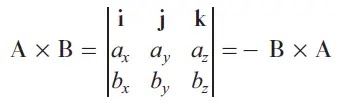
The cross product is illustrated as a 3x3 matrix:
Formula
The sense of A X B is determined by the right-hand rule:
A × B = |A||B|n sin θ (14)
Where,
n is the unit vector perpendicular to the plane of A and B.
Conclusion
Although this blog provides an overview of mathematical topics found on the FE Electrical exam, you can find a more thorough explanation in School of PE’s FE Electrical exam review course. Learn more or register for a course now!
About the Author: Khoa Tran

Khoa Tran is an electrical engineer working at the Los Angeles Department of Water and Power and is currently pursuing his master's in electrical Power from the University of Southern California. He is fluent in both Vietnamese and English and is interested in outdoor activities and exploring new things.

Thursday, 11 April 2024

It All Adds Up: Mathematics on the FE Electrical Exam

It All Adds Up: Mathematics on the FE Electrical Exam
For those looking to take the Fundamentals of Engineering (FE) Electrical Engineering (EE) exam, we will delve into various concepts and components of mathematics, including:
1. Algebra and trigonometry
2. Complex numbers
3. Discrete mathematics
4. Analytic geometry
5. Calculus
6. Ordinary differential equation
7. Matrix Operation
8. Vector Analysis
Please note that the materials presented here are an overview. We encourage you to explore further resources if you wish to learn more about any particular topic.
Algebra and Trigonometry
A. Algebra
Algebra serves as an essential cornerstone in the realm of engineering. Nearly all analytical assessments in engineering require the use of algebraic equations. To adequately equip oneself for the FE Electrical exam, it is paramount to possess the proficiency to adeptly manipulate elementary algebraic equations, enabling the subsequent determination of solutions. This segment showcases illustrative instances of equation manipulations for comprehensive comprehension.
B. Trigonometry
Within the “Mathematic” section of the FE Reference Handbook, one can find a comprehensive compilation of essential trigonometric relations.
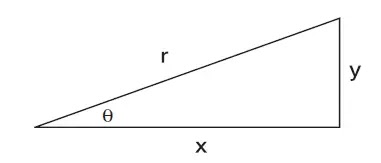
A notable use of trigonometry is analyzing the behavior of right triangles (Figure 1).
Figure 1

Figure 1
sin θ = y/r; cos θ = x/r; tan θ = y/x; cot θ = x/y; csc θ = r/y
sec θ = r/x
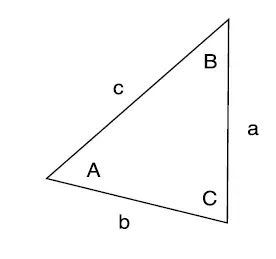
However, for non-right triangles, we cannot apply the above trigonometric relation to solve for the unknown values. Using the law of sines and cosines, all unknowns of a triangle can be characterized (Figure 2).
Figure%202%20(1)

Figure 2
The law of sines is depicted below
 a/sin A = b/sin B  = c/sin C
The law of cosines is depicted below:
a2= b2+ c2 – 2bc cos A 
b2= a2+ c2 – 2ac cos A
c2= a2+ b2 – 2ab cos C
Complex Numbers
Complex numbers are a mathematical characterization equation that combines both a real part and an imaginary part (Electronics Tutorials, n.d.). It is typically written in the form
y = a + jb (1)
Where,
 a = real component
b = imaginary component, and j is the imaginary variable with the unit of √(-1). 
Complex numbers allow for the representation and manipulation of quantities that involve both real and imaginary components, extending the number system beyond the realm of real numbers.
There are two forms that the complex numbers can be represented: rectangular form or polar form (Electronics Tutorials, n.d.).
A. Rectangular Form
In the context of complex numbers, the rectangular form refers to a way of representing a complex number using its real and imaginary parts.
y = a + jb
B. Polar Form
In complex numbers, the polar form represents a way of expressing a complex number using its magnitude (or modulus) and argument (or angle). A complex number in polar form is written.
y = r(cos cos θ + jsin sin θ)=  z∠θ
To convert the complex number from rectangular form  to polar form, we can use the following formulas:
z = √(a2+b2 )
θ = (b/a)  (in degree)
Conversely, to convert a complex number from polar form to rectangular form, we can use the following formulas:
a = r × cos cos θ 
b = r × sin sin θ 
Complex numbers can be added, subtracted, multiplied, and divided. Let’s say we have these 2 complex numbers:
A = 2+3j
B = -1+4j
Given the above values, complex numbers can be added and subtracted in rectangular form:
1. A + B = 2 + (-1) +3j  +4j  = 1 + 7j
2. A – B = 2 – (-1) + 3j - 4j = 3 - j
While, multiplying and dividing is performed in the polar form:
1. Convert the complex number A and B into polar form
a. For A: z = √(22+32 ) = 3.6056 and θ = (3/2) = 56.31 deg . So, A = 3.6056 ∠56.31deg.
b. For B: z = √(〖(-1)〗2+42 ) = 4.123 and θ = (4/(-1)) =104.04 deg . So, B = 4.123∠104.04deg.
2. When A x B:
A x B = 3.6056∠56.31deg × 4.123∠104.04deg = = 3.6056*4.123∠(56.31+104.04) =14.87∠160.35deg
3. When A / B: 
A / B = (3.6056∠56.31) / (4.123∠104.04) = 3.6056/4.123∠(56.31-104.04) = 0.87∠-47.73deg. 
Discrete Mathematics
Discrete mathematics is a branch of mathematics that deals with mathematical structures and techniques focused on countable or finite sets. It encompasses topics such as graph theory, combinatorics, set theory, logic, and algorithms, which are instrumental in solving problems involving discrete structures and countable sets (Hayes et al., n.d.).
Set theory is key within discrete mathematics, it is the study of collections of objects. Set operations, such as union (∪), intersection (∩) , and complement (') are fundamental in set theory (Hayes et al., n.d.).
Example:
Suppose we have two sets A = {1, 2, 3} and B = {2, 3, 4}. The union of A and B (A ∪ B) is then represented as {1, 2, 3, 4}, and all the distinct elements from both sets are outputted. The intersection of sets A and B (A ∩ B) is then represented as {2, 3}, and all the common elements between the sets are outputted. The complement of set A (A') is the set of all elements not present in A.
For further information about discrete mathematics, you can visit this website to explore more!
Analytic Geometry
Analytic geometry, also known as coordinate geometry, is a branch of mathematics that combines algebraic techniques with geometric concepts. It involves studying geometric figures and relationships using algebraic equations and coordinates.
In analytic geometry, points, lines, curves, and other geometric objects are shown using coordinates in a coordinate system: Cartesian coordinate system. The Cartesian coordinate system consists of two perpendicular lines called the x-axis and y-axis, intersecting at a point called the origin (Nykamp, n.d.). Each point in the plane is uniquely identified by its x-coordinate (horizontal position) and y-coordinate (vertical position).
A. Slope of Equation
The x-y plane serves as a two-dimensional coordinate system that represents pairs of values (x, y). These pairs, known as ordered pairs, are referred to as points. A line can be defined by two points. The equation of a line can be expressed in the slope-intercept form, which is given by:
y = mx+b
Where,
m is the slope of the line
 b = y intercept, where b is the value of y when  x = 0;
The slope between two points can be found by:
m=(y2-y1)/(x2-x1
By rearranging the slope equation, it becomes possible to calculate the value of "b" using any point that is provided on the line.
b = y - mx
Example:
Given two points (10, 20) and (-30, -40). Find the line equation
1. m = (-40-20) / (-30-10) = (-60) / (-40) = 1.5
2. We will pick the first point (10, 20) to solve for b
b = y - mx = 20 – (1.5)(10) = 5
Therefore,  y =1.5x + 5
B. Conic Section
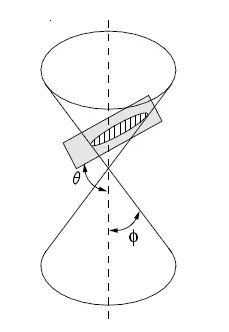
Conic sections are an important class of equations involving two variables. They encompass four types: parabolas, ellipses, hyperbolas, and circles. The term "conic section" originates from the concept of intersecting a cone with a plane in different configurations.
Figure 3

Figure 3
When a plane intersects a three-dimensional double right circular cone at various positions and angles, it gives rise to conic sections (refer to Figure 3). The equation describing the resulting conic section depends on the characteristics of the cone, specifically the angle between the cone's side and its axis (ϕ), as well as the angle between the intersecting plane and the cone's axis (θ). The relationship between the plane and the cone is quantified by the eccentricity (e) (Strang & Herman, 2022).
In the FE exam, the problems pertaining to this section are presented in a straightforward manner. One can employ the provided equations and relationships to determine the unknown values based on the specific type of conic section involved. It is crucial to thoroughly read and comprehend the problem statement in order to correctly identify and utilize the appropriate equation.
Conclusion
This is a lot of information to sort through on first reading, so please take the time to reread and practice the problems on your own. We will finish the other half in the second part of this blog. Are you interested in a comprehensive exam review course that will cover the topics of this blog and more? Check out School of PE’s FE Electrical exam review courses now.
References
Electronics Tutorials. (n.d.). Complex Numbers and Phasors in Polar and Rectangular Form. Electronics Tutorials. Retrieved July 6, 2023, from https://www.electronics-tutorials.ws/accircuits/complex-numbers.html
Hayes, A., Parvej, M. R., Vee, H. Z., Nelson, A., & Khim, J. (n.d.). Discrete Mathematics. Brilliant. Retrieved July 5, 2023, from https://brilliant.org/wiki/discrete-mathematics/
Nykamp, D. Q. (n.d.). Cartesian coordinates. Math Insight. Retrieved July 6, 2023, from https://mathinsight.org/cartesian_coordinates
Strang, G., & Herman, E. '. (2022, September 7). 11.5: Conic Sections. Mathematics LibreTexts. Retrieved July 6, 2023, from https://math.libretexts.org/Bookshelves/Calculus/Calculus_(OpenStax)/11%3A_Parametric_Equations_and_Polar_Coordinates/11.05%3A_Conic_Sections
About the Author: Khoa Tran

Khoa Tran is an electrical engineer working at the Los Angeles Department of Water and Power and is currently pursuing his master's in electrical Power from the University of Southern California. He is fluent in both Vietnamese and English and is interested in outdoor activities and exploring new things.

Thursday, 4 April 2024

Cracking Control Systems: What You Need to Know for the FE Electrical Exam

Ever wonder how auto-pilot works or how assembly robots move so quickly yet accurately? Control Systems. Not only does this apply to automation or specialized industries but also to our refrigerators, our cars, and everything where a device or system needs to have a desired output, control systems are implemented.

The FE requires examinees to understand and be able to solve questions regarding control systems. In this blog, we will go over a brief overview of what control systems are and what equations are expected for test takers to know for the exam.

Cracking Control Systems: What You Need to Know for the FE Electrical Exam
What are Control Systems?
A control system is a system of devices that regulates the different behaviors of other devices to achieve a desired result. There are two types of control loops: open-loop and closed-loop.
Open-loop control systems have the control action totally independent of the outcome of their systems. A simple example of this is an electric hand dryer; the hot air (output) remains on for as long as an object is detected under its sensor (input), regardless of how dry the object may be.
Closed-loop control systems, on the other hand, have the input affected by the output in order to achieve the desired output. This behavior is referred to as feedback. To bring back a previous comparison, refrigerators are an example of a closed-loop system, where the cooling devices have their output throttled to maintain a certain temperature inside the refrigerator. This not only ensures that the temperature in the device is constant but also a balance between cooling time and power efficiency.
Control system stability refers to the behavior of a system over time and its ability to maintain a desired state or equilibrium. A stable control system is one that, after experiencing a disturbance or change, eventually returns to its original state or reaches a new stable state.
In the Stability section of the Control System topic for the Fundamental of Engineering (FE) exam, there are two methods to determine the stability of the system:
1.Stability Theorem
2.Coefficient Test
3.Routh-Hurwitz Criterion
Stability Theorem
We can use the Stability Theorem to determine the system’s stability.
1.Stable System: A system is considered stable when the poles of its transfer function reside on the left side of the s-plane. However, if the poles move closer to the origin, the system’s stability decreases (Stefani, 2002, 71).
Ex: H (s) = 2 / ((s+1) (s+2))
a. Set the denominator equal to zero, we have s = -1 and s = -2 We know the poles lie on the left-hand side of the s-plane. Therefore, the system is stable.
Stability Theorem
Figure 1
2. Marginally Stable System: A system is considered marginally stable when the poles are present in the imaginary axis (Stefani, 2002, 71).
Ex: H (s) = 2/ (s2+2) = 2/((s+√2 i) (s-√2 i))
a. Set the denominator equal to zero, we have s = ±√2 i. We know the poles lie on the imaginary axis of the s-plane. Therefore, the system is marginally stable.
Marginally Stable System
Figure 2
3. Unstable System: A system is considered unstable when there are repeated poles on the imaginary axis of the s-plane and/or poles in the right half of the s-plane (Stefani, 2002, 71).
Ex: H(s) = 2 / (〖(s〗2+2) (s-1)) = 2 / ((s+√2 i)(s-√2 i)(s-1))
a. Set the denominator equal to zero, we have s = ±√2 i  and s = 1. We know the poles lie on the imaginary axis of the s-plane. But there is a pole on the right-hand plane. Therefore, the system is unstable.
Unstable System
Figure 3
Coefficient Test
For a high-order polynomials transfer function, if there is a missing s term, it is safe to say that the system is unstable (Stefani, 2002, 144-145).
Example, a transfer function T(s) = 6s5 + 5s4 + 3s2 + 7s + 10. The transfer function is missing the s3 term.
Routh-Hurwitz Criterion
The Routh-Hurwitz stability criterion is a mathematical method used to determine the stability of a linear control system. It provides a systematic approach to analyze the stability of a system by examining the coefficients of its characteristic equation.
The characteristic equation of a linear control system is obtained by setting the denominator of its transfer function equal to zero (Eqn. 1). It is typically a polynomial equation in terms of the system's parameters. The Routh-Hurwitz criterion uses the coefficients of the characteristic equation to construct a table called the Routh array or Routh table. The Routh array organizes the coefficients into rows and columns, allowing for a systematic evaluation of stability (Stefani, 2002, 145).
an s+ a(n-1) s(n-1) + a(n-2) s(n-2) + ... + a0 = 0 (1)
Arrange all the coefficients into the table below:
Table 1

sn

an

an-2

an-4

sn-1

an-1

an-3

an-5

sn-2

b1

b2

b3

sn-3

c1

c2

c3

:


s0


b1 = (a(n-1) a(n-2) - an a(n-3)) / a(n-1)  (2)
b2 = (a(n-1) a(n-4) - an a(n-5)) / a(n-1)  (3)
c1 = (b1 a(n-3) - b2 a(n-1)) / b1  (4)
c2 = (b1 a(n-5) - b3 a(n-1)) / b1  (5)
When all the coefficients a, an-1 , b, c1 are all of the same positive sign, and none is zero ,then the system is stable. Else, the system is unstable.
Let’s examine this T(s) transfer function stability:
T(s) = s4 + 2s3 + 6s2 + 4s + 1  (6)
Table 2

s4

1

6

1

s3

2

4


s2

b1

b2


s1

c1


s0

d1


b1 = 2(6) - 4(1) / 2 = 4

b2 = 2(1) - 1(0) / 2 = 1

c1 = b1(4) -2(b2) / b1 = 4(4) - 2(1)  /4 = 3.5

d1 = c1(b2) - b1(0) / c1 = 3.5(1)- 4(0) / 3.5 = 1

Therefore, the complete table is:
Table 3

s4

1

6

1

s3

2

4


s2

4

1


s1

3.5


s0

1


By looking at the highlighted region, there is no change in sign, and all coefficients are positive. Therefore, the system is stable.
The quantity of right half-plane (RHP) roots in T(s) corresponds to the count of sign changes in the elements of the leftmost column of the array, progressing from the top to the bottom (Stefani, 2002, 147). We will change the value sign of s1 value row in Table 3 to demonstrate this aspect.
Table 4

s4

1

6

1

s3

2

4


s2

4

1


s1

-3.5


s0

1


From Table 4, there are two signs of changes in the highlighted column (4 to -3.5 and -3.5 to 1); therefore, T(s) has two RHP roots.
Conclusion
We’ve gone over what control systems are and how to use the Stability Theorem, Coefficient Test, and Routh-Hurwitz Criterion, but for a more thorough and comprehensive study plan, I recommend checking out School of PE’s FE Electrical exam review course, which offers an extensive and detailed curriculum to ensure a comprehensive understanding of the subject matter. Good luck!
References
Stefani, R. T. (2002). Design of Feedback Control Systems. Oxford University Press.
About the Author: Khoa Tran

Khoa Tran is an electrical engineer working at the Los Angeles Department of Water and Power and is currently pursuing his master's in electrical Power from the University of Southern California. He is fluent in both Vietnamese and English and is interested in outdoor activities and exploring new things.

Thursday, 28 March 2024

Across State Lines: Does It Matter Where You Take Your FE Exam?

An engineer’s first step to obtaining their professional license is passing their Fundamentals of Engineering (FE) exam. As candidates prepare for this important examination, they often wonder whether the state in which they choose to take the FE exam truly makes a difference. In this blog, we will delve deeper into this topic, exploring various factors to consider when selecting the state in which to pursue the FE exam.
The National Council of Examiners for Engineering and Surveying (NCEES) is responsible for designing and administering the FE exam nationwide. However, the actual administration of the exam falls under the jurisdiction of individual state engineering boards. While the exam content remains consistent across states, there are significant considerations to keep in mind when deciding on the optimal state to take the FE exam.
Across State Lines: Does It Matter Where You Take Your FE Exam?
Licensure Portability
One crucial factor to consider is licensure portability. Upon passing the FE exam and earning your Engineer-in-Training (EIT) certification, you will have made a major step towards becoming a licensed professional engineer (PE). However, the specific requirements for PE licensure can vary from state to state. Some states have additional prerequisites, such as extra exams or work experience. Therefore, if you have a particular state in mind where you intend to work as a professional engineer, it may be beneficial to take the FE exam in that state to align with its specific licensure requirements.
Exam Availability and Scheduling
Another vital aspect to consider is the availability and scheduling of the exam in your desired state. While the FE exam is typically offered throughout the year, the dates and locations can vary. It is essential to consult the NCEES website or the state engineering board's website for exam availability in your chosen state. Opting for a state that offers more frequent exam administrations and flexible scheduling can provide you with greater options and convenience.
Competency of State Exam Administrators
The efficiency and professionalism of the state engineering board responsible for administering the FE exam can significantly impact your testing experience. Some state boards have established a reputation for well-organized and streamlined exam administration processes. Researching and considering feedback from candidates who have previously taken the FE exam in different states can provide valuable insights into the quality of exam administration.
Networking and Job Opportunities
The state where you take the FE exam can also have implications for networking opportunities and future job prospects. Taking the exam in a state with a vibrant engineering community can provide you with chances to connect with professionals and potential employers. If there is a specific state in mind where you intend to work as a licensed PE, consider taking the FE exam in that state, as this can help you establish local connections and build a local professional network.
Conclusion
While the content of the FE exam remains consistent across states, various factors should be carefully considered when choosing the state in which to take the exam. Licensure portability, exam availability, scheduling, the competency of state exam administrators, and networking opportunities are all vital aspects to evaluate. Thoughtfully analyzing these factors will enable you to make an informed decision that aligns with your career goals. Not only would you have to consider when and how you approach the FE, but also where you take the FE; this decision can positively impact your journey towards becoming a licensed professional engineer.
No matter where you decide to take your FE exam, School of PE can help you every step of the way. We have a wide array of FE courses designed to help you pass on your first try. Check them out now!
About the Author: Khoa Tran

Khoa Tran is an electrical engineer working at the Los Angeles Department of Water and Power and is currently pursuing his master's in electrical Power from the University of Southern California. He is fluent in both Vietnamese and English and is interested in outdoor activities and exploring new things.

Thursday, 21 March 2024

Location Matters: The Impact of Neighborhood Context on Project Design

Among the topics covered in the Project Planning and Design portion of the ARE is the impact of neighborhood context on project design. Consideration of the project site’s neighborhood includes access to nearby transportation, commercial amenities, and public spaces, such as parks, trails, and waterfronts. Utility infrastructure must be considered, as well as environmental factors such as noise pollution in an urban environment. Additionally, the spatial, material, and cultural aspects of surrounding buildings should be considered, particularly in areas of historic character where there may be historic preservation requirements or established design standards for building forms, façade elements, or materials. Navigating the various requirements and constraints of the project site context can be a challenge but also an opportunity for a design that responds productively and creatively to the local context and its resources.
Location Matters: The Impact of Neighborhood Context on Project Design
Local Transportation
Proximity to various modes of transportation is an attractive feature for building projects, particularly residential and office projects, as it can allow for commuting via public transportation. This can include metro, rail, and bus services, among others. Such modes of transportation can allow for reduced dependency on automobiles, resulting in less traffic on roadways and a reduction in pollution and carbon emissions. When considering a site, it is advisable to consider walking distance to bus stops, rail stations, and metro stations. The closer the walking distance, the more likely it is that people will choose to take that mode of transportation rather than drive. Safe and extensive bicycle routes are also a positive feature to have within the neighborhood, reducing dependency on automobiles and providing a more sustainable transportation option. Where a building is to be designed in an area with extensive bike routes, it is advisable to provide bike storage on site along with showers for those who might commute to the building by bicycle. Ideally, a site is within walking distance of commercial and public destinations nearby, not only to reduce congestion on transportation systems but also as an attractive amenity for the occupants of the building, which can increase the building’s value for the owner, and encourage healthy and active lifestyles of the occupants. Some common attractive commercial amenities are restaurants, cafes, stores, gyms, banks, and workplaces. Walkability to such amenities is more likely in areas of greater density, particularly where local zoning ordinances allow for a mixture of uses. Public spaces that can add value to the property include public parks, playgrounds, waterfronts, and bicycle or walking trails.
Utility Infrastructure
The utility infrastructure of a site can have an impact on the project design. It should be determined whether the site has access to municipal storm lines. If not, careful consideration should be given to how stormwater will be directed from the site. Green roofs, permeable paving, rain gardens, bioswales, and other features can be used to reduce surface runoff from the site. The local jurisdiction may have limitations on the percentage of the lot, which may be covered in non-permeable paving. In rural locations where there may be no access to sanitary lines, an on-site wastewater treatment system, such as a septic tank, is necessary. In terms of water supply, it is necessary to determine the water pressure which can be supplied to the project, particularly where sprinkler systems are to be utilized. If the pressure is not adequate, then a fire pump may be necessary. These are just a few of the circumstances to consider when reviewing the utility infrastructure of a site as it relates to the building design.
Noise Pollution
Depending on the project location and the use of the building, the potential effect of noise pollution on building occupants should be considered. For example, a hotel located in close proximity to an airport, an office space in the city on the ground floor, or a concert hall might all need special consideration given to the mitigation of sound transmission from the surrounding environment. It may also be necessary to consider light pollution from the building project, particularly if there are local ordinance requirements in the jurisdiction to limit the amount of light emitted from the site. This is sometimes referred to as dark sky compliance. Light pollution can have a negative effect on humans as well as wildlife, disrupting circadian rhythms and causing other negative health effects, in addition to having detrimental effects on our experience of the environment.
Spatial, Material, and Cultural Effects on Perception
The spatial, material, and cultural aspects of the neighborhood should be analyzed prior to the building design. Whether the designer’s approach is to blend in, complement, or stand out from the surrounding built environment, it is necessary to understand the context to properly formulate a design response. Not only do these aspects of the neighborhood affect the perception and experience of a proposed building design, but depending on the local jurisdiction, there are typically at least some requirements that are necessary to be met for the project to receive a permit.
Zoning Ordinances
In addition to defining allowable building uses within a particular district, zoning ordinances may define required setbacks from property lines, limit building heights or number of stories, and establish floor area ratios. The floor area ratio (FAR) is the ratio of the total building area to the area of the lot on which it is built. For example, a FAR of 2 would mean that the total building area is allowed to be up to 2 times the area of the lot. Zoning ordinances can have a substantial impact on building massing and form. Aside from zoning ordinance limitations, the spatial context of the surrounding neighborhood should be considered in order for the building to be designed to appear on an appropriate scale in relation to adjacent buildings.
Design Standards and Guidelines
It should be determined whether the project site is located within a historic district, which will put further constraints on design possibilities. Even where not located within a historic district, local jurisdictions may have design standards or guidelines that must be followed. These can include limitations on the material palette, prescriptions for façade features, or other guidelines, the intent being to establish criteria by which a design can be deemed as not detrimental to the existing character of a neighborhood. While such guidelines can be based on subjective judgments, the constraints that they put on the designer must often be followed closely for the design to be approved and the project to be realized.
Community Board Presentations
Presentations to a community board are sometimes required, where the designer communicates the design features of the project and attempts to demonstrate compliance with the established planning standards. In other cases, where a project can have a substantial impact on a community, the design process may involve required meeting sessions with the community so that the design team can receive and incorporate feedback from community members into the design.
Conclusion
In summary, architects must be aware of the context of the neighborhood in which a project is situated. Consideration should be given to transportation access, utility infrastructure, zoning ordinances, nearby amenities, historic district requirements, local design standards, the spatial and aesthetic character of the neighborhood, and community input, among other factors. While project constraints resulting from local requirements and context can be challenging, they can also provide direction and opportunities for creative design solutions or even collaboration with local community groups. It is important that the architect considers the perspectives of all stakeholders, building users, and the surrounding community in all project designs. A building project can have a lasting impact on a local community, and as such, care and consideration should be made in all design decisions. A successful project is an asset to a community, providing benefits to the neighborhood that can extend beyond the building owner and the building users.
Master the Project Planning and Design division of the ARE® 5.0 exam with an exam review course from School of PE! We also have an exam review guide to help you along the way to exam-day success.
About the Author: Adam Castelli

Adam Castelli is a licensed architect and engineer currently practicing in the Pittsburgh area. He holds a master's degree in architecture from the University of Massachusetts Amherst and a bachelor's degree in civil engineering from Villanova University.