Showing posts with label pe mechanical. Show all posts

Thursday, 19 June 2025

PE Mechanical Exam Format Changes Effective October 1, 2025: Key Updates and How to Adapt Your Study Plan

PE Mechanical Exam Format Changes Effective October 1, 2025: Key Updates and How to Adapt Your Study Plan
With big changes coming to the PE Mechanical exams starting October 1, 2025, it's completely natural to have questions—maybe even a little anxiety. At School of PE, we've walked with thousands of engineers on their journey to licensure and know how format shifts can disrupt even the most careful study plans. Our goal is to help you not just adapt, but confidently get ahead of these updates, so you can stride into exam day fully prepared and focused.

What’s Changing on the PE Mechanical Exam in October 2025?

Let’s cut through the speculation and get to what’s actually changing. As announced by NCEES, exam specifications for all three PE Mechanical exams will be overhauled. You can expect:
  • New exam specifications—these serve as the definitive checklist for study, with detailed areas and skills to master. There will be increased discipline-specific content and reduced general content, allowing a deeper focus on your specific area of expertise.
  • Reference and code updates—reference books, codes, and standards will align with more current industry practices. There will be updated terminology to reflect current industry standards.
  • Greater real-world emphasis—the changes aim to mirror the daily demands and complexities working mechanical engineers encounter rather than purely theoretical or legacy topics.

School of PE’s 4-Step Strategy for Adapting to the 2025 Changes

  1. Mark Your Calendar: Key Dates
    NCEES released the final new exam specifications in April 2025. Download them and read them thoroughly—we cannot stress this enough. Everything else cascades from what’s listed here. You can find all updated exam specifications here.  
  2. Update Your Reference Library and Problem Sets
    Remove outdated codes and reference books from your workspace. Whether it’s the Mechanical Engineering Reference Manual (MERM) or standards like ASME or ASTM, ensure you’re using versions aligned to the 2025 specs.
  3. Refocus Your Practice Methods
    The new exam places even more importance on application over memorization. Center your study routine around solving multi-step, scenario-based problems. Time yourself rigorously—allocate just 6 minutes per question to mirror the test.
  4. Choose a 2025-Aligned Prep Course
    Not all review courses adapt quickly to new exam developments, but at School of PE, our lectures and study materials are overhauled for every specification change. Taking a course that’s in sync with the 2025 format gives you a proven edge.
Start compiling your resources now, so you can pivot quickly post-spec release:

Extra Tips from Our Instructors

  • Allow Room for Unknowns: Even after specs are released, it can take a cycle or two for prep materials and the exam “feel” to fully settle out. Build in practice time to adjust to sample questions as they emerge.
  • Leverage Interactive Learning: If you haven’t used live or virtual review sessions before, now is the time—they adapt to nuances in the new format much faster than printed materials or old recordings.
  • Stay Plugged into Updates: Bookmark both the official NCEES PE Mechanical page and our blog for interpretation of specification updates and first-hand insights.

Frequently Asked Questions: Transitioning to the New PE Mechanical Exam Format

  • What if I have been preparing for the pre-October exam?
    If you have been preparing for the pre-October 1 exams and have your exam date scheduled before the change, we recommend staying the course. Keep studying and take the exam you’ve been preparing for. If you are on the fence or not planning to begin preparing until after the exam change, we’d recommend you wait to study with the new exam specs.
  • How many hours should I expect to study? 
    Most successful students report 300–400+ hours of total study time, but with a heavier focus on applying new concepts than memorizing formulas or theory.
  • Is this format shift likely to make the exam harder?
    Not necessarily harder—but different, with a premium on current, real-world practice and fewer legacy or strictly academic questions.

Final Thoughts: Stay Agile and Use the Change to Your Advantage

Major format changes can feel daunting, but they’re also a golden opportunity for proactive students to get ahead. At School of PE, we treat every exam update as a moment to fine-tune our resources and help candidates put their best foot forward—just as we’ve done with so many NCEES exam overhauls before. Don’t let the October 2025 PE Mechanical exam changes catch you off guard. With timely specs, the right study habits, and targeted review, you can truly gain the edge.
Be sure to check out our revised PE Mechanical prep courses with pass guarantees and flexible, updated options for the new 2025 exam.


Friday, 23 July 2021

My Experience on Passing the Mechanical PE Exam

I feel that a lot of individuals struggle to pass both the FE and PE exams because they just want to get it over with, attain the license, and move on. My experience with passing the Mechanical PE exam was less of a linear process and more of a journey, though. As I was preparing for the PE exam, I realized that I needed to find other kinds of motivation-it would not be enough to simply want the PE license for a title change or potential pay raise.
The first two steps in my journey were to complete my undergraduate education and pass the FE exam. The FE exam is more focused on undergraduate subjects, which is why it is recommended to sit for the FE exam while in college or a recent graduate. I passed the FE exam in the fall of my collegiate senior year and submitted my transcripts as proof of graduation before my EIT designation became active. My journey continued as I entered the industry and gained four years of work experience as a practicing engineer. As I started my career, I realized that despite beginning as an entry-level engineer, I would finish as a highly trained professional.
During those four years as an EIT, I saw that my projects increased in complexity as I delved more into the industry. I was learning not just hard technical skills, but also soft skills like how to collaborate with co-workers, contractors, and third-party agencies. After my initial four years passed, I became eligible to sit for the PE exam. When I first reviewed the PE exam application, I noticed it was much more involved than the FE exam application. However, this change made sense to me logically since every level in a process typically increases in difficulty. The PE exam would not only consist of a more difficult application process, but also a more challenging exam process in general. These new challenges were part of the journey and contributed to my professional and personal growth.
My Experience on Passing the Mechanical PE Exam
The PE exam is a much more practical exam than the FE exam, with questions and problems based on actual engineering scenarios that you would see in the industry. For the FE exam, you learn core competencies and theory to help prepare you to pass the exam, enter the career field, and gain experience. When that career experience is gained, you're ready for the PE exam. When I passed the PE exam, it felt like another graduation commencement; I could now practice fully as a licensed professional engineer. Along with the license also came responsibility. I could use my experience to help other engineers strive for their PE License as a reference, as well as provide exam advice for younger engineers.
For me, passing the Mechanical PE exam was always about striving to improve myself. Even now that I have achieved my goal of becoming professionally licensed, I know that my journey is still not finished. I will continue to learn within my industry and fulfill continuing education requirements. That was my motivation; the experience was just that...the experience. My motivation was not just about calling myself a professional engineer or trying to earn a bigger bonus in the workplace. I knew that if I could pass the PE Exam, I could become a better individual, not just for myself, but for the people around me like my family, friends, and coworkers.
About the Author: Gregory Nicosia

Gregory Nicosia, PE is an engineer who has been practicing in the industry for eight years. His background includes natural gas, utilities, mechanical, and civil engineering. He earned his chemical engineering undergraduate degree at Drexel University (2014) and master's in business administration (MBA) from Penn State Harrisburg (2018). He received his EIT designation in 2014 and PE license in 2018. Mr. Nicosia firmly believes in continuing to grow his skillset to become a more well-rounded engineer and adapt to an ever-changing world.

Monday, 3 May 2021

How I Passed the Mechanical Exam

I passed the Mechanical PE Exam (Thermal and Fluid Systems) in October 2018. I was fresh off completing my Master's in Business Administration (MBA) for grad school (graduated May 2018) and was looking for the next goal. I have always believed the best way to ensure consistent growth and enrichment is to continuously challenge yourself, whether it be an athletic challenge or academic challenge. Ripping yourself  month break, I began my application. As you will find in other aspects of life, each round becomes tougher. The FE Exam application was mostly about your educational background and did not require a Wfrom the comfort zone is how you grow and become a more well-rounded individual. Like most states, you only need four (4) years of full-time work experience to become eligible for the PE Exam in Pennsylvania (PA).
After about aork Experience narrative. But since the PE Exam is the next round, there is a higher expectation (e.g., background check, more references, etc.). I have already said that every round gets tougher. However, the application process was another opportunity for me to learn and gain more experience, becoming that more well-rounded individual. My application was due July 1 if I wanted to sit for the October 2018 Exam, so I was able to take good steps forward with the application and meet with my licensed references to gain their input. They each recommended certain reference manuals, practice exams, and review classes. I found the online course with School of PE to be especially beneficial! It truly was the best learning tool to gain a better idea of the difficulty level and types of questions that you should expect to see on the PE Exam.
When it came time to write my Work Experience narrative, I was not sure how to go about it. I knew that you wanted to show increasing both increasing knowledge and responsibility, so that you could act decisively and intelligently when completing engineering tasks for public betterment. My Work Experience turned into a story, starting with my first day as a true full-time employee. I had completed internships while in college and even passed the FE Exam in my senior year, but the EIT designation did not become active until my completion of undergrad (June 2014).
How I Passed the Mechanical Exam
Keep in mind it is not always a bad thing to stay late and do extra work early in your engineering career; this will give you more opportunities to learn which can in turn all be added to your Work Experience narrative. In my second and third years in the utility industry, I was tasked with additional assignments to help carry extra load in my department since one co-worked transferred to another office. It was a little overwhelming at first, but what I realized later was that this all became additional knowledge that I was able to absorb and help me towards gaining approval to sit for and then pass the PE Exam.
I submitted my PE Application before the July 1 deadline and heard a couple weeks later that I was approved to sit for the exam. I had accomplished the first step, but now needed to begin my preparation. I had already started obtaining reference materials and practice exams and was overwhelmed at first. But the School of PE Review Course was helpful and provided me with much better direction and the confidence to succeed. I would also recommend some diversion activities to alleviate any stress and clear your mind. While studying for the PE Exam, I also studied martial arts and practiced yoga to help stay fresh. I even attended a martial arts class on Thursday evening before the Friday exam to ensure I would have that exam mentality in the morning, and it was certainly one of the best decisions that I made!
For me, the PE Exam was about the growth and enrichment. I never saw it as a roadblock; I was able to enjoy other activities while not feeling forced into studying whenever I had spare time. What I realized before taking the PE Exam, that even had I not passed, it was still a success. Not just from studying, but also from going through the application process and writing my Work Experience narrative. Passing the Mechanical PE Exam was simply a product of all that I had learned along the way.

About the Author: Gregory Nicosia

Gregory Nicosia, PE is an engineer who has been practicing in the industry for eight years. His background includes natural gas, utilities, mechanical, and civil engineering. He earned his chemical engineering undergraduate degree at Drexel University (2014) and master's in business administration (MBA) from Penn State Harrisburg (2018). He received his EIT designation in 2014 and PE license in 2018. Mr. Nicosia firmly believes in continuing to grow his skillset to become a more well-rounded engineer and adapt to an ever-changing world.

Monday, 26 April 2021

Are You Ready to Pass the Mechanical PE Exam? Here is What it Takes

The Principles and Practice of Engineering (PE) Exam is different from what you have seen with the Fundamentals of Engineering (FE) Exam. The PE Exam is much more practical, focusing on actual engineering scenarios that you may encounter in your career and industry. You need to be able to make decisions and be mindful of allocating your time differently for each question. Some questions you will see and immediately know the answer, while other questions require some thought and longer process steps. Remember, that it is okay to take a little longer with certain questions; the key is to stay cool and recognize that you do not need to solve out every questions and attain a perfect score to pass the PE Exam.
There is a "Cut Score" which determines your Pass/Fail result (similar to the FE Exam, there is no true letter grade or percentage assigned to you). I believe the PE Exam is also relevant towards current industry events, so you should see the PE Exam as an opportunity to learn, not a hurdle that you must overcome. By studying and learning you will find the PE Exam to be a much more fruitful experience, and that is how you can reach the next level. Since you need Licensed PE References, you should chat with those individuals about their study habits and methodology. I found the PE Exam to be more about becoming familiar with the subject matter and knowing where to find specific reference information, rather than trying to memorize certain equations and process steps. Many of the topics overlap and all mix together, so you may notice hints within questions. Remember too, that the PE Exam questions must be realistic; if you are using parameters such as the density of water and Earth's gravity, then the other parameters and solutions must also be realistic. You may even encounter a question or two where you can immediately identify the solution based on the most realistic answer choice. The Mechanical PE Exam is entirely multiple choice, so you are not being graded directly on your methodology and showing your work on scratch paper; you need to demonstrate that you can approach an engineering situation appropriately for the good of public welfare.
Are You Ready to Pass the Mechanical PE Exam? Here is What it Takes
You should not dwell or ruminate over certain questions you may not fully understand. I passed the Chemical FE, so when I saw questions from the Morning General section on Mechanics of Materials, I was certainly taken aback! There is a good chance that many other candidates in the exam room are encountering similar questions, but you should focus solely on playing your own game. I would recommend taking the first couple minutes to look through the exam before starting on the first question; this will give you a better idea of how the exam will flow, from the one topic to the next. You can make mental notes of which topics you will need for certain questions. Fluid Mechanics covers flow, and you will need to be in control of your own pace and flow during the PE Exam!
Become familiar with your Unit Conversions; many questions can be systematically solved by cancelling out units and understanding the unit convention. You will need to co-exist with the different unit systems (e.g., SI, U.S. Customary). Different equations can be used to solve for different parameters, such as heat transfer (Q). The "Q" value can be obtained from different methods, so always be on the lookout for another angle. There is no universal study habit or equation that solves every question.
Preparation is vital. I do feel that most failures and incidents occur due to a lack of preparation. This applies not just to the PE Exam, but also holds true for the engineering industry. It is true that many workplace and accidents could have been avoided if there was better planning and preparation. Be sure that you are taking the time to prepare so that you feel good about the upcoming examination. Again, it is not just about passing the PE Exam, so you have the licensed credentials; it is also an excellent opportunity to learn and expand your knowledge.
About the Author: Gregory Nicosia

Gregory Nicosia, PE is an engineer who has been practicing in the industry for eight years. His background includes natural gas, utilities, mechanical, and civil engineering. He earned his chemical engineering undergraduate degree at Drexel University (2014) and master's in business administration (MBA) from Penn State Harrisburg (2018). He received his EIT designation in 2014 and PE license in 2018. Mr. Nicosia firmly believes in continuing to grow his skillset to become a more well-rounded engineer and adapt to an ever-changing world.

Thursday, 4 March 2021

8 Quick Tips About the Mechanical PE Exam

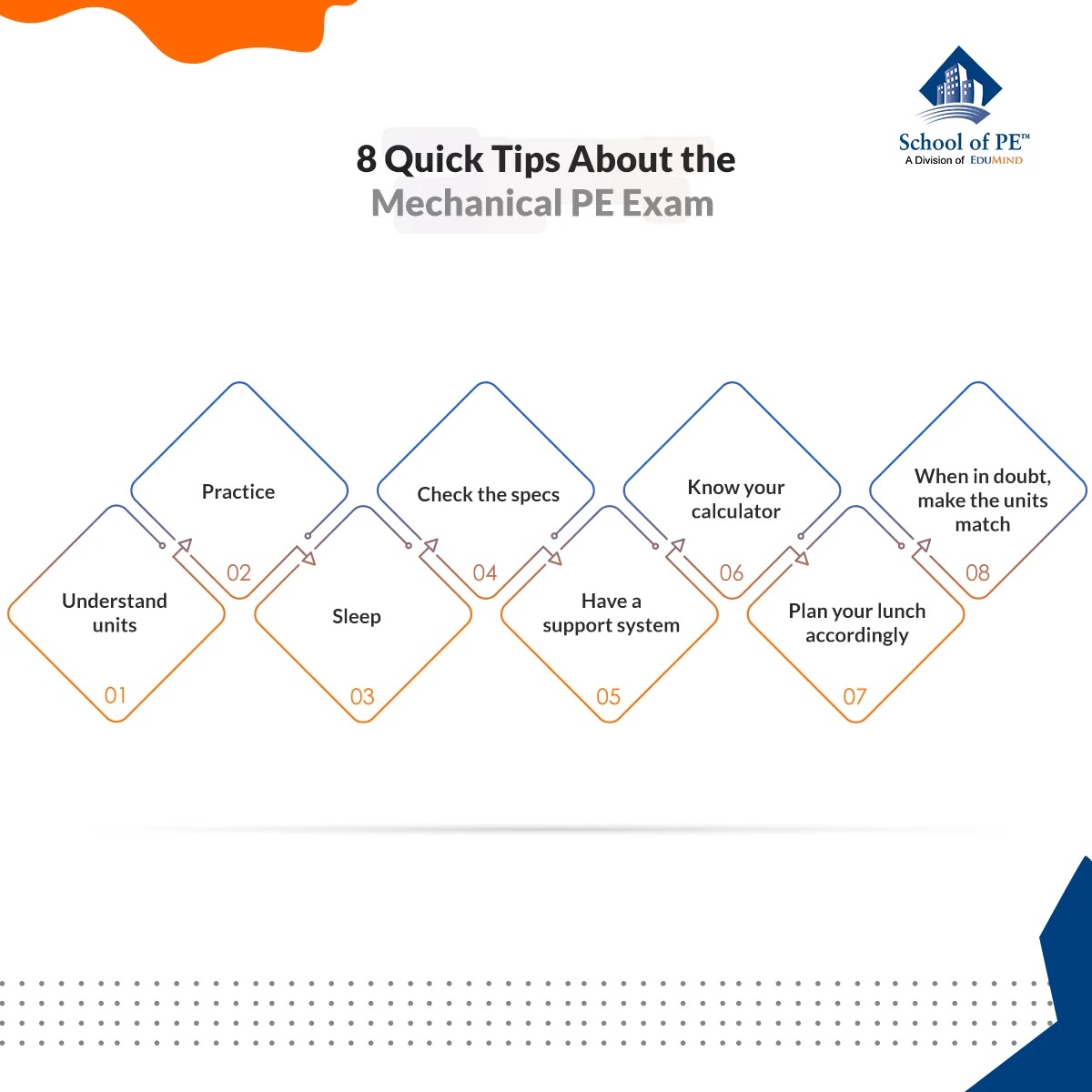
1. Understand units:
The PE exam is administered in both metric and US customary units. It is important to know the pound mass and pound force and their relationship.
2. Practice:
Practice exams are your best friend. Various sources produce practice exams and there is a lively debate about which is best. Most test takers do agree that the NCEES provided practice exam provides the closest experience to the real deal. It's also important to treat practice exams like exams and do them under as close to real world conditions as possible. That means, don't do them in your bath robe and slippers.
3. Sleep:
Get a good night of rest before the exam. Know where you need to be and arrive with plenty of time to spare. Work backwards from that time to determine when to go to bed and get the right amount of sleep for you.
4. Check the specs:
Always check the most up to date version of the exam specification. Sometimes you might be studying topics that have no chance of being on the exam or overlooking others that are extremely important.
8 Quick Tips About the Mechanical PE Exam
5. Have a support system:
The PE is not an easy exam and its best not to go it alone. Tell your family of your significant other about your plans for study. Make sure they realize how important this exam is to you. Look for communities online that can help prepare you or work our problems with you if you are struggling.
6. Know your calculator:
For those that have only known the TI-83 or the old TI-30 calculators from their university days, the calculators allowed on the PE are a bit less powerful for the former and more powerful for the latter. Though you can use a TI-30 calculator for the exam, you would be forgoing some increased capability by not using a TI-36 of Casio FX-115. Also importantly, you should practice and become knowledgeable on the workings of whatever calculator you choose to use for the exam. Getting through a problem only to realize you had the calculator set to radians would not make for a good day.
7. Plan your lunch accordingly:
The exam is a full day affair and it's important that if you eat on your lunch break, you do not suffer any nap inducing aide effects. You know your body best and it's important to plan what if anything you will eat for lunch to ensure you can be at your best for the second half of the exam.
8. When in doubt, make the units match:
Sometimes the exam will give you a question on a topic you are not familiar with. If the question is quantitative in nature, your best bet is to see what you are given and the units for the answer and work out how to go from one to the other. Be sure not to devote too much time to such problems unless it's your last one or two before being done.

Monday, 1 March 2021

How Long Does It Take to Study for the PE Mechanical Exam?

This is a common question that many people who have passed the FE exam often ask when they make the commitment to embark on the road to passing the PE exam. Many who have passed the FE exam will recall taking it during their senior year in college, being well versed in all of the concepts, and waltzing through to a passing score with little to no preparations.
Sadly, PE is not such an exam, and those lucky or gifted classmates of yours that never studied but got straight A's won't be so lucky. It's important to note that while the PE has moved to a single reference handbook, there is still considerable content that must be known from memory both in terms of basic concepts and industry experience/knowledge.
How Long Does It Take to Study for the PE Mechanical Exam?
Before the CBT version of the exam, the paper and pencil exam was administered two times per year. A good baseline of study time was to study for at least one 6-month exam cycle. This would usually break down to 3 months of review of the materials and 3 months of practice problems. You may choose to pace yourself differently based on the time available to you. Use the exam specifications and determine what you do and do not know well. Make a plan and study around this. You must also do practice problems and attempt to take a full-length practice exam so you can judge your time management and gauge your weak topics. It's very important to know how to use your calculator and the PE handbook to find the right answer. Knowing where information is located is critical to getting through the exam in a timely fashion. You should also try and commit a few of the more basic formulas to memory so that you do not need to look them up for each question. Basics for stress and strain as well as motion and force equations are highly recommended.

Thursday, 11 July 2019

Featured Engineer: How One Female Helped Shape the Mechanical Engineering Field

Kate Gleason
Are you interested in becoming a licensed engineer? Becoming licensed in the engineering field has great significance in one's professional engineer- but have you ever considered how the engineering field has evolved throughout the last century to be as advanced and forthcoming as it is today? Although there are many factors that have made the engineering field so abundant, there are many individuals who helped transform the field into what it is today. 
If you're interested in becoming a PE Mechanical engineer, Kate Gleason is a great figure to point out. With her inventions, her determination, and her differentiation of being female, she made enormous strides which have affected how the engineering field operates today. 
1. Who was Kate Gleason?
Catherine Gleason, who went by "Kate," is largely known as being both a businesswoman and engineer in the late 1800s/ early 1900s. During her career, she was seen as an inspiration and role model for many aspiring female engineers, as she had many accomplishments in a predominantly male field. 
2. What did she do? 
In the late 1800s, Gleason joined her family business and worked alongside her father, eventually becoming the Secretary-Treasurer of the organization in 1890. A highlight of her work there included the design and invention of a machine which produced cheap beveled gears at a rapid pace. This invention ultimately allowed the family business to grow and flourish, and became the leading national producer of gear-cutting machinery during the First World War. 
After eventually leaving her family's business to further develop her career, she began various businesses including a construction company. Altogether, she started eight businesses. 
3. What were her accomplishments? 
Kate Gleason had many accomplishments throughout her career. Of course, being such an accomplished female engineer in a male-dominated field is an accomplishment in itself, especially during the late 1800s/ early 1900s. To top off the gender gap, Kate became the first female to join the American Concrete Institute as well as the American Society of Mechanical Engineers. 
4. How she is celebrated today
Although Gleason died in 1933, she is still remembered and honored by engineers everywhere. In fact, the American Society of Mechanical Engineers established its Kate Gleason Award in 2011. This award is meant to celebrate female leaders in the engineering industry. 
Engineers at Rochester Institute of Technology (RIT) also recognize Gleason for her hard work and dedication every day, as the institution named the engineering college after her.

Tuesday, 2 July 2019

Structure Spotlights: Arthur Ravenel Jr. Bridge Designed to Withstand Earthquakes

Everywhere and anywhere we go, there are products literally everywhere that were created because of engineers. The roads that you drive on were strategically mapped out by transportation engineers; the air conditioners that keep commercial buildings cool during the summer were designed by HVAC mechanical engineers; and- the purpose of this article- the structures all around you, whether they be towering skyscrapers or bridges- were strategically designed by architectural and structural engineers. 
As an engineering licensure exam prep provider, we want to celebrate the amazing products that engineers around the world (especially our students) create. This, as well as future Structural Spotlight articles, will focus on one structure in the United States that stands out. 
For this feature, we want to put the spotlight on the Arthur Ravenel Jr. Bridge in Charleston, South Carolina. 
If you've ever visited Charleston, South Carolina, you've probably seen colorful, colonial buildings, multiple groups of history tours, and this tall, two diamond bridge suspended over the Cooper River. 
Structure Spotlights: Arthur Ravenel Jr. Bridge Designed to Withstand Earthquakes
So why did we choose this bridge to spotlight? While there are many spectacular aspects of the design of the bridge, the main reason we want to feature the Arthur Ravenel Jr. Bridge is because of the stability that was put into strong consideration in the architecture of the bridge. 
In 1886, the strongest earthquake on the east coast struck the town of Charleston, SC, causing $5-$6 billion in damages. Almost all of the buildings in the town were damaged and had to be repaired or torn down and built back up. The earthquake was measured having an approx. 6.9-7.3 magnitude- which, if you know anything about earthquakes- anything above a 6 magnitude is considered strong to major and can cause detrimental damage. 
According to an article on the matter of seismic activity in the Charleston, SC area, the area is predicted to have a high chance of a 6 magnitude earthquake in the next 50 years, whereas 42 other states only have a "reasonable chance." 
With this in mind, as well as the common thought by geologists that earthquakes typically repeat themselves every 100 years or so, modern architectural projects were built with the focus of complete stability in order to maintain the least damage possible in case of an earthquake. The Arthur Ravenel Jr. Bridge in Charleston, South Carolina was one project that PE Architectural engineers, as well as Structural engineers, focused on. Opened in 2005, the 4-km-long bridge was designed by engineers to withstand seismic activity. With a large span, the bridge was constructed to withstand up to a 7.4 magnitude earthquake.
If you visit Charleston, SC in the near future, this bridge is a must to see! This bridge, along with various other amazing structures nationwide, were all strategically designed by PE Architectural and Structural engineers.

Monday, 27 May 2019

Augmented Reality is Transforming Mechanical Engineering

Augmented Reality.. what is it really? 
If you have a smartphone, chances are you've been using augmented reality without even realizing it. From sending filtered selfies on Snapchat to catching Pikachu on PokemonTM Go, or even giving still images life in the TotalAR mobile application, augmented reality has made its way into our everyday lives. 
So what is Augmented Reality, exactly? Augmented Reality, or AR, can be defined as an "enhanced image or environment as viewed on a screen or other display, produced by overlaying computer-generated images, sounds, or other data on the real-world environment."i So in Snap Chat, for example, AR comes to play when one adds a filter to a picture via face recognition. 
AR technology has become so popular throughout the few years that it is starting to make appearances in various professional work environments such as education, medicine, and mechanical engineering.
Since you're here, you're probably wondering how AR can be used in mechanical engineering. We break it down in some examples below: 
1. Automation 
In the age of constantly craving convenience, automation is the end goal for many technologies. As a society, we strive to create self-driving cars, smart buildings, and more. In mechanical engineering, automation is a common theme in developing technologies. As mechanical engineers work towards automated products, AR can help with the overhead management. For instance, if a robotic lift was being used to stack boxes, one with an AR application or a Hololens could use AR to point or look at the robot to run a diagnostic test, therefore evaluating production metrics. 
2. Maintenance 
On a relatively same note as the above item, AR can help run maintenance evaluations. By using AR in the inspection of a Roof Top Unit, for example, an HVAC/ Refrigeration engineer could obtain performance metrics on the given unit. The same is true in machine design and Thermal and Fluid system engineers. Once evaluated, AR applications could suggest maintenance actions to perform to ensure the device continues to run correctly. 
3. Inspection 
AR can be used in mechanical inspections when something isn't working correctly. By visually analyzing a component of a mechanical machine, AR can pinpoint certain errors such as a broken wire, a loose gasket, or missing parts. This is especially helpful for those engineers who work and design various models because errors are more easily pointed out. 
References 
i. Augmented Reality. Retrieved from https://www.dictionary.com/ browse/augmented-reality
ii. Cundle, M. Augmented Reality in Engineering. Retrieved from https://www.rs-online.com/ designspark/augmented reality-in-engineering

Wednesday, 14 June 2017

The Conduction Process and its Importance in Mechanical Engineering Applications

1. Introduction
Regions with greater molecular kinetic energy pass their thermal energy into regions with less molecular energy through direct molecular collisions. This process is known as conduction. In metals, a significant portion of the transported thermal energy is carried by conduction-band electrons.
2. Definition of Conduction
Conduction is the transfer of thermal energy that does not have any flow of material medium and is the main process by which thermal energy is transferred from one solid to another. Our PE Mechanical course reviews the physical properties of heat.
The Conduction Process and its Importance in Mechanical Engineering Applications
3. Importance of Heat Transfer Conduction
Sticking a metal pole into a fire is an example of heat transfer conduction. Particles at the heated end vibrate vigorously. They collide with the neighboring particles and transfer their energy. Eventually, the particles at the cooler end are set into vigorous vibration, which causes the entire metal pole to become hot.
4. Types of conduction
There are two types of conduction:
(i)Molecular vibration
(ii)Free electron diffusion
(i) Molecular Vibration
When heat is supplied to one end of an object, the molecules at that end start to vibrate vigorously. During this process, they bump into their neighboring molecules, which transfers some energy. The receiving neighbor molecule gains energy and starts to vibrate more vigorously. The cycle continues. (ii) Free Electron Diffusion
This form of conduction takes place only in metals because only metals have free electrons. Electrons are freed from a molecule when heat is applied, which forces the electrons to travel toward the colder end of the metal. At the colder end, the electrons collide into many molecules, and therefore, pass energy to the molecules at the other side.
5. Conduction in Metals
In solids, thermal energy is transferred through the vibration and collision of particles. However, in metals, due to the presence of free electrons, thermal energy is spread through electron diffusion. Electrons gain kinetic energy and move rapidly and collide with the atoms in the cooler parts of the metal to pass on their energy.
The process of conduction in metals is important for engineers to understand when preparing to pass the PE Mechanical exam.
6. Fourier's Law of Heat Conduction
The law of heat conduction, or Fourier's law, states that the time rate of the heat transfer through the material is proportional to the negative gradient in the temperature and to the area.
Q = -kA(dT/dx)
'Q' - heat flow rate by conduction (W)
'k' - thermal conductivity of body material (W m-1 K-1)
'A'- cross-sectional area normal to direction of heat flow (m2) and 'dT/dx' is the temperature gradient (k-m-1)
The negative sign in Fourier's equation indicates that the heat flow is in the direction of negative gradient temperature, which makes the heat flow positive
The thermal conductivity "k" refers to the transport properties 
Thermal conductivity "k" provides indication of the rate at which heat energy is transferred through the medium by the conduction process 
7. Applications of Conduction Phenomena in Engineering
  1. Mechanical Engineering Equipment
  2. Home Appliances
  3. Boilers

Wednesday, 8 March 2017

Role of Bearings in Mechanical Engineering Applications

Introduction:
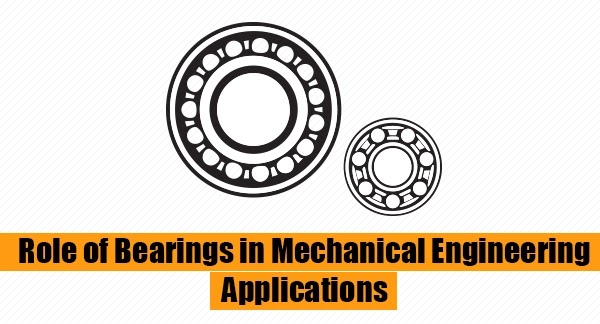
Bearings are machine elements that allow components to move with respect to each other. There are two types of bearings: contact and non-contact. Contact-type bearings have mechanical contact with equipment, which includes sliding, rolling, or flexural bearings. Non-contact bearings include liquid, air, mixed phase, and magnetic bearings. The lack of mechanical contact eliminates static friction. PE Mechanical exam review courses cover industrial applications and material properties of bearings. 
Every bearing type has its own application area. Every mechanical engineer should be aware of the applications and limitations of each bearing type as well as the fundamental operating principles of different bearings so that the correct bearing for the intended application can be selected. Our PE Mechanical review course recaps the fundamentals of bearings and their applications.
Role of Bearings in Mechanical Engineering Applications
Bearings and Mechanical Applications:
Ball Bearings
Ball bearings are a very common type of bearing, as they handle both radial and thrust loads. However, they can handle only a small amount of weight. These can be found in a wide range of applications such as roller blades and hard drives.
Roller Bearings
Unlike ball bearings, roller bearings are equipped to carry large loads. The load distribution is spread over a wide area as the primary roller is in the form of a cylinder to carry large loads. However, these bearings cannot handle thrust loads. If there are space constraints in the equipment, needle roller bearings need to be used. 
Ball Thrust Bearings
This type of bearing is designed for applications specified for low speed and low weight that can carry a thrust load. An example of a ball thrust bearing is a bar stool used to support a seat. 
Roller Thrust Bearings
These bearings are similar to ball thrust bearings as they are designed to exclusively handle thrust loads. However, unlike ball thrust bearings, they can handle larger loads. These bearings can be found in a wide range of applications including helical gears in car transmissions.
Tapered Roller Bearings
Unlike ball bearings, tapered roller bearings can handle both large thrust and radial loads. These bearings are used in automobile transmissions, which contain huge thrust and axial loads.
Sliding Contact Bearings
A wheel on a simple axle with sliding contact between the two is one of the most common types of bearings. Bushing is a sliding contact radial bearing element used to support a shaft and have integral flanges to support axial loads. Sliding contact bearings are commonly used for low and modest speed applications.
Rotary Motion Bearings
This anti-friction bearing is often used for rolling elements, such as balls or rollers, which reduce friction. The rolling element is normally constrained between a ring (inner race) and another ring (outer race). A cage typically acts as a separator and keeps the rolling elements apart to prevent rubbing. 
Specialized Bearings
For some specific applications, specialized bearings are produced similarly to giant roller bearings for handling extremely large loads and magnetic bearings for high speeds.
Mechanical engineers preparing for the PE exam should be familiar with engineering applications of bearings.

Monday, 30 January 2017

Pros and Cons of Using Water and Steam as a Heating Medium in Heat Exchangers

Although water is abundantly available for commercial use, it contains various minerals that create corrosion and scaling in heat exchangers. The process of scaling adversely affects heat transfer and can lead to equipment failure. Chemical treatment is required to prevent corrosion and scaling deposits. Microbiological fouling is also an important factor when selecting water as a heating medium in heat exchangers. Properties of water and the functionality of heat exchangers are reviewed in PE exam prep courses.
Pros and Cons of Using Water and Steam as a Heating Medium in Heat Exchangers
Steam is used as a heating medium in heat exchangers. Pressure steam is classified as low pressure steam and high pressure steam. Low pressure (LP) steam carries more latent heat, is normally of higher quality, reduces scaling, and reduces the fouling factor. LP steam typically requires pressure reducing values, which require more space and require large pipes for condensation. The space requirement and size of the pipes add maintenance and operational costs. High pressure (HP) steam requires smaller pipes and has a lower installation cost than LP steam piping. Professional Mechanical engineers design and create drawings of piping systems prior to installation. Our PE Mechanical exam review course offers a thorough refresher of HVAC principles and topics related to heat exchangers.
1. Water vs. Steam as a Heating Medium
  1. Water does not change state while it is being used as a heating medium. As it gives up heat energy to the secondary medium, its temperature drops. If one pound of water drops one degree Fahrenheit in temperature, it produces approximately 1 British thermal unit (BTU) of heat.
  2. Steam also does not change state while it is used as a heating medium, and it gives up heat energy to the secondary medium. During the process, its temperature drops, but the fluid condensate remains at the same temperature. One pound of steam at a pressure of 30 psi gives up approximately 929 BTUs of heat. Steam gives up more energy per unit mass than water.
2. Factors That Influence Heat Transfer Rates
The following factors influence heat transfer rates:
  1. Surface area
  2. Temperature
  3. Flow characteristics
  4. Fouling/Scaling
  5. Film coefficient of fluid
  6. Thermal conductivity of metal
3. How to Find Rate of Heat Transfer
For fluids that change state, the rate of heat transfer "Q" is given by:
Q = W*C* Temperature change of the fluid (△T) + W* Latent heat of vaporization (△H)
W = Flow rate of fluid (kg/hr.)
C = Specific heat of fluid (BTU/kg/degrees C)
△T=Temperature change of the fluid (degrees C)
△H = Latent heat of vaporization (Btu/kg)
For fluids that do not change state, the rate of heat transfer "Q" is given by:
Q = W*C * Temperature change of the fluid (△T)
If the rate of heat transfer is higher, then the heat exchanger's efficiency is higher and vice versa.
The above equations are important for engineers who plan to take the Principles and Practice of Engineering (PE) exam for their career advancement.

Wednesday, 7 December 2016

Significance of Solar Energy in Power Generation for Mechanical Engineering Operations

1. Introduction
The sun emits very high, intensive energy in the form of solar radiation. The energy emitted by the sun in three minutes is equal to the world's energy consumption during a year. Most of the energy we receive from the sun is in the form of light by short-wave radiation, which is visible light to the human eye. When this radiation strikes a solid or liquid, it is transformed into heat energy. Within the past several years, solar panels have become increasingly popular as energy-saving devices that use this ideology. Solar panels are flat plate collectors that are used to collect solar energy. Solar energy has many uses including water pumping, solar heaters, solar driers, and solar power generation. 
Significance of Solar Energy in Power Generation for Mechanical Engineering Operations
2. Arrangement of Solar Power Panels 
In a flat-plate collector, radiation energy from the sun falls on the flat surface coated with a solar film. This surface has a high absorbing capacity and is placed toward the general direction of the sun for maximum efficiency. The materials used for the plates are copper, steel, or aluminum, and the thickness of the plate is approximately 1 to 2 mm. When evaluating the mechanics of a copper plate, thermal energy is transformed from the absorber plate to a fluid, which is then distributed in the copper tubes through the flat-plate collector. Panels are designed to have thermal insulation, with the preferred material being fiber glass behind the absorber plate to prevent heat loss from the rear surface. Engineering materials and their properties are important for the PE exam. Many PE review courses stress this topic.
3. Utilization of Solar Power Panels for Mechanical Engineering Applications
The solar panel collector reflecting surface is considered parabolic. The solar energy falling on the collector surface is focused on the absorber tube. When a large quantity of energy falls on the collector surface, it results in the temperature of the absorber liquid being higher than the flat plate collector. The flat-plate collectors may be used to heat water up to 80 degrees Celsius; the concentrators are designed to heat water from a medium temperature to high temperatures. The heated water in the flat plate solar collector is used for boiling butane under high pressure in the butane boiler; the boiling point of butane is about 50 degrees Celsius. The butane vapor, which is part of solar power plant arrangement, is used to run the steam turbine. This results in electricity. 
PE mechanical engineering review courses cover the principles of turbines and boilers. Qualified mechanical or electrical power plant engineers with professional engineering licenses can install and setup solar power plants for mechanical engineering applications.
Advantages of Solar Energy
  1. The sun is an infinite source of energy, so solar energy is inexhaustible and renewable and available all over the world. 
  2. It is environmentally clean and pollution free. 
  3. It is the best alternative for the rapid depletion of fossil fuels. 
Disadvantages of Solar Energy 
  1. The intensity of solar energy on sunny days is approximately 1.1 KW/square meter area. Therefore, a very large collecting area is required. 
  2. Collecting solar energy creates a need for a large amount of land. 
  3. Solar energy is not available at night or on cloudy or rainy days. 

Friday, 7 October 2016

Boilers for Heat and Steam Production in Mechanical and Industrial Engineering Applications

Introduction to Boilers: Definition and Usage (Mechanical or Industrial Applications)
Boilers are also known as steam generators; they are a closed vessel in which water is converted into steam through the application of heat. The steam is used for driving steam engines or steam turbines for power generation. The steam is also used for producing process steam, which is used for sizing and bleaching in the textile industry. The capacity of boilers used for power generation is considerably large compared with other boilers.
Boilers in Engineering Applications
Boilers are required to hold a certain quantity of water to generate and deliver the steam safely at the required temperature and pressure at the defined rate. Maximum heat produced by the fuel in the furnace should be utilized for engineering economics calculations. The boiler should be accessible for inspection and for further improvement. Mechanical or industrial engineers with their Professional Engineering exam certification are able to inspect and check quality control and quality assurance practices of the facility.
Different Types of Boilers Used for Various Engineering Applications
Boilers are classified according to the flow of water and hot gases.
Fire tube boilers: In fire tube boilers, hot gases pass through the tube, which is surrounded by water. There might be a single tube, as in the case of Lancashire boilers, or several tubes as in the case of Locomotive boilers.
Water tube boilers: With water tube boilers, water circulates through a large number of tubes, and hot gases pass around them. Babcock and Wilcox boilers are both water tube boilers.
Based on the location of the furnace, boilers are classified as externally or internally fired boilers.
  1. In internally fired boilers, the furnace is located as an integral part of the boiler structure.
  2. In the case of externally fired boilers, a separate furnace is built outside the boiler shell. 
According to the application and position, boilers are classified as stationary or mobile:
  1. A stationary boiler is one which is installed permanently on the boiler foundation in any production or manufacturing unit.
  2. A mobile boiler is used for ocean cargo and passenger ships with an inherent fast navigation capacity.
Difference Between Fire Tube and Water Tube Boilers
Fire tube boilers are simple, vertical type boilers; they are the simplest form of internally fired boilers. Fire tube boilers do not require a heavy foundation, and they require minimum area. In water tube boilers, water is circulated inside the tubes, and hot gas flows over the tubes. The system requires a considerable amount of area for installation. Thermal and fluid systems of mechanical engineering in PE exam review courses will describe various types of boilers and functionality differences.
Advantages and Disadvantages of Water Tube Boilers
  1. Steam can be generated at a very high pressure in water tube boilers.
  2. Steam can be raised at a quicker rate with large water capacity
  3. The hot gases flow toward the direction of water flow, so the maximum amount of heat is transferred to the water
  4. Bursting of one or two tubes does not greatly affect the boiler, so water tube boilers are sometimes known as safety boilers
  5. The different parts of water tube boilers can be separated so it is easier to transport and is also suitable for use in steam power plants
  6. Water tube boilers are less suitable for hard water because a small deposit of scale may cause overheating and bursting of tubes. Thus, the water treatment plant is very essential for water tube boiler consumption.
  7. High operating and maintenance costs
  8. A delay in water supply, even for a short period, will likely make the boiler overheated. Water level must be watched very carefully during the operation.
Professional mechanical engineers with their PE exam certification will be aware of all engineering applications of boilers and their capacity to generate steam.