Showing posts with label PDH. Show all posts

Monday, 15 March 2021

What are PDH Credits? How do I get them?

PDH stands for "professional development hour" and PDH credits are simply that - an hour spent on developing skills or knowledge for your profession.
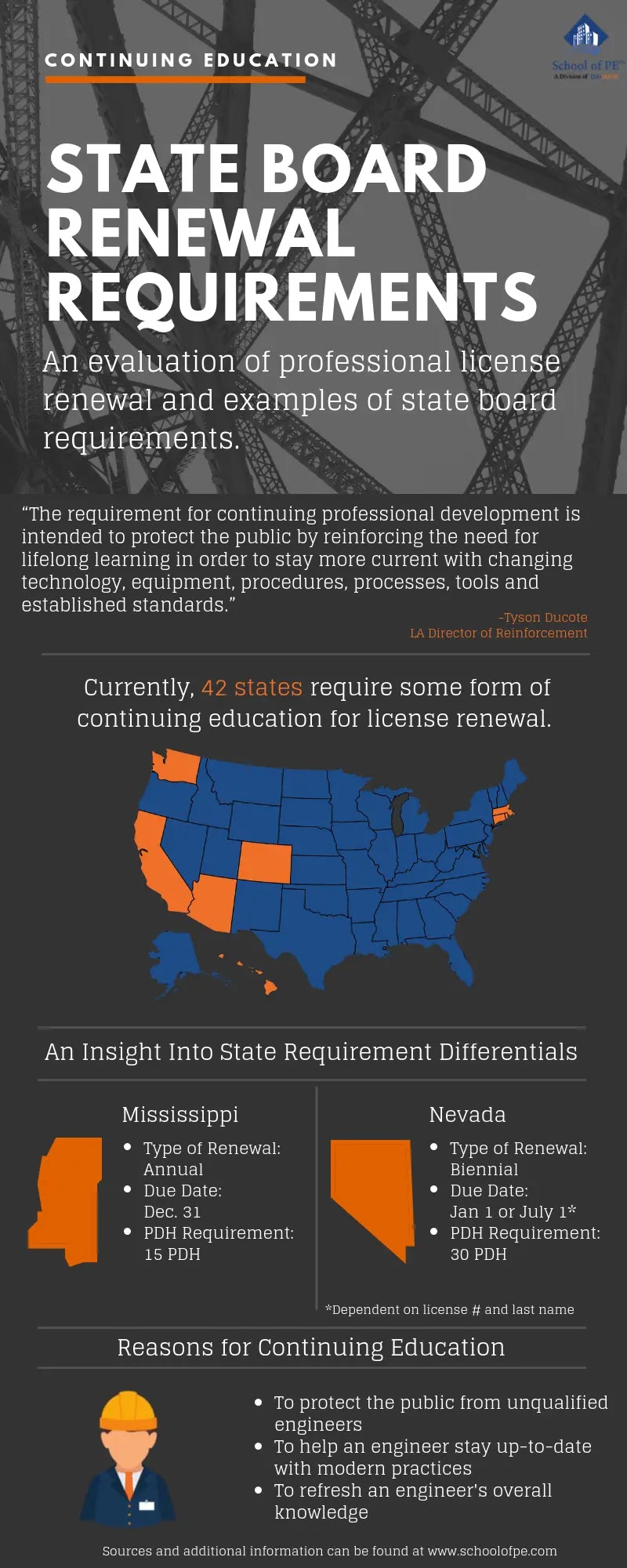
PDH credits are currently required in 42 of 50 states for renewal of your P.E. license. In this case, it is easier to list the states where they are not required, which are: Arizona, California, Colorado, Connecticut, Hawaii, Massachusetts, Rhode Island, and Washington. If you are not seeking license renewal in one of those states, check with your local board since requirements vary widely.
In my opinion, these credits are important for both your ongoing technical competence in the industry and your overall job satisfaction. In my experience, I have found them to be both informational and inspirational - for example, a seminar that can count as a PDH credit can be about a new piece of technology that was implemented to assist in the design or construction of the new world's tallest building. To me, both teach me about a new technique, potentially at my disposal, and inspire me to dream big in my structural engineering career. Even though I live in a state where PDH credits are not required for license renewal (more on that shortly), I am always eager to attend seminars for these reasons.
The only catch to the "simple" PDH definition written above is that to obtain PDH credits for use towards a P.E. license renewal, the PDH hours must be provided by an accepted source based on the state specific requirements. If you're wondering what sources are accepted in your state, the best thing to do is to check with your licensing boards website.

What are PDH Credits? How do I get them?
So now that we've covered what they are and why you need them, how can you get them?
The most common way to gain a PDH credit is to attend a seminar. Sometimes it's enough to just attend a seminar, but sometimes there is a quiz you must fill out to gain the credit. There will usually be a sign in sheet passed around with your name, email, and P.E. license number so the presenter or presenting organization can make sure you get the credits.
You can attend seminars hosted by a wide variety of engineers. Some sources I've used in the past include in house seminars at a large engineering firm, a monthly meeting through a local Structural Engineering Association chapter, a webinar through a national organization such as ASCE or ACI and attending a conference. That last one is a good way to get several credits all at once!
I'll close with one final note, which is important if you live in a state where PDH credits are not required but want to maintain licensure in another state. You will have to be vigilant about chasing down these credits! I was licensed in both New York and California for a while after moving from NY to CA, and I noticed that no one ever passed around the sign in sheet or asked if anyone needed to get PDH credits in California. So, I just want to remind you that if you need to log those credits, be active and ask for them!
Hopefully, this cleared up some of your questions on PDH credits!

Monday, 8 March 2021

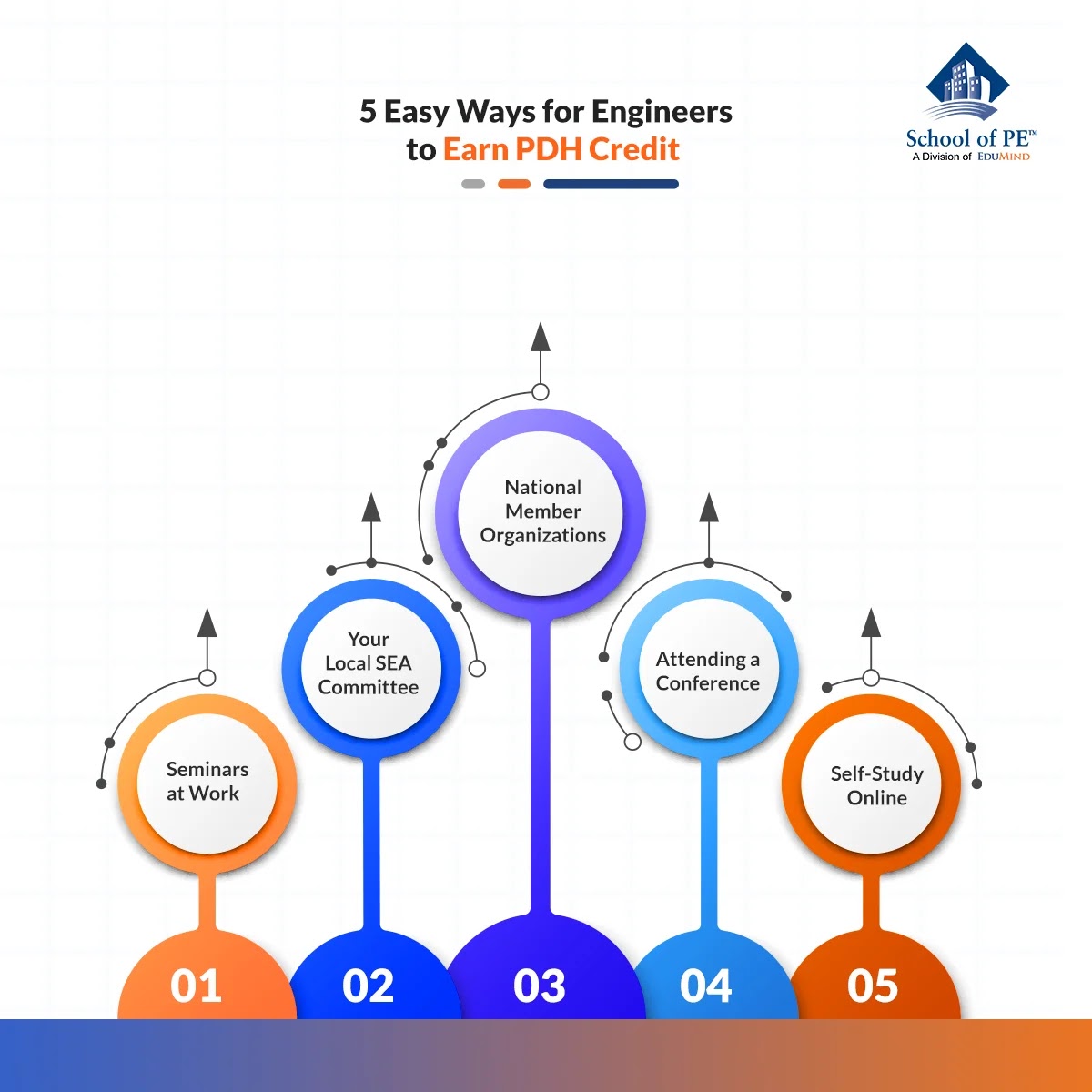
5 Easy Ways for Engineers to Earn PDH Credit

Professional Development Hours (PDHs) are required in 42 of 50 states to maintain or renew your P.E. license in that state. Obtaining and tracking these hours may seem daunting, but there is actually an abundance of places to obtain these. I hope the list below helps you to get started.
1. Seminars at Work
Many engineering firms offer seminars (typically with lunch included!) every so often that can count as a PDH. Sometimes, this means an external consultant or sales representative will present to the company, and other times it will be an internal engineer, presenting on lessons learned from a project they've completed. When I used to work at larger engineering firms, I always looked forward to these. An easy and productive way to spend a lunch hour! These are almost always eligible for PDH credits, but be sure to ask, especially if you live in a state where PDH credits are not required for license renewal.
2. Your Local SEA Committee
Most cities and states have a local chapter of Structural Engineering Association (SEA). If your chapter is active check out their events, which are typically eligible for PDH credits. From my experience, these events typically include a seminar that will range from a local engineer on lessons they've learned from a project to updates they've made to the building code. In addition to gaining knowledge and PDH credits, these events are also a great way to network with local engineers. I personally can't wait until these events can be held in person again, but I've been enjoying them in their virtual format in the meantime.
5 Easy Ways for Engineers to Earn PDH Credit
3. National Member Organizations
Looking a little broader, national member organizations such as the American Society of Civil Engineers (ASCE), American Institute of Steel Construction (ASIC), and American Concrete Institute (ACI) all offer OnDemand seminars for PDH credits. I'm sure these are just the tip of the iceberg for national organizations offering these services. I found that ASCE offers 10 free PDH credits with an annual membership, and AISC offers all of their webinars for free, but there is a fee to have them counted as PDH credits. These are great resources for learning more about specific topics!
4. Attending a Conference
Attending a conference is a great way to get a bunch of PDH credits quickly. With the ongoing pandemic, most conferences have gone online, so now you can attend without the potentially expensive travel costs. Even with online seminars, conferences typically charge a fee to "attend" though. One benefit of attending is that the presentations are curated from engineers across the country, so the quality is typically really good.
5. Self-Study Online
With a quick google search, you can find several websites offering a multitude of seminars for varying prices. Check with your state board before purchasing these, as different states have different requirements for approved PDH providers.
The bottom line is there are a ton of ways to obtain your PDH credits at a variety of price points. After reviewing this list, I hope you have a good idea of where to start!

Monday, 4 May 2020

What are PDH Engineering Credits?

If you're familiar with the engineering world or industry, you've probably heard the term "PDH." This three-letter acronym plays a big part in engineering license renewal. If you're wondering what it really means, and how it impacts the engineering community, learn more below: 
What is a PDH?
PDH stands for "Professional Development Hour." In the engineering industry, those who are professionally licensed as an engineer in most states need to earn PDHs to maintain an active license. 
What Engineers Need to Obtain PDH Credits?
Currently, 42 out of the 50 state boards require some sort of continuing education and PDH for engineers. Engineers in those states who have taken and passed the Principles and Practice of Engineering Examination must participate in some sort of continuing education activity depending on their state board's requirements. 
How do Engineers Obtain PDH credits?
In most states, Professional Engineers obtain PDH Engineering credits by participating in continuing education activities. These activities can include attending webinars, going to an engineering conference, or taking a self-study online engineering continuing education course. 
Do State Boards Differ in Their Continuing Education Requirements?
Yes. Out of the 42 states that require some sort of continuing education, engineering state boards can greatly differ in their PDH requirements. For example, Texas has an annual renewal period while Kansas has a biennial renewal period. States requirements can also differ in the amount of PDHs an engineer has to obtain in their renewal period. Mississippi, for instance, requires an engineer to obtain 15 PDH credits for license renewal while Nevada requires 30 PDH credits. If you're a Professional Engineer, it's always a good idea to check with your state board to determine your PDH requirements for license renewal. 
What are PDH Engineering Credits?
Why Do Professional Engineers Need PDH Credits to Maintain Their License?
Engineers have a big responsibility in keeping the general public safe. Think about it- engineers design bridge structures, buildings, roadways, etc. By requiring engineers to obtain Engineering PDH credits to maintain an active engineering license through continuing education, states are able to ensure that their licensed engineers are up-to-date with different practices and technology.

Monday, 6 April 2020

PDH Courses from School of PE

Passing the PE exam and becoming professionally licensed is a monumental milestone in an engineer's career. With this accomplishment comes an increase in pay, job functions and duties, leadership opportunities, and overall responsibilities. This can be somewhat demanding and stressful for newly licensed engineers. They must work to stay educated on new technology, information, and practices in their respective disciplines in an ever-changing world. If you're familiar with the School of PE instructors and products, you know the standard and the genuine passion that the organization has toward helping students meet their professional goals. 
School of PE offers a variety of professional development hour (PDH) courses. The term PDH is common in the engineering community and is simply the number of contact hours of instruction, study, or presentation. PDHs are typically seen in 0.5-hour to 1-hour increments. Anything less than 0.5 hour should not be counted, and anything between 30 and 49 minutes should be rounded to 0.5 hour. PDHs can be converted to and from other units as needed. Engineers must renew their license with their respective state licensing boards and must obtain a certain number of PDHs each year and show proof of successful completion (such as a course certificate). 
Engineering is a very complex and demanding field that requires a great deal of time and dedication. Practicing engineers can sometimes work 80+ hours per week to fulfill obligations. With the demands of project deliverables, client interaction and satisfaction, and administrative duties, engineers are not left with much time. School of PE PDH courses offer great flexibility for engineers who have demanding schedules. As with many School of PE products, the PDH seminars allow students various options to learn at their own pace. Engineers have at least one year to complete these courses. 
The academics and practice of engineering can differ greatly in some respects, which creates a gap of knowledge. Another benefit of School of PE PDH seminars is that the courses are created by subject matter experts who have both academic knowledge and practice within the industry. This creates the balance needed throughout the discipline. Another great benefit is the range in level of difficulty. Courses are designed for newly practicing, intermediate-level and experienced engineers alike. 
State licensing board requirements vary, which can be especially challenging for engineers licensed in multiple states. School of PE PDH courses are accepted by all state licensing boards, making it easier and universal during license renewal(s). School of PE PDH courses are customizable and economical to students based on their individual needs. In the event that students are unsure of what to purchase, School of PE provides subscriptions and packages that allow them to purchase multiple courses for a great price. School of PE PDH courses are created with specific learning objectives that are known prior to the class. This is very helpful when students are selecting topics, whether it is a refresher of existing knowledge or to become more familiar with a particular subject. 
Visit https://www.schoolofpe.com/pdh/course/pdh for more information.

Monday, 10 December 2018

2018 Engineer Gift Guide: Gift Ideas for Engineers

The holidays are upon us, and it's time to get into the holiday spirit! If you are in need of gift ideas for an engineer in your life, we have some ideas for you! Who knows, maybe you will put one of these items on your Christmas list!Posture Corrector
Posture Corrector Do you know an engineer whose posture sometimes isn't up-to-par? Sitting in the office for long periods of time can have detrimental effects on posture. Lumo Lift is a great solution for those who slouch due to sitting for a long time. 
Portable Espresso Maker
Portable Espresso Maker Engineering sometimes requires long days at both the office and the job site. Sounds tiring, right? A great gift for an engineer would be a portable espresso maker. This espresso maker can continually give energy boosts all day long. 
PDH Courses
PDH Courses Give the gift of education by signing up the engineer in your life for a PDH course. Engineers need to renew their licenses in many states, so signing them up for some continuing education classes will take some of their stress away! PDH courses are great gifts for civil engineers, electrical engineers, and even mechanical engineers!
Wireless Cell Phone Chargers
Wireless Cell Phone Chargers In today's day and age, everyone is extremely busy (especially engineers) and may end up running out of cell phone battery juice. Nobody wants to carry around a charging cable, so wireless chargers are perfect. From solar chargers to charging phone cases, convenience is a necessity in an engineer's life.
3D Printer
3D Printing Owning a personal 3D Printer may seem impossible do to the cost, but FlashForge is selling a 3D Printer that is economically priced. This 3D printer works with Wi-FE, USB cables, flash drives, and even has Cloud capability.


Tuesday, 20 November 2018

Continuing Education for Engineers: PDH State Board Requirements

For many state boards, engineer continuing education deadlines are approaching. Engineers in West Virginia, Vermont, and Iowa, for example, have continuing education deadlines at the end of December of this year. 
Currently, 42 out of the 50 state boards require some sort of continuing education. The continuing education requirements can include activities such as attending engineering PDH webinars, taking an online PDH course, or attending an engineering conference. When engineers participate in these continuing education activities, they can earn Professional Development Hour (PDH) credits. The amount of PDH credits needed to renew a professional license varies from state to state, but generally, states require an engineer to earn approximately 15 PDH credits annually for renewal. 
Check out the infographic to learn more about state board PDH requirements:
Continuing Education for Engineers: PDH State Board Requirements

Monday, 12 November 2018

Upcoming PDH Online Engineering Webinar: A Quick Dive Into Risk Management

With many state board Continuing Education deadlines approaching at the end of this year, many engineers are registering for PDH webinars and online courses in order to meet their state board's requirements. 
To help engineers in the process, School of PE has scheduled a number of interactive webinars for the next two months. One of those webinars is titled "A Quick Dive into Risk Management," and will be taught by Mr. Miller.
Mr. Chris Miller Mr. Miller has over 20 years of successful sales and management experience. He has taught Project Management courses for several years and has developed several Project Management courses. Mr. Miller has a proven track record of successfully coaching students in project management. 


For those who are interested in signing up for this webinar, I sat down with Mr. Miller to discuss the upcoming webinar session.
Can you explain what risk management is exactly? 
Simply put, Risk Management is the process of identifying potential risks (unexpected events), evaluating the identified risks, and prioritizing them. 
How does Risk Management tie into Project Management? 
When you are working on projects, you often have risks, such as unexpected events. An example of this would be falling behind on a project due to unforeseen weather. A project manager's work should not focus on dealing with problem, but it should rather focus on preventing them. 
Why would a webinar on risk management benefit engineers? 
People take risks every day. Everyone who gets out of bed and drives to work is taking a risk. Engineers work on projects and with those projects, there are risks. Attending a webinar on Risk Management can help engineers better understand how to identify, evaluate, and prioritize risks on a project. 
After taking the risk management webinar, what are a few main takeaways for students? 
Those who attend a webinar on risk management should walk away knowing that not all risks are bad and there are both positive and negative risk response strategies for dealing with risk.

Wednesday, 10 October 2018

Continuing Education for Engineers: Why State Boards Require Professional Engineers to Take PDH Courses

Continuing Education is a typical requirement that engineering state licensing boards implement as a way for an engineer to maintain an active professional license. Whether a state board requires annual or biannual license renewal, many engineers dread the process of obtaining enough professional development hours (PDHs) through continuing education. Although the process may seem inconvenient and time consuming (which can be made easier with flexible online engineering pdh courses>), state boards implement license renewal policies for various reasons. The reason a majority of states have implemented continuing education requirements is to not only allow engineers to broaden their knowledge but also, most importantly, to keep the public safe.
Currently, 42 out of the 50 state boards require some sort of continuing education. The continuing education requirements can include activities such as attending engineering PDH webinars, taking an online PDH course, or attending an engineering conference. 
Engineers have the responsibility to keep the public safe, and by keeping up with various engineering methods and safety regulations, they can do so. "The primary purpose of licensing for professional engineers and professional land surveyors is to protect the public from unqualified or unethical practitioners," said Tyson Ducote, the director of reinforcement for Louisiana. "The requirement for continuing professional development is also intended to protect the public by reinforcing the need for lifelong learning in order to stay more current with changing technology, equipment, procedures, processes, tools and established standards." 
On a somewhat similar note, most state boards require continuing education to help develop an engineer professionally as the engineering field evolves throughout time. For example, many tools, operation techniques, and technology have significantly changed throughout the past few decades. Survey engineers who were licensed in the 1980s may not understand how to use drones, which are typically used to map out construction sites in modern-day engineering. By requiring survey engineers to take continuing education courses, engineers have the opportunity to learn about drones and stay up-to-date with modern practices.
"I have found online continuing education to be quite helpful to me as a registered professional engineer," said Harlan Bengtson, a continuing education course writer at EduMind. "Not only has it met the continuing education requirement for renewing my PE license, but it has also allowed me to refresh and update my knowledge in some areas of engineering and to gain knowledge about engineering topics that I want to move into."