Showing posts with label SE. Show all posts

Thursday, 22 September 2022

How to Ask Your Boss for a Raise or Promotion

Engineers seeking to increase their compensation often are uncertain as to how to approach their supervisors. While there are certainly no "one size fits all" rules for how to achieve a salary increase, there are a few things to keep in mind which may be helpful in determining the best approach.
How to Ask Your Boss for a Raise or Promotion
Determining Employee Compensation
Employee compensation is determined by several factors which include: the employee's experience level, knowledge, skills, and educational background; job market conditions; industry market conditions; company-specific needs and goals; and other factors. Understanding the particular conditions and needs of the company is important because ultimately the personal success of an employee, in terms of compensation, job satisfaction, and career advancement, hinges on the successful alignment of the employee's and the company's goals. Proving yourself as a valuable asset for a company's success is a key factor in career advancement within a company. Quite simply, an employee who noticeably adds value to a company is most likely to be valued in return. Demonstrating this value through quality work is one means towards recognition. Making the quality of the work you do an advertisement for your own advancement is one strategy in working towards this end. Doing this work with a high degree of professionalism also helps to demonstrate your value to the firm.
Employee Review Meetings
Many firms have regular employee review meetings, whether annually or at some other increment of time throughout a year. These are perfect opportunities to showcase the contributions which you have made and the future efforts which you have committed to pursuing. If your firm does not have regularly scheduled employee review meetings, it is reasonable to ask your manager to schedule one with you. In this case, the framing of the request for the discussion should be as a goals review meeting rather than a request for a compensation review. The discussion itself will take on the broader outlines of the employee's and the company's goals which then lends itself to the employee's goals for advancement, including compensation increases and promotion. By framing a discussion in terms of both the firm and the employee, the connections and synergies between the advancement of both can be highlighted. It is not a question of the employee simply "asking for" something, which is likely to be looked upon less favorably by an employer, but rather a discussion in which the performance of the individual and the firm are correlated and discussed. This is an opportunity to demonstrate the commitment of the employee both to their own professional development as well as to the firm's goals.
Demonstrate Worth through Self-Improvement
While proven job performance is an essential prerequisite for discussions of advancement, there are several other ways in which to distinguish oneself and set oneself up for success in compensation discussions. For aspiring engineers, the most straightforward way is to pursue licensure. This adds significant value to a firm's team. It also indicates that you are serious about your professional development and willing to take on the responsibilities that a professional title requires. Many firms even have stated policies related to specifically defined salary increases that an employee can expect upon receiving their licensure. Often, firms will compensate the employee for the fees associated with registering for the required licensure exams. While the road to licensure can seem long for those first entering the workplace out of college, it is important for aspiring engineers to begin the process of planning for the exams and documenting their work experience as required by the state in which the license is being pursued. While licensure can only be typically granted after passing the Principles and Practice of Engineering (PE) exam, it is also necessary to pass the Fundamentals of Engineering (FE) exam prior to the PE exam. Once a candidate passes the FE exam, a status of "Engineer in Training" (EIT) can be used. Becoming an EIT is a great short-term goal for engineering graduates. A good piece of advice is to use the passing of these exam milestones as stated goals during employee evaluation reviews and discussions. It shows that the employee is clearly interested in their advancement and willing to invest in themselves for their development. In turn, the firm is more likely to invest in employees who are investing in their own advancement since the advancement of the individual and that of the firm go hand in hand. The firm has already invested in its employees by hiring them, and it therefore has an interest in their advancement.
Professional Development Opportunities
Again, the best means of promotion and compensation advancement is to demonstrate professional development, which adds value to the firm and its work. Aside from the pursuit of licensure and overall quality of work on the job, engineers can distinguish themselves through many other means. This could take the outline of providing something unique and of value which other employees of the firm do not offer. For example, if there is a noticeable lack of quality CAD or BIM standards and the software skills of other employees seems to be somewhat lacking, then there could be an opportunity to take an initiative to help the firm improve in this regard by taking on an informal leadership role. There are ample resources available online for software training, and simply improving one's knowledge and offering assistance to other employees as a resource can provide a true value to the firm's work which is likely to be noticed by project managers. Even project managers who do not regularly use CAD or BIM software themselves can help demonstrate their value by improving their software knowledge so that they are familiar with the level of drafting or modeling effort associated with project work. This in turn could lead to better project scheduling and more accurate estimates for design efforts.
Adding Value
The idea of adding value to a firm can also more specifically relate to design knowledge, which can help to expand the versatility of a firm and aid in their pursuit of a wider variety of work and potential clients. For example, there may be a lack of employees with suitable knowledge of sustainable design principles and credentials. In this case, an engineer can demonstrate the potential value which could be brought to a firm by pursuing and achieving a credential such as LEED accreditation. This could help the firm gain the ability to pursue projects where LEED certification is required. Similarly, an engineer could pursue accreditation in WELL or attain an accreditation from the Construction Specification Institute such as CCS (Certified Construction Specifier) if specifications are an aspect of their work. Structural engineers could demonstrate their knowledge and expertise by passing the SE exam, which could allow an engineering firm to pursue work in states or project types where this credential may be required. Areas of specialization need not entail the pursuit of particular accreditations, though these do provide a means to demonstrate a proven level of knowledge in a particular area of interest.
Conclusion
In summary, for engineers seeking promotion or increased compensation, the best means of approaching the subject is often to demonstrate added value and the commitment to adding value. The pursuit of licensure and other accreditations is an excellent strategy, as they provide demonstrable and measurable levels of design knowledge and expertise. Such achievements may allow a firm to pursue additional types of work, which is a clear added value for an employee's firm. Specialization of expertise is an additional means of providing value which can distinguish you from others in the job market. By pursuing and demonstrating the added value which you bring to a firm, recognizing this value, and highlighting it during employee review meetings, you have the best chance of success in achieving recognition within a firm.
If you are wanting to boost your career with an engineering license, look no further than School of PE! For over 18 years, we have helped thousands of busy individuals pass their professional certification and licensure exams and look forward to helping you next! Sign up for a course today.

About the Author: Adam Castelli

Adam Castelli is a licensed architect and engineer currently practicing in the Pittsburgh area. He holds a master's degree in architecture from the University of Massachusetts Amherst and a bachelor's degree in civil engineering from Villanova University.

Friday, 25 February 2022

Passing the Civil-Structural PE Exam on the First Try:

The Organized Way
After reading this short blog, I am confident you will have the guidance necessary to pass the Civil-Structural PE exam on the first try - it worked for me! Two-hundred eighty-three hours and twelve minutes over one-hundred eighty days may sound like a lot of studying, but it only accounts for 6.5% of my time spent during that period. However, it takes much more than brute force, nose-in-the-books studying to pass the exam; let's get into the specifics.
1. The Courses:
First, I took the School of PE's "OnDemand" and "Live Online" courses. At the time I registered (early), I got a discount on bundling the two. The first four months of my studying I utilized the "OnDemand" sessions while the last two months I took the "Live Online" courses.
The "OnDemand" courses were most useful to organize my notes, book, resources, and materials since I could pause or stop the lectures at any time and pick them back up as my schedule allowed. Listening to the lectures at my own pace was a fantastic way to review and learn the material while, at the same time, prepare my resources for the PE exam.
The "Live Online" classes are where I spent time soaking in information, asking questions, retaining information, finalizing my notes, and homing in my problem-solving skills. During the time I took the "Live Online" courses, I spent less time organizing and more time learning and solving practice problems with the class and through the School of PE quizzes.
One may ask, "It really took 283.2 hours to take the School of PE classes?" Technically, no. But the answer a first-time passer should say is, "Yes!" Let me explain.
2. The Time:
Tracking the time I spent studying was critical to my success - setting realistic goals each week/month maintained my self-motivation. Tracking time by day, week, and month may sound like a lot, but it merely takes seconds before and after you sit down to study. Being the nerd I am, I liked to watch my graph grow as time went on (see Figure 1); it kept me in check, focused, and determined to make my time well spent in the end. I counted all studying: reading, listening to lectures, practice problems, coffee breaks (lots of those), and especially tabbing.
Study Time
Figure 1: My Study Time
3. The Notes:
Ten 3-ring folders and ten textbooks were lugged around in two suitcases to the exam room. Honestly, I used every single one of these resources. The School of PE notes each had a binder per class and separate binders for practice problems relating to structures (see Figure 2).
This method of organization made it easy to locate the exact folder I needed for the question at hand. During the first half of the exam, I had all the binders very accessible. Then, during the second half, I shuffled them around making the structural, geotechnical, and constructions binders easy to access and the others out of the way.
Sorting the notes in this fashion was extremely valuable! However, this was not the most important organizational method; the most useful, valuable, and time-saving organizational method was within each binder.
Notes
Figure 2: My Notes
4. The Tabbing:
Tabbing was the number 1 most helpful way to pass the Civil-Structural PE Exam on the first try. During the exam, I knew exactly where to find any topic in my notes, books, and references. During the "OnDemand" months of my studying, I would pause the lecture at every new section to tab it on the top. Then, within that section, I would tab other important items on the side using the same color (see Figure 3). Because I organized my notes and books in this fashion, I was quickly able to locate the general topic, then the specific subject within that topic. Here's an example:

Tabbing

Figure 3: My Tabs

1. A question related to concrete beam moment design appears on the exam
2. I locate my Structures and Materials folder (Breadth or Depth depending on which half of the exam I am taking)
3. Using the tabs on the top, I locate Concrete Design
4. Then, using the tabs on the side, I locate Moment Design
5. After a quick review of the material, solve the problem
Taking the time to tab your resources yourself in a way you best understand allows for rapid question answering on the exam. Without tabbing, I would have easily run out of time on both the morning and evening half! Once a binder was fully tabbed, I took it to the test in practice quizzes and exams.
5. The Quizzes:
Taking the School of PE practice quizzes allowed me to discover areas I was weakest in and learn topics that may not have been discussed in the online courses. Being able to create your own quizzes based on topic, difficulty, and number of questions made it extraordinarily easy to practice at my own pace. I decided to do 100% of the structural questions, 100% of the construction questions, and all or just over half of the other topics. I would sometimes run a quiz for 5 questions of easy difficulty while my dinner was cooking, or 2 questions of hard difficulty on my lunch break.
Since the quizzes are not timed, if I answered a question incorrectly, I would spend time reviewing the solution provided, tabbing my resources for any new/valuable information or charts, and finally solving the problem on my own. Because I answered the question incorrectly, it would eventually show up on another quiz I would take, and this time I would know where to look and how to solve it.
6. The Practice Exams:
Practice exams were a monumental step in my confidence level before taking the exam. I took the School of PE practice exams as well as other paper-back versions I purchased. I ensured both were timed just as the real exam would be. Like the practice quizzes, I would review the solutions to any that I answered incorrectly and then resolve the problem making any special notes on the side.
The best part about the practice exams was that I could take them to the exam as a reference! Several of the questions on my practice exams showed up on the real exam with a few minor changes: asking for one variable instead of another, changing the scenario a bit, or just switching some values around. Since I spent the time solving each practice exam, it was obvious when a question on the PE exam was similar to one I have solved before - these questions were my favorite!
7. The Exam:
The PE Civil Structural exam is broken into two halves: the first being civil engineering breadth (all subjects), and the second being the structural depth. For both halves of the exam, I utilized the same organizational technique. I was skeptical at first thinking, "Isn't this going to take up some of my precious time?!" But, after utilizing it, the true value was very apparent.
As soon as the proctor permitted us to begin, I looked at each question on the exam for several seconds. I would write next to the question a number with a circle around it assigning it a difficulty level as follows:
1. This question is very easy: I don't even need reference material to solve it
2. This question is easy: I know exactly where to look in my notes/books to solve it
3. This question is tough: I know where in my notes/books this topic may be
4. This question is very tough: I have never seen this before; I will have to dig into a book
Once all the questions were marked (which only took a few minutes) I quickly answered all the 1's and 2's, solidifying correct answers. Then, I began to work on the 3's and skipped any that should have been marked a 4 after I started solving. Finally, I would begin working on the 4's making sure I answered each question (since incorrect answers do not hurt you, educated guesses are worth it if time is running out).
Because my training with the School of PE was so beneficial, there were zero 4's on the first half of the exam for me. And I was able to take the test twice in the allotted time with 20 minutes to spare. Yes, I took the test twice to make sure I got the same answers both times. And yes, I found a few mistakes.
The second half of the exam was a different story. No amount of studying can go over all Civil-Structural engineering. I had six questions marked as 4's and a few marked as 3 that should have been 4. With 15 minutes remaining I had four questions remaining. With 5 minutes remaining I had two questions remaining. Finally, I answered the last question with half of a minute remaining. The good news: I left the exam knowing I passed.
8. The Conclusion:
Passing the Civil-Structural exam on the first try is not an easy task. It takes preparation, concentration, organization, and confidence. Taking the time to prepare yourself is just as important as preparing your resources. Because in the end, the time does not stop ticking and you want to be sure you answer each question. Most of us have the skills and tools to pass the exam, but doing it before the proctor says, "Pencils down" is a more difficult feat.
About the Author: Brian Huttner

Brian Huttner is a licensed professional engineer for Tindall Corporation, Virginia, who designs precast concrete structures, components, and connections. He received his Associates degree in Business Administration from New River Community College (2012) and his Bachelor of Science in Civil Engineering from Virginia Tech (2015). In his spare time, he enjoys being a husband and a father in a loving household of 9 animals including cats, dogs, birds, and a turtle.

Monday, 13 September 2021

We Get by With a Little Help from Our Friends: Benefits of Tutoring

Students sometimes need additional help with understanding topics or concepts outside of class. One of the best actions they can take to clarify questions and boost their subject confidence is to take advantage of tutoring options. Content knowledge is certainly an important trait for a tutor, another important characteristic is personal skills. South Central College finds that tutors must approach their teaching efforts with empathy, honesty, and humor.1 This more personal tutoring style facilitates a positive learning experience for the student and helps boost their subject matter confidence.
We provide tutoring opportunities to our students who may need additional help understanding complex engineering subjects with the goal of helping them gain the necessary confidence for their exams. This blog will focus on the tutoring options we have available and what benefits students will receive through tutoring. A tutor's role is diverse-he or she is responsible for explaining concepts, evaluating strengths and weaknesses, checking progress, providing emotional support, teaching study skills, and more! Tutoring opportunities provide the following benefits to students:
  1. Offers more individualized, systematic, structured learning experience
  2. Provides greater congruence between teacher and learner; closer role model
  3. Improves academic performance and personal growth
  4. Improves attitude toward subject area
  5. Generates stronger effects than other individualized teaching strategies
  6. Motivates self-paced and self-directed learning
  7. Provides intensive practice for students who need it
  8. Improves self-esteem2
We Get by With a Little Help from Our Friends: Benefits of Tutoring
We offer tutoring sessions led by our course instructors for all our courses. Our instructors are professional engineers who have many years of experience in preparing students for NCEES examinations. Once students have registered for a review course, they can purchase tutoring sessions by selecting the "Tutoring" tab in the blue left menu for their selected course. Students will be able to select their tutor based on the desired subject as well as sign up for tutoring sessions based on their availability. Students will also be able to indicate what topics/concepts they are struggling with prior to the tutoring session so the tutor can develop an individualized study plan before their scheduled meeting.
Are you interested in investigating tutoring options with School of PE? Get in touch with us today to find out how we can get your questions answered and get you back on track! Go to www.schoolofpe.com or email us at info@schoolofpe.com.
References:
1 "What Is Tutoring?" Tutoring Training. South Central College. Accessed August 4, 2021. http://southcentral.edu/tutor_training/module1/index.html.
2 "What Is Tutoring?"
About the Author: Martha Hunsucker

Martha Hunsucker is a content writer for EduMind. She received her BA in English from Stetson University and has experience marketing, copywriting, editing, and blogging. In her spare time, she enjoys reading books by Jon Krakauer (her current favorite author), hiking with her two dogs, and sleeping in on weekends.


Monday, 22 February 2021

How to Become a Structural Engineer?

The work of a structural engineer can pose a major public safety hazard if completed by an engineer without the proper technical understanding. As a result, structural engineering is highly regulated industry through certification. With the proper preparation and experience, the process is very attainable, but be warned: it takes time and effort to complete.
Disclaimer: the process below is only one way to become a licensed structural engineer - there are definitely others. This is, in my opinion, the most streamlined way to become a structural engineer.
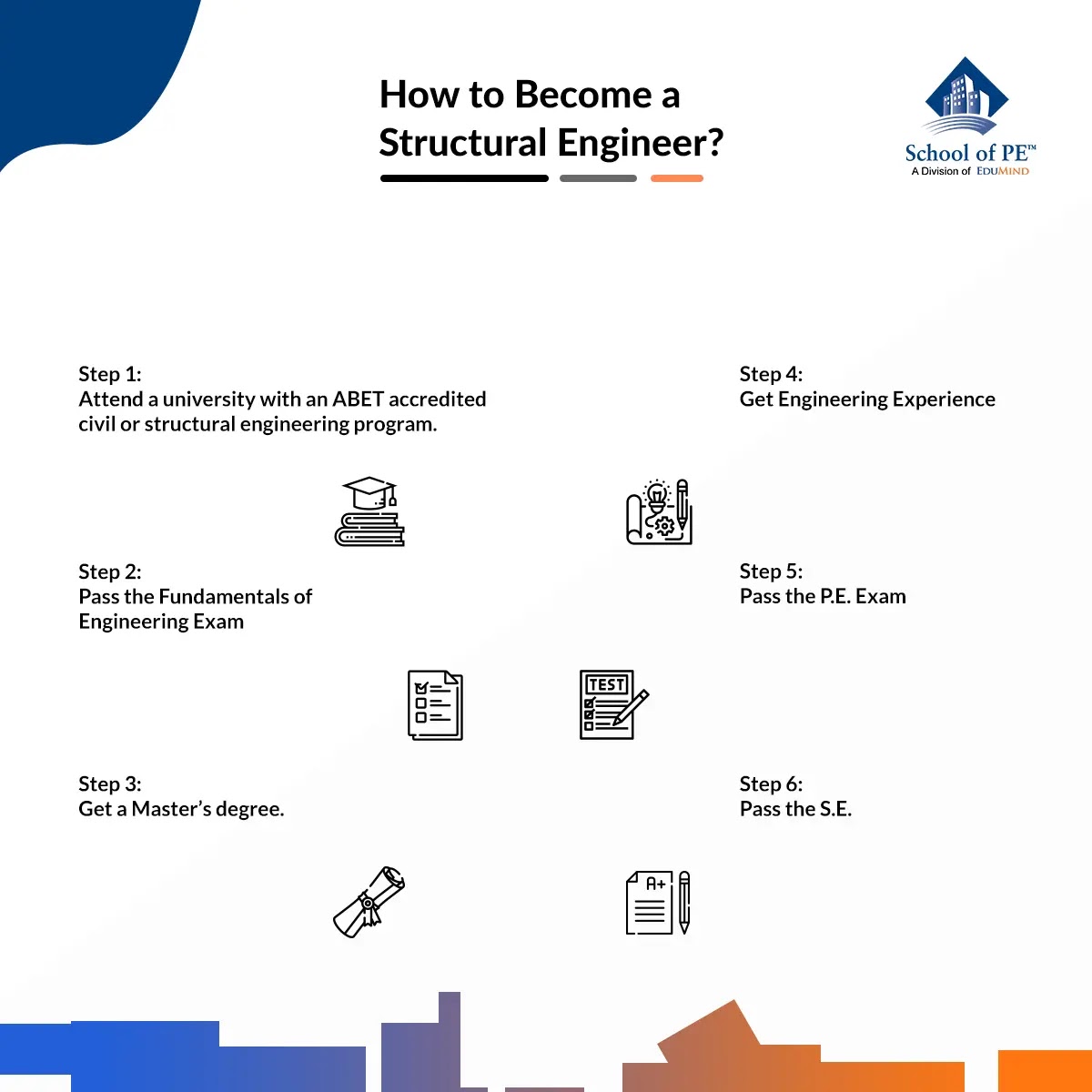
Step 1: Attend a university with an ABET accredited civil or structural engineering program.
NCEES will only approve an ABET accredited degree if you want to proceed with the licensing exams on the quickest timeline. If you go to a school that was not ABET accredited, you can still become a structural engineer, but you may need to wait longer and have more engineering experience before you can take the P.E. or the S.E. I know many engineers who completed their studies abroad or studied (non-engineering) physics as an undergrad - they are successful professional engineers, but their path to the becoming a structural engineer took a little more time and effort!
Step 2: Pass the Fundamentals of Engineering Exam
The Fundamentals of Engineering Exam (F.E.) is a six-hour exam that you are eligible to take in the final semester of your (ABET accredited) undergraduate degree. If you are eligible and able, take it at this stage! It covers a lot of information from courses you took in undergrad, that you, frankly, won't use much of once you graduate and start working. I recommend getting this one out of the way ASAP.
Step 3: Get a Master's degree.
This is becoming less or a requirement for many firms, but when I graduated from undergrad, most firms were only hiring students with a master's degree. My advice is to only get a masters right away if you are sure you want to pursue structural engineering. These degrees are not cheap! But if you do want to be a structural engineer, I highly recommend it. I learned so much in my master's program that prepared me for my career. As a bonus, your civil/structural engineering master's degree can be counted towards your "engineering experience" for the P.E. and S.E. applications. (More on that shortly)
How to Become a Structural Engineer?
Step 4: Get Engineering Experience
When you apply to take the P.E., you will need to prove that you have been actively working on engineering work under the responsible charge of a licensed P.E. The length of time required before the P.E. application will vary in each state. When I took the exam in New York State, the requirement was 4 years of experience, but one year could be a master's degree.
Step 5: Pass the P.E. Exam
The national eight-hour exam that is given twice a year, typically in April and October, that constitutes the "P.E." in most states. In those states, if you pass the exam, you are officially considered a professional engineer. (Hooray!) In California, there are two additional state specific exams which require an additional application (and, of course, fees). These are the seismic and surveying exams. Each are 2.5 hours long and are offered on a rolling basis. You cannot be considered a professional engineer in California unless you have taken these exams.
Step 6: Pass the S.E.
To be a fully licensed Structural Engineer, you must pass the exam called the S.E. The timing for this exam will also vary from state to state, so be sure to check in the state in which you are looking to apply. This exam is sixteen hours long, given over the course of two days. Similarly, to the P.E., it is offered twice annually, in April and October. The test is split in to two sections: vertical and lateral. Each section can be passed independently, meaning that if you pass gravity but not lateral, you don't have to take gravity again.
Hopefully that gives you some insight in to how to become a structural engineer. It is certainly a lengthy and challenging process, but you only need to focus on one step at a time, and as I mentioned, with experience and preparation, I'm sure you'll find each step attainable. Best of luck!

Thursday, 18 February 2021

What Is the Role of a Structural Engineer?

"I'm a Structural Engineer and I make sure buildings don't fall down". This is what I said at my daughters preschool on bring your parent to work day. In a nutshell, it's what structural engineers do. But in practice, the execution of that is quite a bit more involved.
Structural Engineers typically work in close coordination with owners, architects, other engineering disciplined professionals (civil/geotechnical), and specialized tradespeople. The owner is the one with the idea and desire to fund a construction venture and get something built. This can be a local utility company looking to build a new office building, an investment firm looking to build a new housing development, or an NFL owner looking to build a new football stadium. The owner will work with an architect to create a rendering or detailed set of drawings of the building and its features. The structural engineer and the architect work closely to take the building that has been drawn and analyze the forces that will act on in and design every element of the building.
What Is the Role of a Structural Engineer?
Using the governing jurisdictional design codes, a structural engineer will calculate and assume all of the expected forces that could possibly act on the structure. This includes: gravity loads, weight of the structure itself, live loads from occupancy, snow loads, lateral wind and seismic loads and any other potential load. These are combined into different loading scenarios and applied to the theoretical structure. Using tributary area methods and structural analysis, the distribution of forces is calculated for every element of the building. The load path is followed from the roof and exterior walls, to the floors of each level, to the connections to columns all the way down to the foundation, and into the ground. This is done either by hand or using computer models, depending on the complexity of the structure and loading. Once each member has a demand load both from the vertical and lateral loads applied, each member can be selected or designed based on the desired size and material specified by the owner and architect. Capacities for different common material types and shapes can be found in the respective code books. Every beam, column, bolt, weld, nail, concrete slab and piece of rebar are checked for sufficient capacity. For example, a residential wood framed, two-story building may have an open concept lower level. There are no columns or room dividing walls that can take the load of the second story. Large and deep timber beams may work to carry these loads, however, they will not fit within the thickness of the second floor so a more economical steel beam can be selected. Another example is the recently constructed Los Angeles football stadium was designed with a solid roof structure that could let natural light in. Specialized glass and a complex high tension cable system were used to create a safe roofing system that met the owner and architects vision.
On a design and construction project, the Structural Engineer can either be the prime consultant, who works directly with the owner, or the secondary consultant, who works for an architect that works directly for the owner. The responsibility and the function of the Structural Engineer is the same regardless of the contractual role and profit margin. Problems can by typical and easily solved or are extremely complex and require revolutionary building techniques with exotic material. The Structural Engineer at the end of the design phase is ethically responsible for ensuring that the anticipated loads have all been applied to the building and that each member is sufficiently designed so its capacity is larger than its demand. This ethical responsibility, coupled with the contractual obligation to make the vision of the architect and owner a reality are the main functions of a Structural Engineer.
About the Author: Alex Berlin

Mr. Berlin has worked in both the design and fabrication industries for 10 years. He has worked at Vigor (previously OIW) for 9 years. Previous experience includes work in commercial fabrication for the solar renewable energy sector, structural design for the commercial and power sectors and seismic analysis and rehabilitation. He holds a Bachelor's Degree in Structural Engineering from The University of California, San Diego. He holds a PE License in the State of Oregon.

Monday, 11 January 2021

What Is Structural Engineering and What Do Structural Engineers Do?

According to the Structural Engineering Association of California (SEAOC), "structural engineers create drawings and specifications, perform calculations, review the work of other engineers, write reports and evaluations, and observe construction sites." That's a long explanation and, to me, it means that there are a lot of opportunities within this specialized field. 
Structural Engineering is typical considered to be a subset of civil engineering, with a focus on structures. Structures can be buildings or bridges, but they can also be a little more out-of-the-box, so to speak. Many sculptures, monuments, billboards, and rollercoasters need to be structural engineered! 
It's easier to understand the many paths of structural engineering if you consider the lifecycle of a structure. For the case of this blog post, I'll use buildings as our primary structures of discussion. 
What Is Structural Engineering and What Do Structural Engineers Do?
1. New Design 
Every new building (with the exception of small family homes in most states...) needs to be structurally engineered. Typically, the owner hires an architect, and the architect will begin to set up his team. He'll need a structural engineer to produce structural drawings and calculations to give to the city for approval and then the contractor for construction. The freedom of the engineer in this role varies widely, but typically the architect will supply the structural engineer with architectural drawings and the engineer will design a structural system that works within the bounds set by the architect. This doesn't always move smoothly, so be prepared for many conversations discussing options and solutions! If you are a good problem solver, this is an ideal role. There is a lot of creativity in devising these solutions. 
2. Renewal/Retrofit/Restoration
During the lifespan of a building, it's likely that the building will change hands and the new owner will want to upgrade some systems. Or the original owner may just want to bring the building up to current code, potentially for seismic safety, but for many other reasons too. A structural engineer is commonly involved in these situations. These upgrades can be as small as installing new roof mechanical units and making sure the current roof can support the new load, or it may involve adding or removing existing elements of the structural system. Working with existing buildings also will appeal to problem solvers since you are frequently working within a strict set of existing conditions. 
3. Forensics
And then, there are times when buildings don't work as they should. The media programs us to automatically think of building collapses, but this type of work ranges from bouncy floor systems that make tenants uncomfortable to, yep, building collapses. This type of work requires a lot of out-of-the-box thinking because you typically go into the assignment with limited information and will need to use your detective skills to figure out what went wrong. This work is typically performed for lawyers or insurance companies who are seeking to understand the allocation of compensation for the damage. This type of work is good for those who are interested in putting all the pieces together. It typically requires a person who is willing to respond quickly to emergencies and potentially travel to the sites of the failure. 
As you can see there are many paths to take in structural engineering and they all involve problem solving, creativity, strong technical abilities, and communication skills. It can be a very fulfilling career for the right candidate! I've certainly enjoyed my career so far in this field.

Monday, 9 March 2020

How Online Learning Centers Can Optimize Student Learning

Online review courses are increasingly popular, especially for NCEES exam prep. In today's fast-paced world, people often feel they don't have the time or resources to attend an onsite course. 
If you are looking for an FE, PE, or SE online prep course, it's important to understand what each platform offers its students. It may seem overwhelming at first, but ensuring that the exam prep course you choose has the best features possible to optimize learning is vital to success. 
One important feature of online learning centers is the availability of study notes. Instructor-prepared notes not only give you something extra to study outside of class but also give you the ability to study anywhere, anytime by downloading and/or printing the notes. 
Attending an online class may be intimidating to some, but having access to lecture videos after a class has aired will help give you peace of mind in your exam prep journey. If you attend a live online class, chances are you might miss some details during the lecture. The ability to go back and review the class later can be very helpful. Bookmarking capabilities, the ability to fast forward, or make time-stamped notes are great features in an online Delivery Method. 
Online Delivery Methods that offer practice problems and solutions are also optimal for studying. Practicing engineering problems after a class or study session is a proven way to optimize exam scores, so why not take some time every day to quiz yourself? 
How Online Learning Centers Can Optimize Student Learning
Another important feature online learning centers should have is instructor availability. Personalized instructor interactions can truly enhance one's learning experience. When looking at online exam prep platforms, those that include accessibility to instructors (such as tutoring options or the ability to send questions to instructors) can greatly benefit students.
Sound too good to be true? Don't worry-it's not! In fact, School of PE's FE, PE, and SE exam review courses offer all of the above features. Visit www.schoolofpe.com to learn more.

Friday, 10 January 2020

Studying Tactics to Help Your Brain Retain Information When Preparing for an NCEES Exam

If you're preparing for an FE, PE, or SE NCEES exam, you've probably recently been searching for the best studying tips. 
Psychologically speaking, it's important to find tactics that help your brain retain information better or to learn concepts better. We've broken out 3 studying tactics and tips that will help your brain retain the information needed to pass your chosen NCEES exam: 
1. Quiz Yourself Prior to a Study Session 
It's common practice to test yourself after a study session to see what you've actually learned. While that is still a good practice, quizzing yourself before you actually start your study session is extremely beneficial. By quizzing yourself prior, you will be able to gauge what information you retained while not studying. The results of the pre-study quiz can also help determine what you need to focus on in that specific study session. Finding an online quizzing tool for an NCEES exam is a great way to quiz yourself prior to a study session. 
Quiz Yourself Prior to a Study Session
2. Switch Up Your Studying Environment 
Are you one to study in just one place? Perhaps at the same desk or at the same coffee shop? While familiarity may seem like a good thing while studying, studies have shown that studying in differing environments can actually help you psychologically. 
By changing your study environment periodically, you're allowing your brain to retrieve the same information, but in different environments. This helps program your brain that the information it is retrieving in different environments must be important. 

Switch Up Your Studying Environment
3. Avoid Long Study Sessions
If you're one to study hours upon hours at a time, your efforts may not be as rewarding as you think. You may think that by studying in large chunks, you are covering a large amount of material. This is true, but it's not likely that your brain can retain much information after you study for hours. In layman's terms, don't overload your brain! 
Instead of trying to cram information in a longer study session, try studying for only an hour at a time. In fact, neurologists found in a study that the hippocampus region of the brain encoded brain synapses much easier when a subject studied in smaller intervals when compared to a subject studied for hours at a time. 
Avoid Long Study Sessions
So, instead of studying for 4 hours at a time, for example, try studying one hour at a time with 20-30-minute breaks in between sessions. During your study breaks, take a walk, watch TV, or eat a snack- pretty much dedicate your break time to allow your brain to rest. 
For more FE, PE, and SE exam advice, make sure to check out our Facebook page for weekly tips. 

Tuesday, 7 January 2020

3 Tips on Maintaining a Good Life-Study Balance When Preparing for an NCEES Exam

Eat. Work. Study. Sleep.
Eat. Work. Study. Nap.
Work. Study.
Work. Study. Study. Study. Study.
Does the above scenario sound familiar? If you are preparing for an NCEES exam, we get that studying can take up a lot of free time. In fact, many students report studying for their FE, PE, or SE exams up to a total of 200 hours. That's a lot of time!
We get it. Passing an NCEES exam is extremely important for one's career. If you find yourself overwhelmed with studying and cannot find time for other important things such as socializing, eating a well-balanced meal, or exercising, your overall mental and physical health can be negatively affected. It's important to find a good balance to not only ensure you stay happy and healthy, but to also ensure optimal studying. 
To help fit studying into other activities to help give you more time for fun things, check out our list of ideas below:
1. Study at the Gym
If you find yourself sitting at a desk all day while at work and while studying, it's important that you get up and move. In fact, the American Heart Association recommends that everyone should exercise at least 150 minutes per week. 
A great way to study at the gym is to print out FE, PE, or SE course notes (or bring a tablet to the gym to view online) and jump on a treadmill or an elliptical.
Maintaining exercise will help your overall energy levels and keep you in-shape. Also, research has shown that exercising increases activity in the hippocampus, a region in the brain that stores and controls memory. 
Study at the gym
2. Create Notecards
Having study material that is easily portable is great for someone who is always on the go. Creating notecards is a great review in itself, as it forces you to write down concepts. If you do make notecards, you can squeeze study time while you're riding the bus, taking a coffee break, or review the deck right before you go to bed. 
If you work during the day, a great study strategy would be to take 5 minutes every hour to review some notecards.
3. Take an OnDemand Exam Review Course
3 Tips on Maintaining a Good Life-Study Balance When Preparing for an NCEES Exam
Whether you are taking an FE, PE, or SE exam, taking an online OnDemand exam review course allows you to study anytime and anywhere. By signing up for an OnDemand review course, you are able to watch recordings of course lectures at your own pace. Watch a lecture video while eating breakfast, while on the subway, or during your lunch break.

Monday, 2 December 2019

Holy Guacamole: 5 Brain Foods That Will Help You Study for NCEES Exams

Are you studying for an NCEES exam? Are you the type of person that eats tons of junk food while studying? We get it - salty snacks such as chips or sweet snacks such as gummy bears may seem like a great studying snacks, but they don't necessarily benefit you whilst preparing for the FE, PE, or SE exam. That's why it's important to understand what kinds of food help your brain while you study for exams. 
Eating specific food while studying can enhance brain functionality and promote better memory consolidation. Below are our top five favorite brain foods that we recommend to eat while studying for NCEES exams: 
1. Carrots: It's common knowledge that eyes can help improve eyesight. But did you know that carrots can help boost brain functionality? Carrots are rich in luteolin, a chemical compound that can help prevent memory degeneration. 
2. Avocados: Holy guacamole! Avocados are a great study food as they help promote blood flow in your brain. Avocados also have a large amount of potassium in them, which helps in the oxidation process of the brain. 
3. Garlic: Garlic is very yummy, but could easily ruin a romantic date night. No date? Eat as much garlic as your heart desires! Similar to avocados, eating garlic can help promote blood flow in the brain. 
4. Oatmeal: Making oatmeal is a great idea for early-morning studying during breakfast time. Oats have been found to decrease cholesterol which helps overall brain functionality. Oats are also thought to help promote alertness - which is great for both studying and exam taking. If you're wondering how oats can help with alertness, it's because the carbohydrates in oats. These carbs are broken down at a much slower rate than other kinds of carbs - therefore providing a consistent level of energy during digestion. 
Holy Guacamole: 5 Brain Foods That Will Help You Study for NCEES Exams
We of course recommend eating a well-balanced breakfast prior to taking an NCEES exam, so consider eating oatmeal as part of your pre-exam meal. 
5. Dark Chocolate: Who doesn't love chocolate? Even though we did mention earlier in this article that one should avoid sweet foods, dark chocolate in moderate amounts can actually help your brain. 
Dark chocolate is the healthiest of the 3 main chocolates (Dark chocolate, milk chocolate, and white chocolate). Dark chocolate has been found to have antioxidants in it - therefore promoting brain functionality by increasing blood flow.

Tuesday, 6 August 2019

Avoiding Exam Anxiety: FE, PE, and SE Prep Tips and Tricks

If you are preparing for an exam, you may have a good understanding of what pre-exam anxiety feels like. Studying for an exam can be extremely nerve-wracking, but it doesn't have to be! By ensuring you treat your body right by staying in shape and watching what you consume, many factors that cause anxiety can be avoided. We've listed some of our favorite tips and tricks to avoid FE, PE, or SE exam anxiety below: 
1. Exercise
We get it-it's sometimes hard to get motivated enough to exercise regularly. However, exercise can help you decrease your anxiety in various ways. One way, for example, is consistently exercising-a jog around the block, going to the gym, or doing a cardio workout in your living room. When you exercise, your levels of cortisol, a stress hormone, lowers. Your body also releases endorphins when you exercise. Endorphins are hormones that help regulate a positive mood. If studying for the FE, PE, or SE exam is exhausting, a nice workout session will help put you in a better mood!
Exercise
Bonus fun fact: Research shows that cardio workouts increase activity in the hippocampus, the part of the brain that consolidates memory.
2. Eat Anxiety-Fighting Foods
... And by "anxiety-fighting foods," we aren't referencing chocolate, ice cream, or any other sweet foods we get cravings for when we're down. Although sweets are the ultimate "comfort" food, they typically don't help physiologically with reducing stress or anxiety. 
What we really mean are foods that help regulate brain chemicals, hormones, and generally make you feel good. Check out some of our favorite food picks below: 
1. Salmon: This protein contains docosahexaenoic acid and eicosapentaenoic acid. Both of these omega-3 fatty acids regulate neurotransmitters serotonin and dopamine in the brain, which help you relax and stay calm.i 
2. Yogurt: This dairy product has been shown to promote overall mental health. It is believed to do so by inhibiting free radicals and neurotoxins, "which can damage nerve tissue in the brain and lead to anxiety"ii
3. Blueberries: This fruit contains a very high amount of vitamin C and flavonoids antioxidants, both of which have shown to reduce anxiety in numerous scientific studies.iii 
Avoiding Exam Anxiety
3. Decrease Caffeine Consumption
We all (or, well most of us) love a good cup of coffee. While some people enjoy the ritual of drinking a hot, steaming cup of coffee in the morning to begin their day, other people sip on multiple cups of coffee throughout the day.
Even though coffee provides a power-boost, it actually can be detrimental for emotional health. When a caffeinated beverage is consumed, such as coffee, a lot of things happen such as an increase of heart rate, an increase of blood pressure, and increase the secretion of stress hormones (hence the connection to anxiety). Within the actual brain itself, caffeine "hinders the calming neurotransmitter GABA, which puts the brain activity on hold when needed. GABA is married to happiness and relaxation, so it's no surprise that having a low GABA level can lead to anxiety and panic attacks."iv
Avoiding Exam Anxiety: FE, PE, and SE Prep Tips and Tricks
4. Sign Up for an Online Class or Tutoring Sessions
Studying for a big exam, especially one that will have a big impact on your career such as the FE, PE, or SE exam, is stressful to begin with. Did you know that there are resources out there to help you study for NCEES exams? From online classes to online tutoring sessions, having another individual help you through difficult engineering concepts will help decrease anxiety and increase your overall confidence and of course, will help you pass your FE, PE, or SE exam! 
References
i. Bjarnadottir, A. (n.d.). DHA (Docosahexaenoic Acid): A Detailed Review. Retrieved from https://www.healthline.com/nutrition/ dha-docosahexaenoic-acid
ii. Kim, B., Hong, V. M., Yang, J., Hyun, H., Im, J. J., Hwang, J., .. Kim, J. E. (2016). A Review of Fermented Foods with Beneficial Effects on Brain and Cognitive Function. Preventive nutrition and food science, 21(4), 297-309. doi:10.3746/pnf.2016.21.4.297 
iii. Xu, Y., Wang, C., Klabnik, J. J., & O'Donnell, J. M. (2014). Novel therapeutic targets in depression and anxiety: antioxidants as a candidate treatment. Current neuropharmacology, 12(2), 108-119. doi:10.2174/1570159X11666131120231448
iv. This Is Why Coffee Makes You Anxious And How To Stop It. (n.d.). Retrieved from https://www.deathwishcoffee.com/ blogs/news/caffeine-and-anxiety

Monday, 29 July 2019

Practicing Problems for PE, FE, and SE Exam Shown to "Get Brain Juices Flowing"

Is practicing problems for your FE, PE, or SE exam part of your study plan? You may spend time attending online lectures, reading, and making notes in your reference material, but studies have shown that merely reviewing material won't cut it for a thorough exam preparation. 
You've probably heard the phrase "Get those brain juices flowing.." and it makes sense that the flowing of said "brain juices" would be beneficial in studying for the FE Civil, PE Mechanical, or SE Vertical exam, right? So, what is the best way to promote information consolidation? Our answer: Practicing Problems.
Actually practicing a set of problems may seem simple enough, but psychological studies have proven that there is a lot of science behind what makes practicing problems effective. In fact, practicing has been found to be one of the most effective techniques for studying because of the boost in cognitive functionality when doing so.
How Research Supports the Claim of Practicing Problems in Accordance with Brain Functionality 
A study done by Tufts University does show the correlation between practicing problems for an exam and the increase of brain power/ memory consolidation. Researchers time matched two groups of participants: participants who merely studied without practicing problems and participants who used practice problems as part of their study methods. According to Amanda Smith, a psychology graduate who worked on the research project, those who actually practiced problems during their study sessions performed much better on their exams when compared to the other group. "It's not a matter of how much or how long you study," she said, "it's a matter of how you study."i
So why does practicing problems help in preparing for an exam? Though there are many factors that can come into play, actual physical changes in the brain that are caused by practicing can be attributed towards the positive results. 
According to Annie Bolser and Don Greene, who spoke on the subject matter in a TED-ED presentation, practicing something over and over can change the physical structure of your brain. 
When practicing something, such as practice problems for an NCEES exam, myelin begins to build up around axons in the brain, thereby improving overall insulation. Scientists and neurologists believe that the extra insulation that myelin provides can increase overall axon functionality. As axons are responsible for sending electrical signals throughout the brain, it makes sense that the extra insulation can increase brain functionality and even help an individual to recall information quickly in an exam environment.ii 
How We Can Help Get Those Brain Juices Flowing
If you're looking to take an NCEES exam in the near future, we can get your brain juices flowing by assisting you in our FE, PE, or SE exam prep courses. Our courses include practice problem and solutions sheets, so you can sufficiently prepare for your chosen exam (and grow some myelin)!
References:
i Thomas, A., & Smith, A. (Researchers). Practice makes perfect: Learning by taking practice tests protects memory against stress [Video file]. Retrieved from https://www.youtube.com/watch?v=pDIqEui5mpQ
ii Bosler, A., & Greene, D. (Educators). How to Practice Effectively [Video File]. Retrieved from 

Monday, 20 May 2019

The Transition to CBT Exams

Let's take a look into the past, the early-mid 1970s when the scantron was first developed. If you were in grade school or college proceeding the 1970s, you probably remember the stress scantrons caused-ensuring your #2 pencil completely filled in the bubble of your corresponding answer to a question, for example, or (the most stressful) hoping that the bubble you attempted to erase was in fact completely erased. 
Although the scantron completely revolutionized exam-taking and scoring in earlier years, technology continues to rapidly evolve, therefore causing the scantron to slowly lose its popularity. In our case, that statement is especially true for the National Council of Examiners for Engineering and Surveying (NCEES). 
The last few years, you've probably heard the term "Computer-Based Testing" or "CBT" tossed around regarding NCEES examinations. Since 2011, NCEES has been slowly transitioning its exams away from scantron technology for an even more streamlined administrative and scoring process. Beginning with the Fundamental of Engineering (FE) and Fundamentals of Surveying (FS) exams, NCEES has already transitioned a handful of examinations to the CBT format. 
Wondering what a CBT exam really is and what it means for you as an NCEES examinee? If your exam has already transitioned to the new format, you will be taking your exam on (you guessed it!) a computer. CBT exams can be taken at any NCEES-approved testing center based on your schedule (granted, some smaller exams are offered on a limited, scheduled basis). 
So far, the following exams have transitioned over to the CBT format: 
According to NCEES, below are the estimated times of the remaining transition periods: 
Exam
Transition Year
2020
2020
2020
2020
2020
PE Agricultural and Biological
2021
PE Electrical and Computer: Computer Engineering
2021
2021
2021
PE Mining and Mineral Processing
2021
2022
2022
PE Metallurgical and Materials
2022
PE Naval Architecture and Marine
2022
2023
2024
If your chosen exam is a ways from being transitioned, your exam will be administered via the paper and pencil method (aka using a scantron). Exams will also be held only in April and/or October each year, depending on the type of exam. Because those exams are administered using scantrons, they will only consist of multiple-choice questions and do take some time to be scored. For most PE exams, for example, scantron scoring takes approximately a month.
As CBT exams are logistically easier to manage and score, CBT exams have differing question types throughout. These questions are called Alternative Item Type (AIT) questions. AIT questions feature multiple formats including drag and drop questions, fill in the blank questions and questions where multiple correct answers are selected. According to NCEES, those taking the computer-based exams should expect 10 percent of the questions to be AITs, and the remaining questions will be in the traditional multiple-choice format.