The Golden Gate Bridge is an iconic symbol that stands tall and majestic in the skyline of San Francisco, captivating visitors with its grandeur and engineering marvel. Engineers in the past and present have graced humanity with many wonders through sheer ingenuity and creativity, but this iconic bridge stands out. This blog aims to inform and describe the fascinating story behind the construction of this renowned bridge, its purpose and design, the struggles faced during its building process, and the individuals involved in its creation.
History
In 1916, James H. Wilkins, a structural engineer, made the first serious proposal for a bridge across the Golden Gate Strait, connecting the city of San Francisco to Marin County, California. Wilkins' proposal was not new: the concept of a bridge spanning the Golden Gate had been discussed since Charles Crocker's call for a bridge in 1872, but plans had been disrupted by the Great 1906 San Francisco earthquake.
Wilkins' campaign caught the attention of San Francisco City Engineer Michael M. O'Shaughnessy. The city officials formally requested O'Shaughnessy to explore the feasibility of such a bridge in August 1919.
O'Shaughnessy then went off and consulted various engineers across the United States for their opinions on the feasibility and cost of the project. Many engineers believed that building a bridge that expansive would cost well over $100 million and deemed it impossible. However, Joseph Baermann Strauss stepped forward with a different view. He not only believed that constructing the bridge was feasible but also estimated that it could be built for $25 to $30 million (Anagnos & Sheppard, n.d.).
On December 4, 1928, the Golden Gate Bridge and Highway District was formed, and on August 11, 1930, all authorizations and permits were finalized. By 1937, the 1.7-mile-long bridge was finally completed $1.3 million under budget (U.S. Department of Transportation, n.d.).
The bridge held the world record for the longest suspension span for 27 years.
Purpose and Significance
The primary purpose of constructing the Golden Gate Bridge was to provide an accessible transportation route for both vehicular and pedestrian traffic between the city of San Francisco and Marin County. Before the bridge's completion in 1937, crossing the Golden Gate Strait was a time-consuming and risky endeavor, often relying on the use of ferry services to get across. The bridge's completion enhanced travel in the San Francisco Bay Area, significantly reducing commute times and enabling enormous economic growth in the region.
Engineering
1. Tower Height and Cable Tension
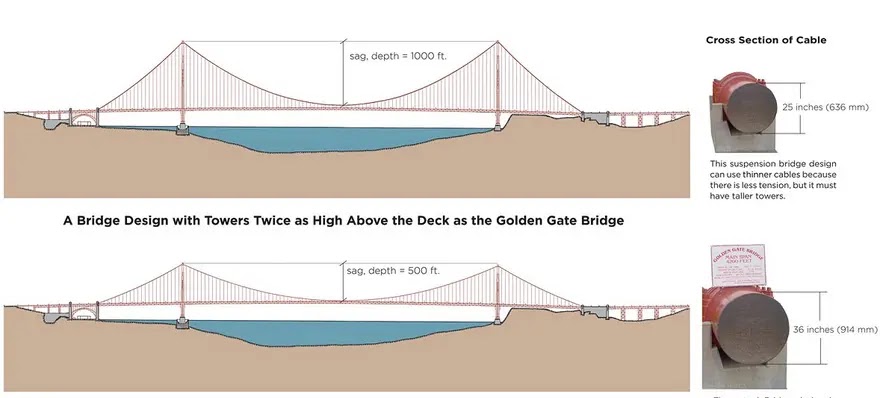
Engineers faced a critical challenge in the design of the Golden Gate Bridge, needing to strike a balance between tower height and cable size. One consideration was reducing the tension force in the cables and cable size, which could be achieved by constructing taller towers (Figure 1) (Anagnos & Sheppard, n.d.). However, opting for significantly taller towers presented a more complex and costly design alternative.
In an effort to address this challenge, engineers utilized galvanized carbon steel wire for the cables. This choice allowed for a strong and durable cable system while maintaining a practical size. Galvanization, a process that involves coating the steel cable with a protective layer of zinc, enhanced the cables' resistance to corrosion, extending their lifespan and ensuring the bridge's long-term structural integrity.
Below is one of many equations that were used to calculate the tension and compression arches in the bridge. Equation 1, a parabolic formula, is used to calculate the shape of both the tension and compression arches:
y = kx2 (1)
Noted in the construction of this suspension bridge is a prominent sag; the sag of the suspension cable controls the stability of the bridge and ensures equal weight distribution across the bridge.
Figure 1
To learn more about bridge cable tension and math equations utilized for the project, you can visit
this website.
2. Understanding the Aerodynamics of Bridge Deck
The stability of a suspension bridge in strong winds is determined by factors such as the weight, torsional stiffness, and the shape of its cross-section. Even subtle changes to the cross-sectional shape can have a significant impact on the bridge's stability.
This was exemplified by the collapse of the Tacoma Narrows Bridge in 1940. On a moderately windy day, the bridge collapsed due to its cross-sectional shape's inability to withstand the wind forces. A scale model of the collapsed Tacoma Narrows Bridge is compared to a modern design in another model. Both models have similar stocky cross-sections in terms of height and width. However, when exposed to wind, the model of the Tacoma Narrows Bridge twists violently, while the model with a stable cross-sectional shape remains relatively unaffected by gusts (Anagnos & Sheppard, n.d.).
The Golden Gate Bridge applies the modern aerodynamically designed bridge (Figure 2) for the deck to stabilize the bridge.
Figure 2
3. Counteracting Torsional Forces by Bracing System
Engineers have long grappled with the issue of excessive movement in modern suspension bridges, dating back to their invention in the early 1800s. The Golden Gate Bridge faced a similar challenge during a storm on December 1, 1951, when it experienced significant twisting and vibrations that resulted in minor damage. As a response, the bridge underwent retrofitting from 1953 to 1954. The retrofitting involved the addition of new bracing, which connected the two steel trusses supporting the roadway deck (the right-hand side of Figure 3). This modification notably enhanced the bridge's torsional stiffness, reducing the extent of twisting during adverse weather conditions (Anagnos & Sheppard, n.d.).
Figure 3
For more engineering aspects, you can find it
here.
Cost
The contract awarded through a successful bidding process offers a detailed breakdown of the cost, as illustrated in Figure 4 (Loomis, 1958, p. 133). Subsequently, in Figure 5, we will present the ultimate expenditure incurred for the construction of the bridge (Loomis, 1958, p. 189).
Figure 4
Figure 5
Conclusion
The Golden Gate Bridge stands as a testament to human ingenuity, engineering prowess, and determination. From its conception by Joseph Strauss to the collaboration between Charles Ellis and Irving Morrow, the bridge's design and construction represent a remarkable achievement in the field of civil engineering. Despite facing challenges during its construction, the Golden Gate Bridge now serves as an enduring symbol of San Francisco and a testament to the power of human endeavor.
Curious about becoming an engineer yourself? Check out School of PE's
FE and PE exam review courses, all of which can help you on your journey to professional licensure.
References
Anagnos, T., & Sheppard, S. (n.d.). Suspension Cable Tension vs. Tower Height - Exhibit Area 4 | Golden Gate. Golden Gate Bridge, Highway and Transportation District. Retrieved May 22, 2023, from https://www.goldengate.org/exhibits/suspension-cable-tension-vs-tower-height/
Loomis, R. T. (1958, October). A Dissertation Submitted to the Department of History and the Comittee on Graduate Study of Standford University. https://www.goldengate.org/assets/1/6/loomis_dissertation_1958.pdf
U.S. Department of Transportation. (n.d.). Golden Gate Bridge Fact Sheet. Retrieved May 31, 2023, from https://www.fhwa.dot.gov/candc/factsheets/goldengatebridge.pdf
About the Author: Khoa Tran
Khoa Tran is an electrical engineer working at the Los Angeles Department of Water and Power and is currently pursuing his master's in electrical Power from the University of Southern California. He is fluent in both Vietnamese and English and is interested in outdoor activities and exploring new things.


 FE Courses
 PE Courses
 SE Courses
 Continuing Education
 Pmp Courses
 Corportate Training