Friday, 25 February 2022

Passing the Civil-Structural PE Exam on the First Try:

The Organized Way
After reading this short blog, I am confident you will have the guidance necessary to pass the Civil-Structural PE exam on the first try - it worked for me! Two-hundred eighty-three hours and twelve minutes over one-hundred eighty days may sound like a lot of studying, but it only accounts for 6.5% of my time spent during that period. However, it takes much more than brute force, nose-in-the-books studying to pass the exam; let's get into the specifics.
1. The Courses:
First, I took the School of PE's "OnDemand" and "Live Online" courses. At the time I registered (early), I got a discount on bundling the two. The first four months of my studying I utilized the "OnDemand" sessions while the last two months I took the "Live Online" courses.
The "OnDemand" courses were most useful to organize my notes, book, resources, and materials since I could pause or stop the lectures at any time and pick them back up as my schedule allowed. Listening to the lectures at my own pace was a fantastic way to review and learn the material while, at the same time, prepare my resources for the PE exam.
The "Live Online" classes are where I spent time soaking in information, asking questions, retaining information, finalizing my notes, and homing in my problem-solving skills. During the time I took the "Live Online" courses, I spent less time organizing and more time learning and solving practice problems with the class and through the School of PE quizzes.
One may ask, "It really took 283.2 hours to take the School of PE classes?" Technically, no. But the answer a first-time passer should say is, "Yes!" Let me explain.
2. The Time:
Tracking the time I spent studying was critical to my success - setting realistic goals each week/month maintained my self-motivation. Tracking time by day, week, and month may sound like a lot, but it merely takes seconds before and after you sit down to study. Being the nerd I am, I liked to watch my graph grow as time went on (see Figure 1); it kept me in check, focused, and determined to make my time well spent in the end. I counted all studying: reading, listening to lectures, practice problems, coffee breaks (lots of those), and especially tabbing.
Study Time
Figure 1: My Study Time
3. The Notes:
Ten 3-ring folders and ten textbooks were lugged around in two suitcases to the exam room. Honestly, I used every single one of these resources. The School of PE notes each had a binder per class and separate binders for practice problems relating to structures (see Figure 2).
This method of organization made it easy to locate the exact folder I needed for the question at hand. During the first half of the exam, I had all the binders very accessible. Then, during the second half, I shuffled them around making the structural, geotechnical, and constructions binders easy to access and the others out of the way.
Sorting the notes in this fashion was extremely valuable! However, this was not the most important organizational method; the most useful, valuable, and time-saving organizational method was within each binder.
Notes
Figure 2: My Notes
4. The Tabbing:
Tabbing was the number 1 most helpful way to pass the Civil-Structural PE Exam on the first try. During the exam, I knew exactly where to find any topic in my notes, books, and references. During the "OnDemand" months of my studying, I would pause the lecture at every new section to tab it on the top. Then, within that section, I would tab other important items on the side using the same color (see Figure 3). Because I organized my notes and books in this fashion, I was quickly able to locate the general topic, then the specific subject within that topic. Here's an example:

Tabbing

Figure 3: My Tabs

1. A question related to concrete beam moment design appears on the exam
2. I locate my Structures and Materials folder (Breadth or Depth depending on which half of the exam I am taking)
3. Using the tabs on the top, I locate Concrete Design
4. Then, using the tabs on the side, I locate Moment Design
5. After a quick review of the material, solve the problem
Taking the time to tab your resources yourself in a way you best understand allows for rapid question answering on the exam. Without tabbing, I would have easily run out of time on both the morning and evening half! Once a binder was fully tabbed, I took it to the test in practice quizzes and exams.
5. The Quizzes:
Taking the School of PE practice quizzes allowed me to discover areas I was weakest in and learn topics that may not have been discussed in the online courses. Being able to create your own quizzes based on topic, difficulty, and number of questions made it extraordinarily easy to practice at my own pace. I decided to do 100% of the structural questions, 100% of the construction questions, and all or just over half of the other topics. I would sometimes run a quiz for 5 questions of easy difficulty while my dinner was cooking, or 2 questions of hard difficulty on my lunch break.
Since the quizzes are not timed, if I answered a question incorrectly, I would spend time reviewing the solution provided, tabbing my resources for any new/valuable information or charts, and finally solving the problem on my own. Because I answered the question incorrectly, it would eventually show up on another quiz I would take, and this time I would know where to look and how to solve it.
6. The Practice Exams:
Practice exams were a monumental step in my confidence level before taking the exam. I took the School of PE practice exams as well as other paper-back versions I purchased. I ensured both were timed just as the real exam would be. Like the practice quizzes, I would review the solutions to any that I answered incorrectly and then resolve the problem making any special notes on the side.
The best part about the practice exams was that I could take them to the exam as a reference! Several of the questions on my practice exams showed up on the real exam with a few minor changes: asking for one variable instead of another, changing the scenario a bit, or just switching some values around. Since I spent the time solving each practice exam, it was obvious when a question on the PE exam was similar to one I have solved before - these questions were my favorite!
7. The Exam:
The PE Civil Structural exam is broken into two halves: the first being civil engineering breadth (all subjects), and the second being the structural depth. For both halves of the exam, I utilized the same organizational technique. I was skeptical at first thinking, "Isn't this going to take up some of my precious time?!" But, after utilizing it, the true value was very apparent.
As soon as the proctor permitted us to begin, I looked at each question on the exam for several seconds. I would write next to the question a number with a circle around it assigning it a difficulty level as follows:
1. This question is very easy: I don't even need reference material to solve it
2. This question is easy: I know exactly where to look in my notes/books to solve it
3. This question is tough: I know where in my notes/books this topic may be
4. This question is very tough: I have never seen this before; I will have to dig into a book
Once all the questions were marked (which only took a few minutes) I quickly answered all the 1's and 2's, solidifying correct answers. Then, I began to work on the 3's and skipped any that should have been marked a 4 after I started solving. Finally, I would begin working on the 4's making sure I answered each question (since incorrect answers do not hurt you, educated guesses are worth it if time is running out).
Because my training with the School of PE was so beneficial, there were zero 4's on the first half of the exam for me. And I was able to take the test twice in the allotted time with 20 minutes to spare. Yes, I took the test twice to make sure I got the same answers both times. And yes, I found a few mistakes.
The second half of the exam was a different story. No amount of studying can go over all Civil-Structural engineering. I had six questions marked as 4's and a few marked as 3 that should have been 4. With 15 minutes remaining I had four questions remaining. With 5 minutes remaining I had two questions remaining. Finally, I answered the last question with half of a minute remaining. The good news: I left the exam knowing I passed.
8. The Conclusion:
Passing the Civil-Structural exam on the first try is not an easy task. It takes preparation, concentration, organization, and confidence. Taking the time to prepare yourself is just as important as preparing your resources. Because in the end, the time does not stop ticking and you want to be sure you answer each question. Most of us have the skills and tools to pass the exam, but doing it before the proctor says, "Pencils down" is a more difficult feat.
About the Author: Brian Huttner

Brian Huttner is a licensed professional engineer for Tindall Corporation, Virginia, who designs precast concrete structures, components, and connections. He received his Associates degree in Business Administration from New River Community College (2012) and his Bachelor of Science in Civil Engineering from Virginia Tech (2015). In his spare time, he enjoys being a husband and a father in a loving household of 9 animals including cats, dogs, birds, and a turtle.

Friday, 18 February 2022

PE Civil-Structural Exam: Tips, Tricks, and Trips

The Civil-Structural PE exam can be tough, but with these tips, tricks, and trips you will have a better shot at becoming the professional engineer you aspire to be. How do I know these suggestions will help? Number one, they worked for me; and number two, they can't hurt! Breaking your PE exam journey into four "seasons" is where we will begin and where we will end is for you to decide!
You just signed up to take the Civil-Structural PE exam and you are not sure you're ready or, even worse, you're not sure you know how to get ready! Those are the shoes I was wearing the day I started preparing to prepare. Thus began the first season: Preparation Paradise. That leads into the second season: T-Minus 24 Hours. Shortly thereafter, season three begins: Examination Exhilaration. Finally, enter the final, and most joyful, season: Celebration and Relaxation. Each season has its own tips, tricks, and trips to take advantage and beware of. Let's begin.
PE Civil-Structural Exam:  Tips, Tricks, and Trips
Season 1: Preparation Paradise
This can be the longest or shortest season depending on your strategy. The first trip to avoid is not studying at all and trusting your current knowledge and skill level. You want this season to last the longest, producing the most fruit and giving you the tools and skills to pass your exam with confidence. Personally, I set aside 180 days for this season (6 months). I would not recommend much longer because you are more likely to forget anything that is older than 6 months in your memory banks. Giving yourself time to learn, study, and practice at a comfortable yet demanding pace is critical. And that all began with signing up for School of PE's OnDemand classes (bundled with the Live Online classes).
The OnDemand courses were perfect to start out with; I could print all the notes at my own pace, listen to lectures at my own pace, and work on practice problems at my own pace. Beware, do not watch lectures when you're sleepy - I tried overcoming exhaustion and it was more harmful than good. I tracked my study time day-to-day setting a goal that would allow me to finish the OnDemand courses a week or so before the Live Online courses began. During that interlude, I was able to comb through the material a few times, finalize my tabs, become familiar with my textbooks, and take a short mental vacation. The most important and helpful task I did during the OnDemand courses was tabbing my notes exactly how I wanted to: color-coordinated, a binder per subject, tabs on the tops of pages for broad categories, and tabs on the sides of pages for specifics. Tabbing my books was less complicated since I decided to only tab chapters/subjects for easy reference.
Before the Live Online course begins, you should be sure you have all the books you plan to have on exam day and all your SOPE notes printed (and hopefully tabbed already). This way you can focus on the lecture, dive into the practice problems, and ask relevant questions that will help you and your classmates during class. It is highly recommended to have your notes tabbed at this point because there is no pausing the videos and you'll fall behind if you are stopping to tab every few pages - don't trip. However, if you do not take the OnDemand, the lectures are available after the live date, and tabbing could be done later.
Exam day is looming, and you've obtained a lot of knowledge and gathered new tools to attack and defeat your exam. But are taking the courses and organizing your notes and book enough? Maybe. But do you want to walk into the exam room thinking you may pass the test? Or would you walk in there knowing you're going to be successful? I'd say the latter option is preferred. So, take a month to do as many practice problems as you can. Whether they be practice exam books, practice exams through SOPE, practice quizzes through SOPE, or some other means of practice quizzes - this will be the hardest hitting preparation you'll do. You'll learn very quickly what you are good at and what you are not-so-good or quite bad at. I remember I set up a quiz through SOPE and answered all the questions incorrectly. Study the solutions, take additional notes, bring the solutions with you on exam day, and be ready to see a question nearly identical to one you've already solved; I had several of them!
You are down to the last weeks and your notes are in order, your books are tabbed, you've solved practice problems, and finished practice exams and quizzes but have you become familiar with your textbooks? You've worked through the notes twice now, but only referenced your textbooks a handful of times (exactly how my experience was). Spend some time in the final stretch becoming familiar with how each textbook is organized, how the index is sorted, and how to navigate the pages to come to a topic or equation you'll need on the exam. ASCE, AISC, ACI, PCI, IBC, ASSHTO, NDS, and others are all sorted differently, and knowing your way around the book (in general, don't read them cover-to-cover) will help on the exam.
It is one week until your exam and you are fully prepared, right? Have you driven to the test site? Have you driven to the test site at the exact day and time you plan to on test day? A major trip would be to map out your route on a Monday evening only to find out it takes twice as long on a Friday morning when you drive to your test. Do a test run - wake up early exactly 1 week before your test, go to the place you plan to get breakfast, park at your test site, walk inside, and locate the room you will be testing in. If your test were today, would you be late, early, or right on time? I'd suggest arriving on the early side. Maybe not as early as me, being the first one there was not worth the two hours of thumb-twiddling.
Season 2: T-Minus 24 Hours
Don't study the day before the test. If you've followed all the tips and tricks (and not the trips) up to this point you don't need to. Get your bag/s packed, relax, do something fun, and eat/drink well to ensure you are healthy for the day to come. This season is short, stressful, and sensitive. I tripped during this season by not realizing how many resources I was bringing - they didn't fit in the bag I was going to bring! Suitcases work well, backpacks are decent, and many people used boxes on a dolly. I'd recommend bringing all your notes and books (of course), earplugs (to get yourself into the zone), two approved calculators (that you are familiar with!), a sweatshirt (AC could be out of order), and a straight edge (in case you don't have time to interpolate, and a graph is provided).
Be confident on this day. Double-check your bag/s, pack your vehicle, and enjoy the rest of the day. Tomorrow begins a new season and you are fully prepared to come out victorious.
Season 3: Examination Exhilaration
Your vehicle has all your tools in it, your mind has all the skills, and you've driven the route before in these exact conditions. You're ready. Make sure to eat a good breakfast and arrive at the testing site early with the items you need (ID, testing papers, etc.). As you walk into the testing room and to your seat, take inventory of the space you are provided for yourself and your references. It is important for the morning half of the Civil-Structural PE exam to have all subjects accessible. I decided to have all books in a suitcase on my left and all notes in a suitcase on my right; it was easy during the test to find whatever it was that I was looking for. Listen and follow the instructions given and as soon as you open the exam do not answer the first question...
The first thing you should do (and I thought everyone was crazy who suggested this to me) is rank each question 1-4 based on personal difficulty. You know your strengths and weaknesses: use this to your advantage! Quickly read each question and write the number you decide with a circle around it on the corner based on the following:
  1. This question is very easy: I don't even need reference material to solve it
  2. This question is easy: I know exactly where to look in my notes/books to solve it
  3. This question is tough: I know where in my notes/books this topic may be
  4. This question is very tough: I have never seen this before; I will have to dig into a book
Once all the questions are ranked, start solving all the 1's - well, you got all those correct. Now, work on the 2's - pretty sure all of those are correct also. Start working on the 3's; some of these may be harder than you thought. If that is the case, mark them as a 4 and move on. Finally, start chipping away at the 4's; if a 4 is taking longer than 10 minutes move on. Once you have answered all the questions that you could solve, see how much time is remaining. Remembering that you may not have answered a few 4's you'll want to come up with a plan:
i) If you have ample time: take the test again! This is what I did, and I caught a few "silly" mistakes. Before time runs out, be sure to give those few 4's your best shot and select an answer.
ii) If your time is running low: select the best answer for those few remaining 4's and double-check as many 2's and 3's as you can.
The same technique should be used on the evening exam, but I can assure you that there will not be enough time to take the test over again. This portion of the exam will have more 4's and 3's than the morning half and may take you to the last 30 seconds to answer that last question. "Pencils down." Time for the final season.
Season 4: Celebration and Relaxation
Drive home excited, you passed (if you followed these tips and tricks). Set up a day to celebrate with your parents, a loved one, a friend, or a colleague. Let all the stress evaporate off your shoulders and await your results (even though you know what it is going to be). If you avoid the trips while following these tips and tricks you can change your email signature to "P.E." before you know it! Best of luck.
About the Author: Brian Huttner

Brian Huttner is a licensed professional engineer for Tindall Corporation, Virginia, who designs precast concrete structures, components, and connections. He received his Associates degree in Business Administration from New River Community College (2012) and his Bachelor of Science in Civil Engineering from Virginia Tech (2015). In his spare time, he enjoys being a husband and a father in a loving household of 9 animals including cats, dogs, birds, and a turtle.

Friday, 11 February 2022

The US Professional Engineering Licensure vis-a-vis engineering registration across the globe

Background
After I published my blog The Historical Evolution of Professional Engineering Licensure..., I was asked "how is the profession of engineering regulated in other parts of the world?" This query set me on a mission to investigate the subject of engineering registrations across the globe.
Documenting this for every country in a blog is beyond scope, therefore, I will distill the information and present it for the countries that do this process differently than how we do it in the USA. This has led me to learning about the registration and licensure process pursued in countries like India, Sri Lanka, Pakistan, Germany, and the United Kingdom. As a bonus, I subsequently discovered that these five countries together contribute to more than half of the world's total annual production of engineers! This provided a sheen of completeness to this study.
As stated in my blog, "the practice of professional engineering in USA is highly regulated and the title 'professional engineer' is legally protected." Each state assumes the authority to formally grant a professional engineering (PE) license to an individual. This professional engineering license in the USA is by and large obtained by fulfilling the following four requirements:
  • Obtain a four-year Accreditation Board for Engineering and Technology (ABET)-credited college/university degree in engineering.
  • Complete the Fundamentals of Engineering (FE) examination administered by the National Council of Examiners for Engineering and Surveying (NCEES) and qualify oneself as an Engineer-In-Training (EIT).
  • Accumulate the specific years of engineering experience in the chosen engineering discipline for which the PE license is being sought.
  • Pass the Principles and Practice in Engineering (PPE) examination administered by the NCEES.
It is interesting to note that of all the countries surveyed, Iran has adopted the above USA (NCEES) model for PE licensure to a T. Iran's NCEES equivalnt, the National Organization for Examinations and Training (NOET) (referred to as Sanjesh in Persian) conducts the FE and PPE examinations. The only variation is that the licensure of the PEs is governed centrally by Iran's Ministry of Science, Research and Technology, whereas in the US, PEs are registered by individual states. Mohandess Payeh 1 and Mohandess Payeh 2 are the equivalent titles used for PE and Engineer-in-Training (EIT), respectively1.
Trivia: Iran is among one of the ten largest producers of engineers per year in the world, 70% of whom are women.2.
Professional Engineering Registration across the Globe
The US Professional Engineering Licensure vis-a-vis engineering registration across the globe
1. India
In India, engineers with a bachelor's or master's degree in engineering or technology from a university are allowed to practice as consulting engineers. However, to submit public plans and drawings for approval and documentation, the consulting engineers must be licensed or registered or chartered with respective municipalities, regardless of their disciplines or area of practice.
The Institution of Engineers (India) (IE)(I) was granted the British Royal Charter in 1935 by which the aforementioned degreed engineers and any Life Corporate Member of the IE(I) can be admitted as a Chartered Engineer (CEng) (India). A special certificate specifying as CEng (India) can be obtained by India engineers and engineers from other countries with the payment of appropriate fees.
The IE(I) also offers registration as a Professional Engineer (PE) (India) and international professional engineer (PE (Int'l) to member-engineers having seven years of active experience post-academic degree.
2. Sri Lanka
In Sri Lanka, engineers holding engineering degrees from college/university accredited by the Institute of Engineers Sri Lanka (IESL) and with adequate training and experience are eligible to become Chartered Engineer in Sri Lanka (CEng (SL)). IESL, the apex body of engineering in Sri Lanka, awards credentials such as the CEng (SL), which enables one to practice as a licensed engineer in the country.
The title "engineer" is not regulated. However, per the Engineering Council Act No. 4 of 2017 (Act), all engineering practitioners in Sri Lanka need to be registered with the Engineering Council of Sri Lanka to practice. Failure to register with the Engineering Council will result in punitive damages that includes fines and prison time. Additionally, the Act prevents foreign qualified engineers from engineering practice in Sri Lanka3.
3. Pakistan
In Pakistan, engineering is regulated at the federal level by the Pakistan Engineering Council (PEC) via the PEC Act 19764 and the subsequent PEC Continued Professional Development (CPD) Bylaws 2008 (CPD 2008). Thanks to the CPD 2008 law, starting July 2010, the graduate engineers would follow the US model of requiring the passing of Engineering Practice Examination (EPE) (equivalent to the NCEES' PPE examination), preceded by at least five years of relevant work experience and accumulation of at least 17 CPD points (in lieu of the NCEES' FE examination) 5.
The PEC has introduced a progressive and balanced CPD points system, which encourages participation in CPD activities that will further work experience like guest lectures, publishing research, authoring books, and charitable engineering work over and above on-the-job experience.
4. Germany
In Germany, the award of the academic title Dipl. Ing signifies the completion of the academic engineering education-but not the license to practice engineering. Dipl. Ing does not confer licensing by the government and therefore is not equivalent to the steps of licensing (i.e., references, work experience and written examinations) conducted in countries like USA, UK, or Iran. However, the designation Dipl. Ing is recognized by FEANI and as the prerequisite for registration as Eur Ing.
The international organization with headquarters in Germany - Federal Association of Higher Professions for Technology, Economy and Design (Bundesverband hoherer Berufe der Technik, Wirtschaft und Gestaltung e.V.) awards the title BVT to its members who qualify as professional engineering technologists. Such members are recognized as State Certified Engineer with the post-nominal letters "BVT."
The BVT should
  1. Have a minimum 2,400-hour college diploma in engineering or technology;
  2. Complete a 42-month apprenticeship program;
  3. Have two years of relevant experience; and
  4. Pass the state examination.
5. United Kingdom
In the United Kingdom, the title most analogous to the PE (as referred to in the USA) is the "Chartered Engineer, CEng". This post-nominal title is not granted through an examination process, but the procedure to attain it is rigorous, nonetheless. The elements of this procedure are as follows 6:
  1. A graduate engineer must undergo a three-four year supervised and structured on-the-job training. The approved education is typically at a master's level.
  2. The engineer submits two written papers for evaluation and grading, which comprise a multi-hour interview, followed by a 15-minute technical presentation of one of the papers.
  3. Finally, the engineer writes two 1500-word extempore reports in three hours on two questions-one technical and one professional, which are used to demonstrate his or her technical and commercial leadership and management competencies.
The successful passing of all the above elements grants the acceptance as a member of their institution and the CEng title.
A CEng of UK is entitled to register through the European Federation of National Engineering Associations (FEANI) as a European Engineer and use the pre-nominal designation: Eur Ing. This is fortunately unaffected by Brexit, because FEANI, which administers the European Engineer qualification existed before the formation of the European Union (EU). So, the Eur Ing title, which is widely recognized across Europe and internationally, has remained unaffected as FEANI is a European and not an EU organization.
A CEng may also carry post-nominal letters specific to their specialist engineering institute, such as MIET (Member of the Institution of Engineering and Technology), recognized under EU Directive 2005/36/EC.
Note: PEng (UK) is another post-nominal title used by engineers who are members of Society of Professional Engineers UK and should not be confused or equated with CEng.
Conclusion
The above assessment of the professional engineering licensure over a large cross-section of world engineering community clearly shows that the path to professional licensure is varied, with countries like India and Sri Lanka on one end of the spectrum relying on membership in their apex engineering bodies paving the path for registration/licensure and countries like Germany and United Kingdom requiring rigor in the registration/licensure process for the accomplishment of the "Charter" or "Professional" Engineer title.
The awareness of the variation in the registration process is paramount for the global engineering community, when design developed in one part of the world is implemented in another part of the world. This research also sheds light to the fact the NCEES model for PE licensure in USA is popular with the world's engineering community at large.
Given our increasing global interaction and outsourcing of technical work, should the popular US (NCEES) professional engineering licensure model be made universal? What do you think?
References
1 "National Organization for Examination and Training (NOET) of Iran" sanjesh.org.
2 World Economic Forum 2015/UNESCO, Institute of Statistics/Forbes Statista
3 Engineering Council Act No. 4 of 2017, Certified on 9th March 2017, Parliament of the Democratic Socialist Republic of Sri Lanka.
4 PEC Act, 1976, Published in the Gazette of Pakistan Extraordinary dated the January 14, 1976, Amended up to 1st December 2016.
5 Professional Development of Engineers (Procedures and Guidelines; Engineering Professional Development Committee (EPDC), Pakistan Engineering Council, 2009 (Updated up to December 2017).
6 Engineering Council Chartered Engineer (CEng); https://www.engc.org.uk/

About the Author: Surajit Amrit

Surajit Amrit has a 30+ year career as a practicing engineer at Engineering News Record (ENR)-ranked engineering firms. He has a bachelor's degree from Indian Institute of Technology and a master's degree from Vanderbilt University. He is a licensed PE, Certified Energy Manager (CEM®) and LEED® AP. He is currently pursuing his CVS certification (Value Engineering - SAVE International). In his spare-time he enjoys reading books, listening to political satire, trail walking, and dabbling in trivia, jigsaw puzzles and numismatics.

Friday, 4 February 2022

What Does the Bipartisan Infrastructure Deal (Infrastructure Investment and Jobs Act) Mean for Engineers?

As a company whose primary consumer base consists of engineers, the news of a new infrastructure bill certainly piqued our interest. With America's exponential growth and rising demands for population support, the need for improvements within the fields of transportation, energy, water, and technology only increase. This blog will delve into why it is necessary, what concerns it will address, and the implications it will have for engineers.
What Does the Bipartisan Infrastructure Deal (Infrastructure Investment and Jobs Act) Mean for Engineers?
Why is it necessary?
Described as "crumbling"1 in the White House's own briefing, America's infrastructure leaves much to be desired. In fact, our infrastructure scored a C-2 on the American Society of Civil Engineers' 2021 Report Card for America's Infrastructure, which reviews categories like energy, roads, and stormwater. A C- rating indicates mediocre infrastructure requiring attention: with a water main break estimated to happen every two minutes as well as 43% of our public roadways in poor or mediocre position, changes clearly need to be made.3 The Bipartisan Infrastructure Deal (Infrastructure Investment and Jobs Act) is a $1.2 trillion infrastructure package that will deliver much needed financing "from bridges and roads to the nation's broadband, water and energy systems"4 over a five-year period. This bill will improve the quality of millions of lives across the nation.
What are some infrastructure categories that will be affected by this bill?
(Summarized descriptions of improvements gleaned from this fact sheet published by the White House)
  1. Aviation: Supply chain disruptions and bottlenecks within aviation impact inflation. Funds will help repair and maintain airports, increase sustainability, reduce emissions, and support US competitiveness.
  2. Broadband: Millions of Americans are currently living in areas that have limited or no access to high-speed internet necessary for business, school, work, and or leisure. This bill will help ensure every American has access to high-speed internet as well as help lower internet service prices.
  3. Drinking water: Access to clean water is another luxury that not all Americans share. The crisis that took place in Flint, Michigan starting in 2014 really brought to the forefront this issue of lead contamination and poisoning in American residences. Funds will help both provide clean drinking water and eliminate lead service pipes to disadvantaged communities.
  4. Energy: This bill will support a shift to clean, reliable energy, help prepare our power grids to deal with extreme weather events, fund new programs to develop and deploy clean energy, and establish a network of electric vehicle chargers.
  5. Rail: The US is significantly lacking in terms of passenger rail options. This bill will eliminate Amtrak maintenance backlog and bring rail services outside the northeast and mid-Atlantic.
  6. Roads: Surveys have shown that one in five US roads are in poor condition. Funds would help repair roads and bridges as well as support the Safe Streets and Roads for All program designed to reduce traffic fatalities.
  7. Transit: The US transportation sector is the largest single source of greenhouse gas emissions. This bill will replace deficient vehicles with zero emission vehicles and improve transit accessibility for all.
What does this bill mean for engineers?
On November 15, 2021, President Biden signed this historic bill into law, effectively creating a new world of multidisciplinary possibilities for thousands of engineers.
Civil Engineers: The ASCE, responsible for putting together the Report Card for America's Infrastructure, asked the question, how will the [new bill] change the civil engineering industry? and found that there will be an increased demand for civil engineers.5 Civil engineers are responsible for designing and overseeing the construction of public works, which include but are not limited to roads, bridges, dams, tunnels, and airports. This bill will breathe new life into thousands of projects across the nation that require the expertise of civil engineers.
Electrical Engineers: We have been relying more and more on electrical power but have not always been able to generate it in the most efficient or environmentally friendly way. Electrical engineers seek to improve efficiency in everything from the nation's power grids to our electrical vehicles' motors. Electrical engineers will be critical in facilitating the focus on green and efficient electricity production as well as optimizing building plans to reflect on sustainability goals.
Environmental Engineers: Another focus of this bill is to reduce our impact on the environment during infrastructure projects. Environmental engineers seek creative solutions to problems like water scarcity, climate change, erosion, hazardous-waste management, and water treatment. They will be integral to ensuring our life-improving projects do not have a negative effect on the environments in which they take place.
Despite being one of the wealthiest countries in the world, the US ranks 13th in terms of our infrastructure quality.6 Numerous events, like the water crisis in Flint, Michigan, and power outages in Texas due to extreme weather in 2021, have brought these problems into the public eye. This bill represents the fact that our nation's leaders are seeking to improve our livelihoods in meaningful and lasting ways-and engineers will be supporting these efforts every step of the way.
References:
1 "Fact Sheet: The Bipartisan Infrastructure Deal." The White House. The United States Government, November 6, 2021. https://www.whitehouse.gov/briefing-room/statements-releases/2021/11/06/fact-sheet-the-bipartisan-infrastructure-deal/.
2 "ASCE's 2021 American Infrastructure Report Card." Infrastructure Report Card. ASCE. Accessed January 25, 2022. https://infrastructurereportcard.org/.
3 "ASCE's 2021 American Infrastructure Report Card."
4 Lobosco, Katie, and Tami Luhby. "Here's What's in the Bipartisan Infrastructure Package." CNN. Cable News Network, November 15, 2021. https://www.cnn.com/2021/07/28/politics/infrastructure-bill-explained/index.html.
5 Walpole, Ben. "How Will the Bipartisan Infrastructure Law Change the Civil Engineering Industry?" ASCE American Society of Civil Engineers, December 8, 2021. https://www.asce.org/publications-and-news/civil-engineering-source/article/2021/12/08/how-will-the-bipartisan-infrastructure-law-change-the-civil-engineering-industry.
6 "Fact Sheet: The Bipartisan Infrastructure Deal."
About the Author: Martha Hunsucker

Martha Hunsucker is a content writer for EduMind. She received her BA in English from Stetson University and has experience marketing, copywriting, editing, and blogging. In her spare time, she enjoys reading books by Jon Krakauer (her current favorite author), hiking with her two dogs, and sleeping in on weekends.

Friday, 28 January 2022

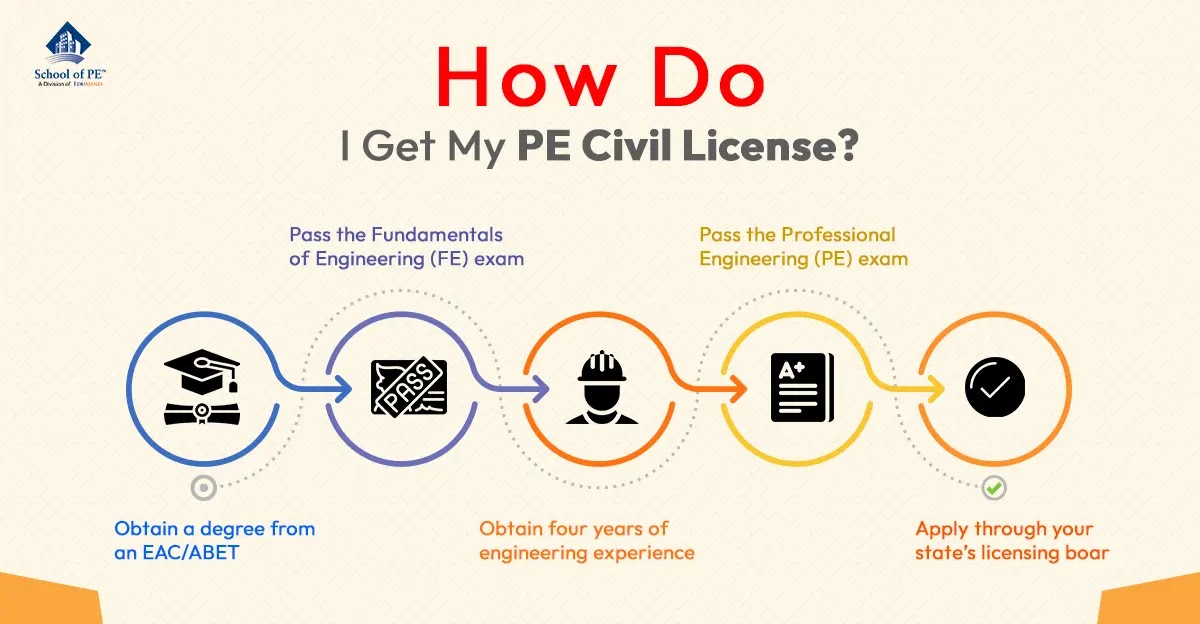
HOW DO I GET MY PE CIVIL LICENSE?

Getting your Professional Engineering (PE) license can be one of the most rewarding achievements in your professional career. It is a testament to the dedication you have made to learning, studying, and understanding the field of engineering you are into the point where you have the authority to design and create new things safely, responsibly, and legally. Obtaining your license is a journey-many who embark on this journey begin in their college years but there are also other, lesser-known paths to licensure. Regardless of when you begin your journey to licensure in civil engineering, you will have to complete the following steps:

HOW DO I GET MY PE CIVIL LICENSE?
1. Obtain a degree from an EAC/ABET-accredited engineering program
You must obtain a degree from an accredited program in engineering to become a professional engineer. This can be in the form of a bachelor's degree, master's degree, or doctoral degree in many states, but most professionals obtain a bachelor's degree. If you are still looking for a program to attend, you can search accredited programs through the ABET website. At this location, you can search for specific institutions or disciplines of engineering.
2. Pass the Fundamentals of Engineering (FE) exam
This is the first of two exams that are typically required to become a professional engineer in the United States. The FE exam is a test of knowledge across the entirety of your selected engineering discipline. It is 110 questions, six hours long, and includes a scheduled break. It is also entirely computer-based and must be taken at an NCEES-approved Pearson-VUE test center. The test's targeted age range consists of recent college graduates or students close to finishing their degree program. Taking this exam soon after graduating or toward the end of your program is a great idea since your college knowledge is still fresh in your mind. Many of the items on the FE exam are conceptual and may not be used daily in your actual profession moving forward, so delaying it only requires you to study harder later! Additionally, many colleges offer study courses for this exam and there is a plethora of study materials online, like those provided by School of PE, you can find.
3. Obtain four years of engineering experience
The NCEES requires a minimum of four years of progressive and qualified engineering experience in order to obtain a license. Qualifying experience typical means under the supervision of another licensed professional engineer. While four years is the standard, some states allow exceptions. For example, some states may only require three years' worth of experience if you have obtained a master's or doctoral degree. This trend, however, seems to be fading in favor for the four-year experience, since many professional engineers can obtain a license in one state and then more quickly obtain a second license in another state. Because of this state-to-state licensing, many states are moving away from reduced experience levels.
4. Pass the Professional Engineering (PE) exam
If you have found this blog post, you are probably already aware of what the PE is. For civil engineering, the exam is an 80-question test that lasts for nine hours, including 50 minutes' worth of breaks. Beginning this year, the civil PE will be a computer-based exam-like the FE-and can only be taken at NCEES-approved VUE testing centers. This exam is much more daunting than the FE exam, as it covers the general practice of civil engineering as well as specific questions that are based on your chosen sub-discipline, questions that are typically harder and more precise. Passing this exam requires lots of studying and preparing by utilizing study resources and becoming familiar with the test format.
5. Apply through your state's licensing board
The last step is to formally apply for licensure once you have completed the previous four steps. Each state within the United States has its own licensing board through which you must apply; in fact, you can find a comprehensive list of each state's licensing board on the NCEES website. There is typically an application fee and other items required such as references and documented experience depending on the state of application.
And there you have it! Once you have finished all five of these steps, you will be ready to sign and seal your own civil engineering designs and conquer the world! Professional licensure is one of the most monumental milestones in your professional career and opens you up to a world of possibilities! If you are wondering whether you should become a licensed engineer or not, check out my last blog post for my thoughts on the benefits of becoming licensed, found here!
About the Author: John Holmes

John Holmes is a professional civil engineer who works on airport infrastructure including runways, taxiways, aprons, and terminals. He was born and raised in North Carolina and still lives there where he obtained both his BSCE and MCE from North Carolina State University. In his spare times, John loves spending time with his wife and son. He also enjoys tending to his growing farm and garden, including chickens, turkeys, and goats.


Friday, 21 January 2022

Here's Why You Should Consider Getting Your PE Civil License

If you're like me, you may be wondering if all the extra work it takes to get an engineering license is worth it. The short answer is "yes." An engineering license has the power to change your career, your opportunities, and your life.
Getting a license in civil engineering most certainly altered my career by increasing my engineering knowledge and challenging me to push my skill set as an engineer. Though it is a rigorous process to get there, the rewards and benefits of earning a license are very much worth it in my opinion. Here are just a few of the main reasons why I think obtaining a civil engineering license is well worth the effort.
Here's Why You Should Consider Getting Your PE Civil License
1. Do it for the career!
This first reason is probably the most obvious and tangible. Having a license has a 100% chance of positively impacting your career as an engineer. For civil engineering, a license is actually a job requirement once you become eligible for many project management and lead design positions. Many employers are willing to pay considerably more in salary for individuals with a license compared to those with equal experience but without a license. This is because licensed engineers are the only ones who can legally sign and seal engineering documents for various projects. A license instills a trust with the client that the project was designed properly with respect to applicable codes, with safety as a priority, and with expectations in mind. Without licensed engineers to design and sign off on projects, nothing would ever get built in civil engineering!
Obtaining a PE license, like many other certifications out there, not only sets you apart from your peers but also sets you up to better advance your career. Whether you wish to one day have your own civil engineering firm or you just want added job flexibility, having a license makes you a valuable asset not commonly found in today's demanding job market. Being able to sign and seal documents allows you to control your own career-you become fully responsible for the designs and projects as opposed to relying on someone else's expertise.
Job security is also a fantastic reason for getting a license in civil engineering. Licensed engineering professionals are typically difficult to outsource given certain requirements for local design as well as state laws requiring that engineers have licensure in the states where they practice. While some elements of design, such as drafting or technical writing, could be outsourced in certain cases, there is virtually no chance of this happening for a licensed profession engineer. Additionally, with recent legislation and outdated infrastructure, the need for licensed civil engineers has grown dramatically. The demand for civil engineering has been on a consistent increase and will continue to grow for the foreseeable future as long as people improve, modify, and use public infrastructure. Behind every single infrastructure project is an engineer who had to sign off on the design. That person is always in high demand-and even better, that person could be YOU!
2. Become part of a unique group of people!
Obtaining an engineering license will certainly set you apart. You will join a unique and limited number of professionals who are at the top of their professional game. While not the main reason to pursue licensure, there is most definitely a prestige that is associated with obtaining your PE. Having a license, much like a diploma, is a symbol of the work and dedication you have poured into improving yourself. A license is not something you can just buy, instead, it is something you must earn. This is a reward in itself because you will have earned it. And you should be proud of having done so. For me, getting a license was definitely the most challenging professional obstacle I have faced to date, and I fondly remember the moment when I received my license in the mail as well as the first time I used my seal. These were unforgettable experiences.
So, while you should certainly be proud of all your accomplishments to date, obtaining an engineering license is a significant one that you will want to celebrate.
3. Make a difference!
Lastly, one of my favorite things about civil engineering is that our projects almost always have impacts on the public at large. While this means we also must deal with public input more often, it also means that we get to help hundreds of thousands-even millions-of people with something we already love to do.
Take me for example: I thoroughly enjoy what I do as an airfield civil engineer. I enjoy solving complex problems and creating solutions to address them. I enjoy learning about unique projects and getting a chance to work on them. But something I often forget is just how many people I actually affect, whether implicitly or explicitly. In my job, a recent project involved improving a taxiway and updating it to current standards, which are primarily safety related. This taxiway receives millions of passengers every year. Every single one of those passengers will use new features that I helped design. That, to me, is an incredible feeling of accomplishment and satisfaction. A roadway engineer who designs improvements to an interchange may impact millions of people each year and save thousands of hours of cumulative commuting time. An engineer who designs improvements to a local broadband system can bring high speed internet to multiple homes who will gain improved access to the world through the internet. An engineer designing a gas line extension may help multiple families have access to more affordable natural gas to heat their homes instead of propane or electric heat.
Almost every civil engineering project is conducted to promote the wellbeing of its users, which in this case, is the public. The fact that civil engineers consistently take on public works projects sets civil engineering apart, as a lot of civil engineering projects benefit everyone and not just consumers with purchasing power. Civil engineering projects can shape communities, change city skylines, and increase the overall happiness of millions of people even without these individuals realizing the projects are taking place. To me, having a license to lead, manage, and sign off on these sorts of projects is well worth its weight in gold.
In conclusion, an engineering license in civil engineering is a worthwhile investment. While it will take a lot of hard work to get there, it will open a world of possibilities for you as an aspiring engineer and set you apart from your peers. While having the letters after your name is noteworthy itself, the impacts you can make to your community and the world become limitless with a license.
About the Author: John Holmes

John Holmes is a professional civil engineer who works on airport infrastructure including runways, taxiways, aprons, and terminals. He was born and raised in North Carolina and still lives there where he obtained both his BSCE and MCE from North Carolina State University. In his spare times, John loves spending time with his wife and son. He also enjoys tending to his growing farm and garden, including chickens, turkeys, and goats.


Friday, 14 January 2022

The Historical Evolution of Professional Engineering Licensure: From Craft Guilds to Engineering Councils

History of Professional Licensure
If we go back to the history of professional work, we can find that the earliest forms of regulated work through professional licensing were in the Middle Ages, c. 1100 - 1453. Craft guilds in Europe, like the Hanseatic League (Burdick, 2020), gained privileges in form of proclamations, letters of patents, and "Charters" from the monarchs to exclusively practice their trades, which can be credited to be the earliest form of licensing. This form of licensing aided and abetted the monopolization of trade and ensured governmental control on trade revenue. However, at the time, regulating a trade with licensing to ensure public health, safety, and welfare was not a primary purpose.
The Historical Evolution of Professional Engineering Licensure: From Craft Guilds to Engineering Councils
Doctors Pioneered the Modern Licensing
The concept of legislation that allowed only licensed professionals to practice is traced back in the historical records to a decree made by King Roger of Normandy in 1140 AD. This decree required doctors to present a "proof of competency" to practice on the public (Ref. 3).
As many as four hundred years later, Dr. Thomas Linacre determined this proof of competency fulfilled by passing an examination by a group of peers.
In 1509, King Henry VIII appointed Thomas Linacre as the royal physician. This position garnered considerable influence in the field of medicine. Dr. Linacre used this unique position of power to deliver the most important service to the society of professionals by founding the royal charter of the College of Physicians in London, later known as the Royal College of Physicians of London (RCP).
The RCP was established in 1518. It was affirmed and its powers were extended beyond London to the whole of England by the Act of Parliament in 1523. It became the British professional membership body dedicated to improving practice of medicine, primarily through the accreditation of physicians-their knowledge to be ratified through examination.
The RCP granted licenses to those qualified to practice medicine and punished practitioners who were unqualified or engaged in malpractice. The RCP became the first professional body to set the international standards for classification of diseases until the present day, when it was brought under the auspices of the World Health Organization.
Medicine was the first professional occupation that ensured only qualified and competent professionals would practice. It is the exclusive forbearer of professional licensing in the modern era, and its licensure standards have saved countless lives.
What is a professional engineer* and how is the role different from an engineer?
An engineer is someone who has graduated from an accredited engineering program, while a professional engineer (PE) is someone who has completed their education in an engineering field, accumulated engineering experience, and passed the discipline-specific Principles and Practice of Engineering Exam administered by the National Council of Examiners for Engineering and Surveying (NCEES). For engineers, licensure is mandatory to submit plans to a public authority for approval, to work as a consultant, or to be in responsible charge of engineering work.
PEs are bound to a code of ethics and uphold the highest standards of honesty and integrity. The National Society of Professional Engineers' (NSPE) Code of Ethics notes that a PE should hold paramount the safety, health, and welfare of the public. PEs shall perform services only in their areas of competence and set forth a conduct that is honorable, responsible, and lawful.
In the United States, the practice of professional engineering is highly regulated, and the title "professional engineer" is legally protected. It is unlawful to use it to offer engineering services to the public unless formally endorsed by the state through a professional engineering license.
David Steinmann, PE, NSPE founder, past president of NCEES, renowned builder of suspension bridges, and one of the strongest advocates of PEs sums up the importance of the PE all with this statement: "Engineers' registration laws are, of course, necessary for the safety of the public...but they are also necessary for the protection of the good name of the profession."
*In the regards of the USA.
The Historical Path to a Professional Engineer
Ancient Times
The existence of laws with respect to engineering goes back to ancient times (i.e., 1800 BC) to the famous and strict Code of King Hammurabi of Babylon. Hammurabi's Code, though harsh, only punished unlicensed practitioners if their work killed someone. In other words, an unlicensed practitioner could practice, but bore no consequences unless they harmed someone.
Through the End of the 19th Century: First Engineering License Provided in USA
After licensure requirements were established for doctors to practice professionally, other professions followed suit and by the 19th century, barbers, embalmers, ferry operators, horseshoers, pawnbrokers, and land surveyors required licenses to practice their trade (Larkin, 2017, McGuirt, 2007). It was as late as the dawn of the 20th century that saw formal activity in the licensure of engineers...and it started in the Wild West of Wyoming, USA (McGuirt, 2007).
The Modern Era of Professional Licensing
20th Century (1907 - 1919): First 10 States Begin Registering Engineers
In 1907, Wyoming engineer Charles Johnston put forth legislation requiring the registration of engineers that established clear guidelines on who could and could not practice engineering in the state. This would prevent untrained and unqualified folks from dabbling in important work meant to be performed only by educated engineers and surveyors.
Charles Johnston's legislation, in addition to requiring the registration of engineers or surveyors who sought to market themselves to the public, created the state board of examiners for the profession. Charles Bellamy, another Wyoming engineer and mineral surveyor holds the distinction of becoming the first licensed engineer in the US.
This landmark legislation laid the path for the state of Louisiana to pass their own engineering registration law, and by 1919, the states of Florida, Illinois, Iowa, Colorado, Michigan, Idaho, Nevada, and Oregon had all passed legislation to not only require registration but also establish state boards.
1920s: Inter-State Standardization of Engineering Licensure
With each state board taking up the reins of registering its engineers, the problem of out-of-state acceptance of engineer registrations arose, and in 1920, the Iowa State Board of Engineering Examiners in collaboration with the several other state boards created "an organized and systemized method of procedure to be followed in interstate registration to standardize the inter-state registration of engineers."
Eventually, the Council of State Boards of Engineering Examiners (CSBEE) was founded-the precursor to NCEES. A new written constitution was drafted, making the CSBEE a "permanent organization" and ensuring practical uniformity in professional engineering practice as well as reciprocal interstate relations within the engineering profession.
1930s: Strengthening and "Nationalization" of Professional Engineering
In 1932, The NCEES created and ratified the Model Law for the Registration of Professional Engineers and Land Surveyors. In addition to establishing licensing guidelines for the state boards, this law established record-keeping procedures with the creation of the National Bureau of Engineering Registration, designed to assist engineers needing to work in different states.
The National Society of Professional Engineers (NSPE) was founded by bridge engineer David Steinmann in 1934. This society would soon become dedicated to the engineering profession's nontechnical concerns. The NSPE focuses on legislative issues, public understanding and recognition for the profession, adequate compensation, and ethical practice.
By 1939, as many as 47 states and one territory were licensing engineers, and the National Council was ready to take on major problems in the engineering profession. Executive Secretary T. Keith Legare stated that the Council had become "the logical organization to advise and furnish reliable information to the state groups that are promoting the adoption of new registration laws or amendments to existing laws."
1940s: The Last State Standing
In 1947, Montana, the last state to offer engineering licensure standards, enacted its engineering licensure law, and by 1950, the entire country including the District of Columbia had some form of engineering licensure law in effect.
The NCEES was divided into four directional zones and John Remington Jr. of New Jersey became the first president of NCEES.
1950s: Examination - the Third "E" of PE (Education, Experience and Examination)
In 1953, the NCEES' Subcommittee on Written Examinations issued the exam syllabus among the state boards.
In 1958, the NCEES saw the first woman appear as a discussant at its annual meeting: Ms. Clemmie Wall of the Missouri Board participated in the presentation of the State Board Secretaries Conference.
1960: Administering the Engineering Licensure Examination
In 1961, the Northeast Zone led the way by administering the first uniform professional exam. This was a significant milestone for homogeneity and overall inter-state mobility efforts.
In 1965, the first Fundamentals of Engineering (FE) exam was offered. The widespread use of the FE exam was an immediate aid to the state boards for reciprocity. A year later in 1966, the first Principles and Practice of Engineering (PE) exam was administered.
1970s: Centralizing the Professional Data of Engineers
In 1979, the Council replaced the National Bureau of Engineering Registration with the NCEES Records Program, which would become "the central depository of official documentary and personal biodata of all types of engineers."
1980s: Maintaining Uniformity in Examinations
By 1984, all engineering licensing boards were using uniform national engineering exams, and the NCEES went from a norm-referenced method to a criterion-referenced method to determine the minimum passing score for the PE exam. The NCEES focused on strategic plans to shape the future of professional licensure.
1990s: Examination Format Changes
In 1996, PE exams, except for the Structural exam, were voted to be multiple-choice to improve scoring reliability and consistency. FE exams were offered in six discipline-specific modules.
In 1999, Computer-Based Testing (CBT) became the format of the exam.
2000s: Helping State Boards with Examinations and Internationalization
In 2000, the Exam Administration Services department was formed within the NCEES to bring state boards uniformity in conducting examinations. In 2003, a task force reached out to students and educators for feedback with the goal of increasing their awareness of the FE exam.
In 2005, the NCEES created a Credentials Evaluations service, which put in place a uniform, transparent, and reliable system for evaluating foreign-educated candidates and domestic candidates of non-ABET accredited programs seeking professional licensure in the US.
In 2007, the NCEES expanded its international presence by administrating the FE and PE exams first in Japan, then in seven other countries.
2010: Diversifying the Organization and the Examination Processes
In 2010, the NCEES focused on professional engineering licensure for faculty.
In 2013, the NCEES added two new departments-Client Services and Member Services-to increase services for customers and boards. Patty Mamola, PE of Nevada was elected as the first and only woman president of the NCEES in 2013-14.
In January 2014, FE exams were first administered via CBT. The move to CBT allowed for more uniform testing conditions, stronger security for exam content, and greater scheduling flexibility.
2020 - The Centennial Year
2020 marked the 100th anniversary of NCEES!
Conclusion
Although professional engineering licensure had a relatively late start in comparison to other professions, it has evolved into a mature and effective process thanks to incremental yet meaningful progress over the past century as well as its ability to adapt to changes over time.
References
1. Burdick, C; History of Professional Licensure, January 2, 2020.
2. Larkin, Jr, P. J; Legal Memorandum No. 204; A Brief History of Occupational Licensing, http://report.heritage.org/lm204, May 23, 2017.
3. McGuirt, D; The Professional Engineering; National Society of Professional Engineers, May 2007.
4. NCEES, Developments in Licensure - Timeline; Celebrating 100 years of NCEES, November 2020.
About the Author: Surajit Amrit

Surajit Amrit has a 30+ year career as a practicing engineer at Engineering News Record (ENR)-ranked engineering firms. He has a bachelor's degree from Indian Institute of Technology and a master's degree from Vanderbilt University. He is a licensed PE, Certified Energy Manager (CEM®) and LEED® AP. He is currently pursuing his CVS certification (Value Engineering - SAVE International). In his spare-time he enjoys reading books, listening to political satire, trail walking, and dabbling in trivia, jigsaw puzzles and numismatics.