Friday, 29 April 2016

Are you meant to be an Engineer?

Engineering is one of the most coveted professions in the country and engineers from all disciplines are associated with dynamism and ardor. While taking up the FE exam is the first step towards building a strong career in engineering, successful engineers go on to take the PE exam after gaining sufficient experience. Post the success in PE exam, there is no looking back.
However, while acquired knowledge and skills push an engineer to the epitome of success, there are certain inherent qualities that are truly characteristic of a "born engineer". Let us explore them in detail.
Strong problem-solving skills
Successful engineering is all about battling through myriad challenges to find the right solution. In fact this is the reason why every PE review course is designed to test the problem solving ability of an individual. While all resources may be at hand (like the multiple reference books made available in the open book PE exam), sifting through the maze to obtain the most innovative solution can be a real challenge.
Attention to detail
While grasping the big picture is relatively easier, it takes a shrewd professional to dig deeper into the minutest details of a project.
Ability for analysis
Irrespective of the discipline of engineering, one common skill that sets apart a good engineer is his ability to handle numbers. From creating building designs to developing software, engineers need analytical skills backed by a strong love for numbers. If crunching numbers and interpreting them seems like a headache, engineering may not be the right choice for the long run.
A fair sense of inquisitiveness
Those little kids who cannot stop with their long series of "what-ifs" and "whys" can probably make good engineers. Reasoning lies at the heart of engineering and again this is why the professional engineer exam strongly emphasizes the application-oriented questions that test the reasoning ability of the individual.
Commendable project management skills
Once the engineer emerges successfully out of the PE exam, his career starts to take some interesting twists and turns. Bigger projects and better opportunities come along and the engineer must be well-equipped to handle them. This is where the engineer's project management skills come in handy. Students with a flair for handling responsibility can certainly turn into leading engineers in the long run.
When individuals possessing these traits meet the right learning and resources, engineers are rightly empowered.

Thursday, 28 April 2016

Ease the Pressure and Master Organic Chemistry

Organic chemistry demands significant emphasis from students preparing for their FE exams. It is considered to be one of the most difficult topics that deserves intense effort and continuous practice. While all this hype may cause scary illusions about the subject, in reality, there is no class more rewarding than organic chemistry when it is understood correctly.
Compiled together is a set of simple yet effective guidelines that can make organic chemistry a piece of cake for anyone preparing to take the FE exams. 
Ask questions
Never take anything for granted while learning organic chemistry! Reason out every single step of the mechanism and every formula you derive. While advanced subject experts may at times miss out on mentioning certain minute details, students must be willing to explore deeper to get to the very roots of the subject. Also, remember that one of the fundamentals of engineering exam preparation is to never postpone learning, and this especially applies to the case of organic chemistry. Thus students must not hesitate to ask questions and clarify doubts right then and there. 
Try the notecard trick
While understanding concepts is one part of the subject, the ability to remember the facts is another. With so much to remember and so little time, preparing for FE exam efficiently can be a challenge. Prepare notecards with different reactions and chemical naming rules, and carry them around while quizzing your own memory. Although the practice may seem a little excessive, the additional effort is sure to pay off largely in the end. 
Make optimal use of resources
From study material to FE exam review and practice sets, do not spare a single resource that can provide a good opportunity to learn and practice organic chemistry. Leverage the good resources to learn the nomenclature rules, draw the complex molecular structures and gain an in-depth understanding of the various mechanisms involved. The motive here is to familiarize oneself with the subject and thus eliminate the unwarranted fear before taking the FE exam. 
Opt for spaced repetition
"Spaced repetition" is a smart learning technique which involves breaking down the information into smaller chunks and reviewing them regularly for an extended time period. For instance, do not attempt to memorize the chemical properties of acids, aldehydes and alcohols in one single shot. Instead, familiarize yourself with acids first, give yourself a few good hours of break and follow up with aldehydes but only after you have reviewed the acids. Come back the next day to the properties of alcohol but only after you have reviewed acids as well as aldehydes. With time, the properties of all three compounds will stay intact in the student's memory.  
Remember, organic chemistry is not just meant for the chemical engineers who will be appearing for FE exams. It involves the study of molecular mechanisms and chemical reactions that lay the foundation for other branches of science too.

Friday, 22 April 2016

Impact of construction on adjacent facilities and mitigation measures employed

There's a lot more to engineering than simply applying technical knowledge to the task at hand and achieving the required outcome. While being result-oriented is a necessity, as a responsible engineer, keeping a tab on what the implications of one's actions are is of the utmost importance. Construction can have an adverse and noticeable impact on the adjacent community and facilities. An engineer aiming to pass the PE exam must not only learn the technical aspects required for construction but also be aware of its adverse impacts.
Archaeological resources:
Construction can have an adverse impact on important archaeological resources in the vicinity. Excavation or other potential developments could result in in-ground disturbances that may cause damage to historic structures.
Mitigation measures:
The Building Codes in the U.S. propose a monitoring program. Every engineer taking the PE exam prep course should know how to set up an effective monitoring program to detect the beginning of damage. This can allow one to alter the construction procedures used.
Natural resources:
Construction may also affect natural resources, wildlife and aquatic animals. For instance, the construction of an over-water pier involving in-water construction activities may displace several aquatic organisms. The noise generated may also disturb endangered birds and other wildlife.
Mitigation measures:
A survey must be carried out to identify important natural resources that may become affected. For the example stated above, following Best Management Practices (BMPs) can help contain turbid water and reduce the effects on aquatic resources. Noise impacts to fish, wildlife and birds can be reduced by using bubble curtains.
Air quality:
The local air quality may become affected due to emissions from the operation of construction equipment and construction vehicles. Activities such as hauling, dumping, excavation etc., may result in dust emissions that have been known to cause respiratory problems in humans.
Mitigation measures:
Setting up traffic management and air pollution control plans is a must. Dust control measures such as frequent watering of exposed areas and employing dust covers for construction trucks can be effective. Other measures such as minimizing construction vehicle trips and preventing idling of trucks or other equipment should be employed as well.
Traffic and parking
One of the most noticeable and immediate effects of construction is the disruption of traffic and parking spaces available to the public. Depending upon the project, construction may result in road closure, inconvenient traffic detours, reduced roadway capacity and traffic jams during peak hours.
Mitigation measures:
The significant impacts to traffic and parking that can be expected must be clearly understood. Measures like speeding up construction in key areas, setting arrival and departure times for construction workers before peak hours, monitoring movement of construction materials and setting up smart work zones may help. Adequate installation of traveler information systems and safe detours must also be provided to the public.
Parks and recreational space:
Increased traffic congestion, dust and noise make the project area a less than desirable location. The effect of poorly-managed construction activities on parks, open spaces etc. is so disruptive that recreation activities will be temporarily suspended.
Mitigation measures:
In order to avoid causing an inconvenience to the public, a responsible engineer preparing for the PE exam should set up specific mitigation measures. These measures could include identifying pedestrian and bicycle routes, setting up convenient detours, temporary sidewalks etc. As expressed earlier, mitigation measures to reduce noise and emissions should be set in place.
Other impacts to the elderly and disabled population, local businesses and public utility services may also be caused and need to be taken care of.
While preparing for the Professional engineering exam, knowing the potential impact construction can have on adjacent facilities can help one set up a proper mitigation plan. More insight can be gained on the issue by taking a PE review course in order to be better prepared for the PE exam.

Thursday, 14 April 2016

How to Incorporate Effective Exam-taking Techniques

Over and beyond studying the PE exam material and diligently following the PE exam prep course, it is also important to focus on mastering some exam-taking techniques. The multi-hour long PE exam will test your ability to take a test. So, it's a good idea to be well prepared for it. Apparently, your test taking ability can influence up to 10% of the final result of your exam.
Here are some tips and techniques you can consider:
Your overall outlook of the exam
First and foremost, your outlook of the exam matters. The exam might be difficult or easy, but how you approach it makes all the difference. Go with a healthy attitude in dealing with it - be confident yet cautious.
The day before the exam
Instead of attending last minute PE exam prep courses or cramming through study material in the last moment, relax and ensure you have a good night's sleep. Try to avoid staying up late but instead make sure you have at least 8 hours of good rest. If you attend the exam feeling sleepy or tired and not at your best, chances are you can make some careless mistakes. Do note, PE exam can be a bit tricky. Therefore, relaxation is key to handling these exams.
Get to the exam center early
On the day of the exam it is advisable to get to the exam center early, so that you have enough time to settle down and collect your thoughts. So all the necessities for the exam, keep it prepared the day before itself so that you can avoid arriving late for your exam. Make sure you use the restroom before the exam starts. Further, instead of socializing, keep to yourself as by sharing your preparatory skills or discussing the exam ahead, unnecessary exam doubts can sprout out.
Understanding the questions
Once you get your hands on the exam sheet, read each and every question deliberately and cautiously. Read it, word to word, and don't just skim through the question and assume you have understood what is expected. Sometimes questions are not what they appear. Read it twice, sometimes you catch on to something the second time around.
Answering the questions
Most of the questions and problems take just one or two steps while some might need 3 or more. But anything more than that, kindly recheck, as there might be a different approach or method to it. As you answer the questions, be vary of your time and clock yourself, no more than 6 minutes should be spent per question. If you get stuck on one of the problems, move on, continue with the others and then come back to it. Keep a close watch on your time.
Armed with these exam-taking techniques can positively make a difference. While attending PE prep courses and thoroughly studying PE material are indeed pivotal, incorporating appropriate exam techniques can give you a 10% advantage. Practice taking exams prior to the actual exam by enrolling for a PE Exam Prep Course can help build your confidence!

Thursday, 31 March 2016

How to make the best use of the 15 days before your PE Exam

You've crossed off the days on the calendar and have 15 days for the Professional Engineering exam.  Experts suggest that to pass the PE exam you need at least 3- 6 months of rigorous prep. Before you start feeling nervous remember, that you still have 15 days before the PE exam.
While we can't promise you stellar scores but if you make the best use of the 15 days before the PE exam, you can make it through:
Here's how:
Register for review classes
For those of you who haven't started preparing for the exam, it is wise not to try self-study. Instead enroll into a PE review course. Onsite and online classes are a good option, but you may not find classes that actually fit your time slot. Sign up for OnDemand PE exam review classes at once. School of PE's OnDemand classes make substantial amount of recordings available instantly. If you've already prepared for the PE exam the past few months, you can skip this step and revise key topics instead.
Study selectively for one week
Once you've registered for PE prep classes, it is now time for some serious studying. However, trying to cram several hours' worth of refresher classes and workshops is a challenging task. Instead, it is better to master a few important review topics than knowing a bit of irrelevant stuff from everything.
Take up a practice test
Take up a practice test on Day 8 to know exactly where you stand. While the test scores may not seem promising, there's room for improvement. Identify the problem areas and make a list of all those topics that you still need to improve upon.
Review study material
Spend time reviewing the material. Try and understand the concepts you're having trouble with. If you are unable to recollect or understand , review the class recordings from your PE review course. Close to the end of the 15 days, take up a practice test again. If you've sincerely followed the steps above, you will notice an increase in test scores.
Practice more
The more you practice, the more adept you become at tackling the PE exam's challenging questions. So try squeezing in a few practice tests during the fifteen days.
Keep the essentials ready
Make a checklist of the essentials you'll need during the exam - calculator, charts, reference books, etc. Also, if you haven't already done it, make sure you tab your reference manual correctly.
Relax
Relax so that you stay calm and focused on the day of the exam.
With these steps, you can make the most productive use of the 15 days before the PE exam and walk into the exam hall with confidence.  Even if you do not pass, remember, there's always a next time!

Monday, 21 March 2016

How to build safe scaffolding structures?

Scaffoldings are  necessary structures for construction and maintenance. However, erecting and dismantling scaffolding structures remain a high-risk activity to workers and pedestrians. That is why NCEES requires qualifying Professional Engineers to know how to build scaffolding structure. If you're an aspiring Professional Engineer and would like to ace the NCEES PE exam, here's what you should know about safe scaffolding construction:
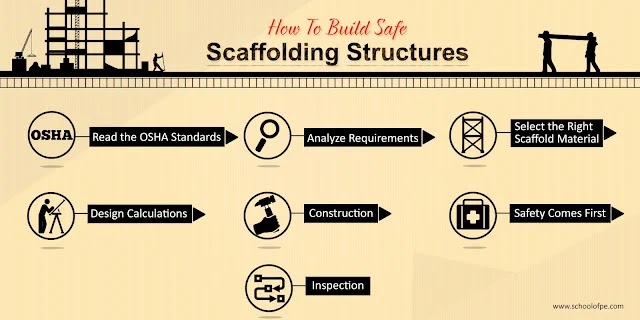
How to build safe scaffolding structures?
Read the OSHA standards
The Occupational Safety and Hazard Administration (OSHA) has laid down strict guidelines to ensure the safety of workers using scaffoldings for construction work. Hence, it is imperative for a qualified person to be aware of the OSHA standards before building scaffoldings.  A complete guide to safety standards can be found on the OSHA website.
Analyze requirements 
Before building a scaffolding structure, it is necessary to have a complete plan on paper. Know what is required, how much load the scaffolding is expected to take, the height it's supposed to reach etc. This ensures that all the required parameters are met before actual construction begins. Review all the written requirements to determine what type of scaffold is needed and where it should be used.
Select the right scaffold material
It is the most crucial step in building safe scaffoldings. From suspended to supported type, each scaffold caters to a different set of requirements.
Design calculations
Before actual construction begins, a Professional engineer must substantiate the design drawings by carrying out scaffold design calculations. It involves assessment of all loading conditions, a capacity check of individual components and evaluation of rigidity and stability. The NCEES Exam tests engineers on their competency to carry out such design calculations.
Construction
Assign tasks to competent personnel who have adequate knowledge of reading design drawings and are capable of directing the construction work.
Safety comes first
Accidents that arise due to poorly constructed scaffoldings can be avoided if strict adherence is paid to the safety standards laid in place by OSHA. The following are the common reasons why scaffold-related mishaps occur and must be avoided at all costs:
  1. Improper access to scaffoldings
  2. Absence of guard rails
  3. Planking gives away - this happens either due to improper placement of the planks, use of poor quality material or overloading.
  4. Tipping of tall scaffolding structures due to improper support i.e. lack of ties or braces.
  5. No fall protection system.
Inspection
Even the best-laid plans can go awry sometimes. A loose bolt or a poor quality plank may seem like a trivial flaw but can be disastrous if left unchecked. It's a must to inspect the structure thoroughly before giving it the green-signal.
Ideally a scaffold is considered to be safe at the height of four times the width of the base is. This aspect should be inspected to avoid any unforeseen situation. Also, Scaffoldings should be kept away from power lines and the weather conditions should be kept in mind before placing the scaffoldings.
The NCEES PE exam tests PE Civil construction aspirants on a variety of construction-related topics and design calculations. If you'd like to ace the NCEES exam and become a successful PE, these steps on knowing how to build safe scaffolding structures can be really useful.

Thursday, 17 March 2016

Tips and Tricks to Beat the FE Exam

The Fundamentals of Engineering Exam (FE) is a 110 question, 5hrs 20mins, computer based exam. The exam can be overwhelming to some, but if you are equipped with the right tips and tricks of the trade, you would be better prepared and more confident to challenge the FE exam.

Manage unwarranted stress
Based on FE exam review material, according to Michael Lindberg the passing scores are tentatively around 70% for the Fundamentals of Engineering Exam, (although the scores are not published officially by the NCEES). Candidates appearing for the exam should focus on the subjects that they have a stronghold and also place equal emphasis on other questions to have a comprehensive learning experience. By concentrating on all questions you can manage unwarranted stress.
Focus is key
When you first look at the exam questions, quickly sort the questions based on the subject you are strongest in and those that you are weakest in. Tackle the ones you are confident about, and in an organized fashion keep moving on. How you prioritize your time and focus on tackling the questions systematically is key to completing the FE exam efficiently.
Tackling Problems
While taking the FE exam prep course you might most likely will be stuck with a problem that you might find difficult to solve. The answer can't be found in the supplied reference handbook. Chances of solving it with the help of a calculator is likely or unlikely. You may or may not even have the  liberty to disregard the answers and take a calculated guess. But, a simple trick might just work  in your favor. You have a better chance at guessing the right answers if you take a leap of faith and select from the multiple choices made available for you to guess.
Program Scientific functions to use your calculator
We all tend to make mistakes, unintentionally of course. It is better to be on the safe side and use the calculator to solve the problems rather than entirely relying on your own manual calculations.  Not just for the accuracy of the calculation, but also for the speed with which you can complete solving the problem - a calculator is ideal for scientific calculations.
These tips and tricks should push you in the right direction and boost your confidence in confronting the FE exam.