Thursday, 2 March 2023

Why Education Reimbursement Supports Talent Development

One of the main reasons that many people don't go to college is because of the cost associated with attendance. Right now, in 2023, most people can't afford to attend college because of the steep cost of university education. The annual average tuition rate for in-state tuition at a public 4-year university in Alaska for example, cost almost 9,000 USD. This doesn't include housing, transportation, food, etc. The fact is that most people are barely getting by with the job they have, and adding a student loan to the mix doesn't make the equation seem any better. This is a bit of a tragic situation because we have an innate desire to learn and cultivate a deeper understanding of our areas of interest.
One of the biggest problems that businesses face is attracting and retaining talented individuals that can prove a beneficial addition to the company culture. Employers need talent, and talent needs continual support to grow and develop. Supporting talent development by creating an education reimbursement program meets the needs of the company and the employee in equal measure.

Why Education Reimbursement Supports Talent Development
1. Who benefits from education reimbursement?
There are generally two different types of education that benefit the workplace, a university education and a professional certification. Not that one has to come before the other, but generally, those already working have a degree necessary for the job. These individuals often seek continuing education in the form of professional certification. The certifications serve to expand on a niche area of knowledge, which is why they come after a degree program.
If willing to provide reimbursement, an employer can choose to pay fees on a course-by-course basis to the employee (to then be paid to the school), or to the educational institution directly, Reimbursement typically depends heavily on the structure necessary within the organization.
Both the individual and the company will reap the talent benefits that come from education reimbursement.
Talent in the Individual- First and foremost, the individual will benefit. Financial burdens are one of the top stresses of the Millennial generation and younger. No longer can a person go to work full-time, go to school full-time, maintain healthy relationships, and pay for all living expenses, tuition, books, and materials. Therefore, the peace of mind that comes from having schooling paid for allows the student a greater ability to focus on the subject material and learn to the best of their ability. In addition, some employees who may show exemplary skills in their knowledge base, like tech programming, may benefit from these opportunities to focus on more underdeveloped oral and written communication skills required for job performance.
Talent in the Company-
Let's talk about the "others," such as the company offering education reimbursement programs. Why would a company offer such programs in the first place if not to benefit them in the end? Let's look at some quick statistics.
In a Bright Horizons survey of more than 30,000 workers currently learning on the job, most respondents (82%) said the skills or degree earned through the employer's reimbursement program helped them be more effective employees, and 84% feel it helped them prepare for future work. In addition, 64% said that the program made them happier at work. This is due to the school of thought that those who feel confident in their particular area of expertise are more satisfied with the work they've done. In the end, employers are recruiting high-quality candidates that desire supplemental education to become top-performing employees.
What about companies that don't require the degree or certification to be used on the job?
In some cases, employers offer education benefits as a simple fact of employment, just like health insurance or a 401K. In these cases, employees are expected to fulfill a certain amount of work requirements to qualify for these continued education benefits.
Take Costco, for example. Costco is very well known for its excellent employee benefits, and a little-known one happens to be its education scholarships. Employees who take advantage of these benefits don't often strive toward a Costco-specific department, instead favoring a more personal route. Costco's scholarships aren't intended to cover the employee's entire program, but these scholarships, combined with the work/school structure balance, allow the employee to spend semesters in school and breaks working in the warehouse.
How does this type of action benefit Costco? Costco itself is known for having high standards for employee behavior, and adding education benefits on top of it allows their employees to both work and attend school-effectively earning a living and an education in a far more sustainable and healthy way than is standard. Providing these opportunities to employees results in employees who are willing to put in the work while they're at work, so they can put in equal effort at school. Being able to separate the two allows the employees to be fully present in each area rather than worrying about everything all at the same time. The skills employees learn in focus, task organization, and community awareness only add more benefits.
2. Leverage education reimbursement programs to attract and retain employees
It's pretty simple-most employees look for jobs that offer supreme benefits that they won't find anywhere else. They're looking for a chance to not only earn a living but also to build a knowledge base. The extensive report, State of the American Workplace, states that 45% of Millennials report that they would change their job for tuition reimbursement benefits. In the previous Bright Horizons report, 88% of Gen-Z workers say they are more likely to recommend their employer because of its educational benefits.
People want to learn and expand their understanding of things they're passionate about. Oftentimes, they'll jump on the chance to learn something new. Tuition assistance programs help attract talented individuals who have a knack for improving themselves by absorbing information. They're more likely to stay with companies that invest in them in equal measure.
3. Creating an effective education reimbursement program
Many companies have education reimbursement programs, but some are more effective than others. Often, reimbursement depends on what your company needs in terms of an employee talent pool. To broach the topic of education reimbursement with your employer, you should advocate for the establishment of the program with the goal to achieve specific objectives. Here are a few things you'll want to do during this process:
  • Assist in setting up the programs.
  • Ask experts in your field for their opinions and procedures. If they already have a similar program in place, it may benefit you to take notes.
  • Decide the type of benefits you want to provide in the education department, be it certifications, full tuition coverage, partial, or any of the variations in between.
  • Decide what qualifications the employee must meet to be eligible for the program, like how Costco requires that the employee works during their breaks.
  • Decide which universities or certificate study programs would be best to partner with. If no feasible local education resources are available, there are plenty of online resources at your disposal.
  • Make your employees aware of your education reimbursement program. Even though employers spend about $177 billion yearly on formal education and training, most working adults are unaware of the associated benefits.
Monitor the effectiveness of the program itself.
In addition, according to The Society for Human Resource Management, creating and managing an effective educational assistance program should follow the "SMART" paradigm to ensure that the goal of the program is being met:
  • Specific, clear, and understandable
  • Measurable, verifiable and results-oriented
  • Attainable
  • Relevant to the mission
  • Time-bound with a schedule and milestones
4. The cost of an education reimbursement program
An education reimbursement program obviously has its benefits, but let's talk about the inherent cost of the creation and upkeep of the program itself. There is an initial cost to the program as well as the cost of tuition and all associated expenses. If employees are given paid time off to complete coursework and attend classwork, other employees may need to take extra hours with potential overtime to compensate. The potential increase in salary necessary to keep the newly educated employee is also something to consider when providing reimbursements. For a 4-year degree, employers can end up paying anywhere from $2,000 USD to $20,000 USD in additional salary costs.
The benefits generally outweigh the cost of such programs, as the employee is now fully equipped with the necessary skills to create a better working environment and as well as more business opportunities for the company.
Creating an educational reimbursement program doesn't have to be complicated or time-consuming to be a benefit to both employer and employee. The program is there to help the individual feel satisfied with their growth opportunities, and for the company to have a profitable balance of talented individuals to benefit the group as a whole. With the right system in place and the group working together to maintain an educational standard, creating the system itself will prove extremely beneficial to all parties in the long run.
About the Author: Anna Taylor

Anna Taylor is a freelance writer and avid researcher- a jack of all trades, but a master of none. She graduated from the University of Hawai'i with an Associates Degree in Liberal Arts because she had no idea what she wanted to be when she grew up. She has since found her love of Extended Reality and the possibilities it brings to the world, as well as gardening, cooking, and writing. Anna lives in Interior Alaska with her family.

Thursday, 23 February 2023

How Professional Certifications Benefit the Entire Company

Professional certifications are one way that employees can show themselves, employers, and clients that they know what they're talking about- that the information they've worked to gain is valuable and current. Other reasons that an employee might seek certifications are:
- Increased marketability
- Validation of knowledge
- Enhanced credibility
- Increased earning power
- Confidence among and respect from peers
- Boosted reputation
- Greater academic performance
There are many benefits that an employee gains from having current certifications under their belt, but what about the rest of the company? In what ways will professional certifications benefit the entire company?
How Professional Certifications Benefit the Entire Company
1. What Constitutes a Professional Certification?
Professional certifications are credentials that a person can earn that show their knowledge and competency with a specific skill type. Confirmation of certification usually comes in the form of a document stating that the person has completed the necessary training and preparation that meets a specific criterion for a given role (more on this in a moment).
Additionally, professional certifications can be broken down into different types that apply to differing career goals.
Corporate certifications come from within. In this case, the employing company seeks to improve the skills and education of their employees with in-house training specific to the company's needs.
Role-specific certifications help professionals develop valuable skills within their field and position them as an authority to clients and others in that field. Some certifications are necessary for more specialized positions, like in accounting, therapy, nursing, etc.
Product-specific certifications offer the employee an in-depth understanding of a specific product or software, like Adobe, VR/AR, and Microsoft Office. These certifications provide employees with specified information regarding products they'll be working with on a regular basis.
There are also different avenues that a company can take when implementing professional certification programs in their company. The business can either hire somebody who already has professional certification (though be aware, these individuals generally expect a larger salary), pay to certify an existing employee, or pay to certify an incoming employee and add to their training.
In addition, a company can also choose to certify their entire company or just one individual. There are benefits and trade-offs to both. Certifying a single individual is considerably less expensive than certifying an entire group. However, certifying an entire group guarantees that the workplace has an internal insurance policy against employee turnover.
2. The Process of Professional Certification
The process is pretty simple: choosing the right program, paying for said program, studying and completing the program, paying for the certification exam, taking the exam, and finally receiving the certificate itself. However, within each step is a nuance that needs to be considered.
Pick the right subject and program for your niche. Whether your interest is nursing, management, animation, or engineering, it's important to do research into schools and companies that can provide applicable information to your chosen field. For instance, there are dozens of nursing certificates that enable a nurse to be adaptable in any given niche within the industry, but not all schools or programs will provide the necessary information to take and pass these exams.
Study in preparation. The right program will provide you with study materials, projects, workshops with peers, and everything you need to succeed in certification. It will also likely provide a certificate of completion, which is a great way to boost a resume.
Complete the program. A little obvious, but it should still be stated. The program will only be as good as the effort you put into it.
Renew your certification. Some types of certifications require regular renewal determined by the state you reside in. Most states will send out notices to all applicable persons, but it's good to keep track of it yourself in case of a move or any other unforeseeable event. Renewing your certification ensures that you are up to date with the most recent and crucial information.
3. How Professional Certifications Benefit the Entire Company
So, how do professional certifications benefit the entire company? We covered a little bit of it already, with up-to-date industry information, employee retention, and ways certification benefits the employee themself, but let's get a little more specific.
1. Improved employee retention: Losing employees is always a detriment to the workplace, even if it's expected and coming from the employer's side. It creates a gap in workplace knowledge, slows the business process, and reduces the number of available employees. It also costs more to replace the employee who has received a training investment. Gallup estimates that it costs one-half to two times the employee's annual salary to replace them. (Source)
In contrast, when you're able to retain employees for longer periods of time, you can create better systems of work, enhance and add to your existing knowledge pool, and create a better, happier company culture. A major reason that most millennials quit their jobs is because the job itself lacks growth opportunities. Positioning yourself as a company that is willing to provide that expertise to your employees shows them that you're also willing to invest in them.
2. Attracting top candidates: As an employer who creates a company with a focus on facilitating employee growth, you will attract individuals who have the desire to improve themselves. These individuals are typically high achievers that in turn add their knowledge base to your other employees. In showing that you already hire those with certified knowledge, you set a minimum standard for applicants, which in turn creates a higher minimum acceptable knowledge base.
3. Setting higher standards for professionalism: As a company that actively seeks opportunities for professional development, you set the standard of professionalism not only within the company, but also within the industry in which you operate. Other companies, after seeing the lengths you'll go to in order to ensure the best for your team, will follow suit and add a greater level of credibility to the niche.
4. Building an agile productive company culture: Having employees certified in multiple areas helps create more productive systems and protects against risks like employee loss or injury. It is an insurance policy that allows the company to operate the same way regardless of changes in management, workload, and workforce.
5. Client confidence: Oftentimes, clients will shop around to find the exact company that will fulfill their needs and finish the job to their satisfaction. It goes without saying that most clients want to partner with companies with proven industry knowledge and experience. Many companies are searching for ways to improve their customers' experience but don't realize that one of the most beneficial ways to do this is by boosting their company's credibility with team licensure and certifications. Never rule out professional certifications where the client is involved.
6. Reducing errors with higher knowledge standards: In certain programs, attendees are given opportunities to share the knowledge they've gained via projects prior to completing the certification exam to help solidify their knowledge. Within the workforce, this means that with the now extensive knowledge and experience they have, they're better able to complete work with minimal error. It also means that they have a shorter learning curve within the company and can learn company-specific processes with similarly minimal error.
7. Excellent networking opportunities: Obtaining professional licensure and certification can grant access to conferences and workshops for your field that are otherwise unavailable. For instance, attending a manufacturing conference can:
  • Provide the opportunity to meet other professionals within your field.
  • Keep you up to date on the latest manufacturing innovations.
  • Give you the opportunity to exchange relevant industry information.
  • Provide insight into different manufacturing solutions.
  • Allow you to discuss global supply chain challenges.
8. Filling skill gaps within your industry: With how rapidly information is generated in today's information-rich environment, there are bound to be skill areas that aren't being covered. With certifications, you will be given the latest information, allowing you to fill the relevant gaps within your industry. This will lend more credit to you for being an authority in your field of work.
Whether we're talking on a business or individual level, it's no longer just a luxury to have professional certifications-it's a necessity. These certifications, though time-consuming and expensive, give your business more credibility not only in the form of the knowledge gained but also in the form of the necessary effort it took to gain the certification. Making time to learn the information, study it, and then test your knowledge is arduous to undertake, but with the benefits of networking and a more productive workplace, you can build client confidence and set higher standards for your industry with provided professional training opportunities.
Looking at partnering with a top-rated professional education provider? School of PE can help you take your team to the next level. Contact us today to learn more!
About the Author: Anna Taylor

Anna Taylor is a freelance writer and avid researcher- a jack of all trades, but a master of none. She graduated from the University of Hawai'i with an Associates Degree in Liberal Arts because she had no idea what she wanted to be when she grew up. She has since found her love of Extended Reality and the possibilities it brings to the world, as well as gardening, cooking, and writing. Anna lives in Interior Alaska with her family.

Thursday, 16 February 2023

Seven Reasons Why You Should Pay for Employee Certification

It should go without saying, but your employees are one of the greatest business investments you'll ever have. They should be the core reason your business runs as smoothly as it does. There are several areas within a given company that need workers to ensure an efficiently run system. You'll find excellent employee uses anywhere from IT to sales and manufacturing and development. Not only are employees an obvious benefit to your business, but investing in the employees themselves in the form of industry-specific certifications can prove to have significant returns for the overall group. For example, employers who invest in additional training and certification are less likely to experience employee turnover, which leads to long-term employees forming efficient processes and a more positive work environment. According to a 2018 Udemy study, 42% of respondents state that learning and development is the most important benefit when considering jobs, meaning that employees are more likely to search for jobs or stay with current jobs that offer professional development opportunities. The budget should not be only for paying your employees but also for helping them gain professional certifications that prove beneficial to you, the work environment, and the employee themselves.
Seven Reasons Why You Should Pay for Employee Certification
What is certification?
Certification in a professional capacity refers to a training program that deals with a niche area of expertise. Certification differs from a university degree because a degree program is a broad overview of an industry with focused classes in individual subjects. It takes roughly four years to complete and has a lot of general knowledge. Take a degree in Information Technology, for instance. This degree will encompass everything from the basics of a subject, like information storage and service-related information, before it gets into the nitty gritty of a degree subject. A certification program will take only a few classes (sometimes as little as three months) in a specific subject-like XR technology-and give every bit of information you would need to be an expert in that area. Certification programs still require testing to prove knowledge retention and personal expertise, but the time needed to complete the certification is significantly reduced.
There are dozens of reasons why you would want to certify your employees, and the specific instances depend on your own industry standards and individual case, but here are the top seven reasons why you should pay for employee certification.
1. Increase in Available Skillset
Possibly the most obvious of benefits is that certifying your existing employees increases the available knowledge and expertise within the company. Knowledge is power, and the only way to gain more of it is to intentionally invest in it. Otherwise, the potential knowledge is simply information. People glean information regularly as a product of living and doing things. It's when we internalize information with the intention that it becomes a valuable asset. Certifying employees gives them (and you) the ability to leverage this knowledge in the best way possible. Certification enables employees to build their skill base and become a bigger asset to the company.
2. Reduced Business Risk
As stated before, taking the time and money to invest in employee certifications and development generally leads to less employee turnover. While there is justification for not certifying (thinking that you're simply giving them useful skills to use in their next job), the proven benefits far outweigh the potential risk involved. Not only are people far more likely to apply to jobs that involve career progression, but current employees are also more willing to stay in a career that invests in them, proving that they care about the workplace and the employee's personal development. Certifying current and incoming employees ensures less turnover. When the alternative equals a greater amount of disruption in standard processes, certification is a logical form of insurance against high turnover rates. As a result, there is less risk to the business as a whole.
3. Increased Productivity
According to IBM, 84% of employees in the highest-performing companies say that they're receiving he right training. Certified employees feel more capable of handling their workload when they've been equipped with training on the proper procedures and information regarding the specific tasks at hand. In order to get the most out of your employees, it's your responsibility to ensure that they've been given the proper tools. Certified employees tend to be more productive in general than their non-certified counterparts. In the same study on the value of training, it states that training helps stakeholders win:
"Objectives will be met 90% more often by increasing team skills. Increasing team skills by 1/3 increases the likelihood of stakeholders meeting their objectives from 10% to 100%." (Source)
Increased productivity leads to higher ROI rates for the company. Investing in the employee makes them feel more responsible toward the company and like investing in the company in turn.
4. Happier Employees
Picture your ideal employee. Be specific. This employee has a great work ethic. They're productive. They get their work done on time. Their attitude is excellent, and they help get new employees acquainted with the routine and standard operating procedures in the workplace. They have the willingness and the ability to do great things and accept learning opportunities as they come with excitement. People are driven by accomplishment and success. The specific term for this is achievement motivation. The cycle of building a better work environment with happy, high-achieving employees begins at the certification level because employees are motivated by their own success.
5. Larger Talent Pool
In today's rapidly advancing age of information, degrees can only get you so far. Licensed therapists, for instance, are required to retest for licensure on a regular basis to stay up to date with current therapy. Part of that is because people, in general, are constantly changing, but also because there are new methodologies and studies on brain function, medication, and other crucial aspects of the job. On top of a degree, clinical hours are required, as well as frequent testing and continuing education to stay current. If you needed mental health support, would you feel better going to a therapist who let their license expire ten years ago or somebody who is actively seeking newer, up-to-date information? Continual certification for long-term employees gives you a larger group of people to source talent and information from to ensure that you have the best, most up-to-date procedures for your organization.
6. Client Confidence and Better Public Image
When a potential client is ready to search for the perfect company to work with, they're going to look for the one with the highest potential to do the job right the first time. A certification is an official industry stamp of approval on the company and its employees. When one of the first things a client sees is the certification titles, they know they're getting somebody who has been tested and proven capable. The image that is then projected to the public is one of assurance and confidence. It says, "We know what you need and how to help." It's an image of professionalism.
7. Premium Prices for Certified Knowledge
Maybe not the most important reason, but definitely, a big benefit of employee certification is that you can charge higher prices for your services with certified information. Let's look at another comparison to give you a good example. Content writing is all the rage for building your business brand and client base. You could go with somebody who's really good at research but doesn't have certifications in your specific field, OR you could hire a writer with industry certifications specific to your business.
There is a trade-off here. The researcher is really good and affordable. However, the certified professional has time and experience in the field and is capable of providing a more authentic read for your client base. The industry professional content writer can charge higher processes because of their specific knowledge. It's the same with employee certification. While not always necessary to get the job done, you are able to charge premium prices for the knowledge your employees are certified with. That extra stamp of approval will give you a greater return on interest.
Conclusion
This begs the question, "Why not hire a previously certified professional?"
The simple fact is that somebody specifically trained in what you need already has experience. They've been certified and are now regularly working with clients and businesses, gaining useful insight and valuable experience. Notice the italics? This experience means you spend more on them than the certification itself. Ultimately, paying to certify your current employees is cheaper and helps you to create a good working trust between you and them.
Investing in your employees also means investing in the future of your business. Your employees already have an understanding of the inner workings of the company and can offer more insight into what the company needs on an internal level. People work hard when they feel like they're valued. Paying for employee certification is one way that you can show appreciation for the work they already do and that you have trust in their abilities. Show that you value your employees and invest in them!
Looking to take your employee training to the next level? Contact a Business Development Representative today to learn how we can help!
About the Author: Anna Taylor

Anna Taylor is a freelance writer and avid researcher- a jack of all trades, but a master of none. She graduated from the University of Hawai'i with an Associates Degree in Liberal Arts because she had no idea what she wanted to be when she grew up. She has since found her love of Extended Reality and the possibilities it brings to the world, as well as gardening, cooking, and writing. Anna lives in Interior Alaska with her family.

Thursday, 2 February 2023

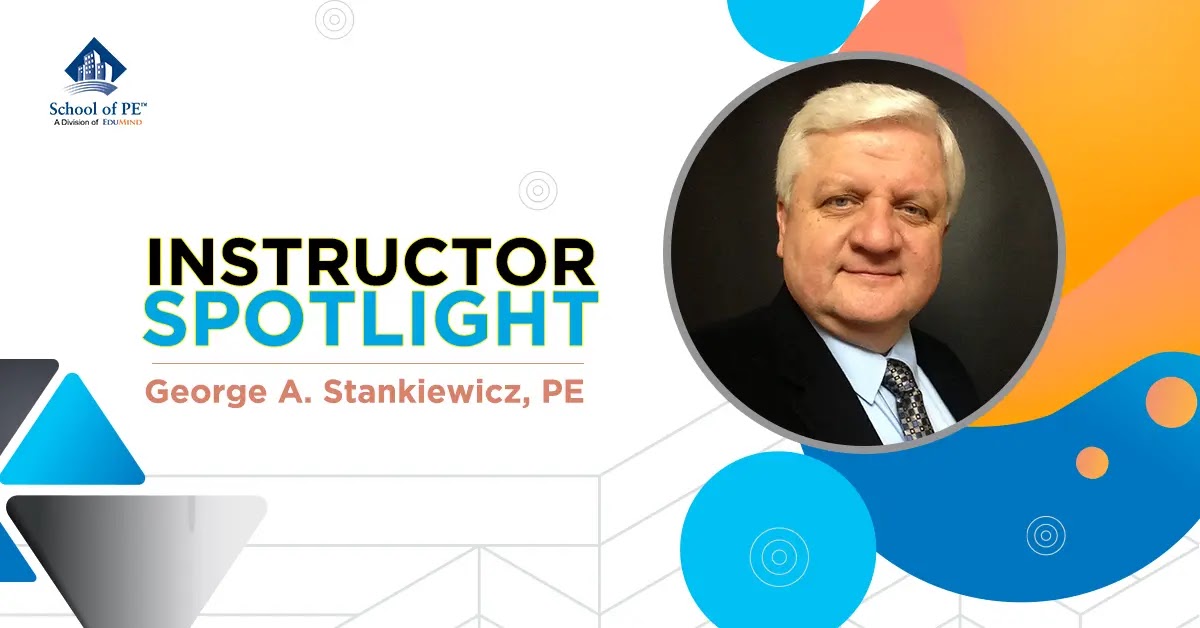
Instructor Spotlight: George A. Stankiewicz PE.

Instructor Spotlight: George A. Stankiewicz, PE.
At School of PE, we employ multiple instructors to teach the material in their areas of expertise-this sets us apart from our competitors. We have received a great deal of positive feedback from our students, and we believe that learning from experts in their respective areas provides the most comprehensive learning experience.
Our Instructor/Author Spotlight series gives you a peek behind the scenes with some of School of PE's highly acclaimed instructors. Read on to find out more about our very own George A. Stankiewicz, PE.
With more than 14 years of providing instruction to 10,000 candidates at School of PE, Mr. Stankiewicz has two undergraduate degrees and a master's degree in management with more than 35 years of experience in the construction industry. Specializing in general building construction, he has played an active executive role in the construction of nearly $1 billion in total projects within the public and private sectors. His broad background in projects engaged with the federal, state, and local governments, universities, and major corporate clients have strengthened his skills as a leader.
As an adjunct instructor for the graduate school of engineering at a major East Coast technology institute, he taught courses in Construction Management, Systems in Building Design (Civil-M/E/P/F), and Project Scheduling. Mr. Stankiewicz has proven teaching experience with School of PE with courses in Surveying, Construction, Materials, Engineering Economics, Statistics and Probability Refresher, California Surveying Refresher, and Project Management.
He has authored chapters for School of PE's FE Civil Exam Review Guide and both volumes of the new PE Civil Exam Review Guide: Construction.
What attracted you to your chosen field/area of expertise?
Construction engineering became my career choice as a consequence of my interests growing up. I enjoyed working with my dad, an auto mechanic, which led to my curiosity in learning how things work and are put together. My focus on building construction came from an interest in understanding the mechanics required and envisioned in the physical world.
As an undergraduate, it was easy to understand the mathematics of engineering principles and immediately apply them to the things I was working with. Newton's laws were quickly applied to static equilibrium, as were Bernoulli's equations for fluid flow. I began to master the principles and reached an expert level with structural, mechanical, electrical, and plumbing systems. The interpretation and application of the International Building Code (IBC) to building construction is an ever-present challenge, as each building project is a unique standalone product.
My career started with projects within the public sector. Municipal, county, state, university, federal, and major corporate projects varied. I worked on many projects, such as municipal schools, county courthouses, US foreign embassies, and with several corporate clients, such as Verizon, AT&T, and Disney. Additionally, I was an adjunct instructor at the New Jersey Institute of Technology, Graduate School of Civil Engineering, teaching subjects in construction management, systems in building construction, and project scheduling for nearly 10 years.
What do you consider your greatest accomplishment during your career as a professional engineer?
Working with people in various engineering disciplines and construction trades while learning from their diverse ways of thinking is a daily accomplishment that seeks no praise. Knowing the engineering behind the assembly of a building and coordinating everyone's effort for the project's success is the reward the team works toward. The tasks are indeed repetitive, but their application varies in many ways.
Applying engineering principles and teaching is a rewarding experience and a career accomplishment I value.
What is the most rewarding thing about being an instructor for School of PE?
The reward for an instructor comes from an engagement with like-minded individuals and connecting the many ways of solving problems. School of PE offers the candidate a knowledge refresher of the basic concepts learned as an undergraduate and advancing the concepts to engineering work.
For example, the equations for solving force vector's magnitude and orientation are very academic, but adapting the principles when working with the forces to assemble a building requires factors of safety to be accommodated. The building code relies on a safety orientation to assure the health and safety of the workers during construction and the general public when the permanent building is complete. Organizing the information and helping to find the solution steps is the goal of success.
What is your approach to teaching exam prep?
The approach to teaching is having students go back to the early years of their education and remind them of the elementary knowledge they possess and bring it forward into the world of applied engineering. Knowledge of geometry transfers to land surveying, simple leverage mechanics apply to know how a crane works safely, simple beam analysis transfers to be able to design bridges, and so on.
The exam review course stresses the three tenets of learning. First, the concept or fundamental building blocks behind engineering principles. Second, terminology or language-specific terms belonging to engineering principles. And third, the application of math equations that finds the solution to the question. Each concept reviewed in the refresher course is on the exam.
My focus is to teach candidates how to understand an NCEES exam question and ask which words are relevant to the solution steps and which are distractors. The exam question tells a story-the premise for an engineering problem-and requires either a quantitative or nonquantitative solution. Each word in the question is a clue to arrive at the correct solution steps.
It is highly unlikely that anyone would be able to successfully answer 80 engineering questions on an 8-hour exam without some kind of prior exam prep. Therefore, the course uses the question/solution learning basics and continually explains the story of the question and the solution steps to avoid distractors and find the "most nearly" answer.
Knowing how to read a question and understand the purpose of all the words in the question is the most important learning the candidates are taught.
What is your advice for someone preparing for the FE/PE exam after a gap period?
My advice is to look deep inside your knowledge base toward all the things learned during the elementary and undergraduate years and transfer that knowledge to what engineers do every day, no matter which area of practice you've chosen. Often, candidates regret being 10 to 20 years from their undergraduate days when facing an exam that may advance their career or achieve a personal goal. That's a good thing. Your learned skillsets as an engineer post-graduation will help you achieve your goal.
The licensure application for each state's Board of Professional Engineers requires a minimum of 4 years of working experience. All exam candidates must be graduates of an ABET (Accreditation Board for Engineering and Technology) program, which assures that the undergraduate curriculum matches the NCEES exam standards.
NCEES encourages examinees to take a review course to refresh their knowledge base on topics that may not have been used since their undergraduate education.
What do you feel is the most important skill for an engineer?
Flexibility! There are many written opinions by the best minds in the world as to what makes an engineer. Good, bad, or indifferent, actually being on the job trains you to stay focused on the task at hand. However, we are creatures of habit and, at times, lazy, which can make us do the same thing time after time.
Flexibility in how you think, work with people, and solve problems allows these valuable skillsets to produce and find viable solutions.
Habitually, candidates compute a solution that is, for example, 52.0089001. However, the closest answer choices to the problem only include 50 or 55. Depending on the content of the question, good engineering judgment comes into play, as many of the answers on the exam are "most nearly." Therefore, if the question asks for the amp rating of an electrical circuit breaker, the answer is 55 amps - thereby addressing the need for safety. However, if the question asks about the factor of safety for a retaining wall, the answer is 50, as 55 is not achieved.
What study strategies would you suggest for someone taking the PE Civil exam?
Focus on the basics! Basic meaning math (PEMDAS), algebra, geometry, trigonometry (SOH, CAH, TOA), Pythagorean theorem, Cartesian coordinate system, conversion factors, simple beam analysis, shear, moment (M = F ê“• D), centroid, the center of gravity, tributary area, load paths, ratios, and proportions.
Focus on reading the question and highlight the content of what the question is asking. Solve for the actual question versus what you may believe is the question.
A few strategies are:
  • Break up the original question into simpler segments and solve each piece individually.
  • Visualize the problem by drawing a picture.
  • Work backward, review the answers, and note the spread among the solution and the level of precision (that is, significant digits).
  • Apply strategies of common sense and good engineering judgment.
  • Manage your time during the exam and answer questions from the perceived easiest to the harder. This is an important strategy. Skip questions. Do not start at one and move to the next. You need to build confidence, and it is very easy to lose 20 minutes on one question.
  • Prepare all the reference materials the NCEES will provide during the exam. A common misconception is that the NCEES-provided PE Civil Reference Handbook has all the answers in it and that it is just a matter of finding them. Just like the FE Civil exam, the reference material provides a guide for a solution but not an answer.
  • Use the NCEES design standards as most of the effort during the depth part of the exam will be to find the information. Become familiar with the structure and organization of the design standards to avoid being surprised during exam day.
  • Use the NCEES Examinee Guide, which is the official guide to policies and procedures for all NCEES exams found on their website. Visit the NCEES website to view YouTube videos to help you become familiar with the exam structure and processes. Use the NCEES resources available to you.
  • Follow the guidance of your School of PE instructors, as they have the experience and depth of knowledge to share for your preparation.
  • Don't be surprised. There will be topics on the exam that you may never have encountered. Move on and let them not become distractors.
What advice do you have for someone who is undecided regarding their specific area of expertise?
Always lead with "what you know." Candidates are often in jobs or have work experiences that do not exactly fit the civil engineering discipline and the five areas of practice, namely: construction, geotechnical, structural, transportation, and water resources.
Often, they explore unsubstantiated theories that one exam area of practice is easier than another or select an area of practice that is a close match to their job. The best approach is to take an inventory using the NCEES' exam specification, check off the topics that they perceive they are best at, and select the area of practice that prevails in their inventory.
What are the biggest challenges with obtaining PE licensure/certification?
Discipline!
Year after year, candidates comment that there is just too much information to study, or they do not have the time for self-study to complete all the workshop questions, etc. The exam is similar to your job-it's hard work, but nobody ever said it would be easy.
Therefore, make the commitment and stick with it.
Why would you recommend taking an exam review course to prepare for the PE Civil exam?
Take the advice of NCEES. They say on their website to prepare for the exam, use the NCEES exam specifications, and study the topics that relate to each of the 5 depth areas of practice. The exam is very broad in its area of practice, and 70% (or 57) of the questions must be answered correctly.
Oftentimes, candidates believe that, for example, they are perfect in the area of Transportation since they repeatedly perform tasks related to Transportation, likely successfully, on a daily basis while on the job. They are confident they will score 100% on their exam topic. However, this logic only earns 60% for the passing grade (48 correct/80 questions). This also assumes that the transportation skillset is answering every question correctly.
That's why a good strategy is to study everything you do not know. Why? If you perceive yourself as being perfect at one topic, then do not study what you already know, the probability is that you will achieve the greatest point score for that topic. Study and increase your skillset with the topics that you do not know to mitigate the probability of any missed questions or shortfalls within your most comfortable topic.
Remember that the PE Civil exam is a skills level exam. Aim to increase your skillset for success. It is based on what every engineer should know with 4 years of experience on the job. The repeatedly learned skills alone you have developed on the job will help you pass the exam.
If you are a repeat taker, use the NCEES' results score and improve your understanding of the areas of practice where you received a low score. School of PE offers personal guidance to help understand the shortfalls and increase your skills.
Taking the School of PE exam review course allows you to build confidence, motivates you to set goals, teaches you how to be flexible, and brings out the enthusiasm and inner passion to succeed, as well as having fun while sharing strengths with your online cohorts.

Thursday, 26 January 2023

Performing Engineer's Cost Estimates for Small Construction Projects

Performing Engineer’s Cost Estimates for Small Construction Projects
Should we stop using him? Why did he tell us it would only cost $13,000 when it actually cost $36,000? We have been using him for almost four years, and all of his engineer's estimates have been close enough for financial planning purposes. It may take well over ten thousand dollars to find another consultant and familiarize him with our procedures. Well, maybe we should find out why his engineering cost estimate was so far off. What method(s) did he use? Why is cost estimating small construction projects so complicated?
To develop and prepare a reliable estimate, you may choose to estimate the project by several methods. A construction cost estimate, which is also called an engineer's cost estimate, is a decision-making tool.
How to Create a Cost Estimate
These include searching your project records, searching the internet to find lump sum costs for similar projects, asking the city or governing body (whether it is a local, county, federal or tribal government) what they think the project will cost, using your own professional judgment, or estimating the project cost by counting the approximate number of hours and cost of materials. Include what you think overhead and profit will be for this project. Some advantages of contacting the governing authority are that you will learn whether a building permit is needed, and you can find out which construction contractor has successfully performed work in your jurisdiction. A good question to ask is whether the contractor is licensed and insured.
When you have an estimate ready to submit to the owner, have someone in your office who has experience performing these types of estimates check your work. Unit cost pricing and price per square foot estimating are of limited use when estimating the cost of small projects.
Defining a Small Project
For the purpose of this article, a small project is something that can be built for under $25,000 and requires formal design by a licensed landscape architect, licensed architect, or professional engineer. The price guidelines are for something built in a location with a reasonable cost of living as opposed to Northwest Los Angeles, the more expensive areas of Manhattan, or the San Francisco Bay Area. Many cost-estimating tools or guides provide an easy-to-use chart on the differences in pricing between varying locales within the country.
For a project in a rural area, it may be acceptable if a boundary is off by a few inches, whereas in Manhattan, an inch would be unacceptable deviance. More precise surveying will cost significantly more. Costs such as these are reflected in the engineer's cost estimate.
Example Scenarios
Small bedroom: As an example, there are so many variables to estimating the cost of adding a small bedroom. Questions that the estimator may seek answers to are: Will a significant amount of earthwork need to be done, and will it be a stand-alone structure? Does the contractor have a safety program, and has she had accidents in the past? What are the current costs of wood, concrete, and steel?
It is important to know if the contractor is environmentally conscious. Would she pour solvent or unused paint on the ground rather than bear the cost of disposing of it properly?
Short culvert: Another example of a small project is a short culvert constructed under a driveway. Even a seemingly simple project requires engineering and at least one bid. Design factors include the size of the culvert, the material that the culvert is constructed of, length, depth of cover, and anything added to the inlet and outlet of the pipe because an unsightly culvert can ruin the appearance of a front yard and profile of the lovely home.
Safety Considerations
If you have been awarded a building permit, then the city or governing authority will inspect the project and work at the appropriate time(s). If you have been working as an engineer, architect, or scientist, you may have seen deadly construction accidents or those that resulted in the loss of body parts such as fingers. When a person works with his hands and they are mangled, he can no longer perform his job function, which makes it hard for him to support his family. The cost of safety should be part of the estimate.
Obtaining Multiple Bids
For small projects, it may not be necessary to obtain multiple bids. It may be fine to do your research on builders and ask one of them for a quote. If it is acceptable and in line with the engineer's cost estimate, you could just select them. This would save you the time of showing the site to potential bidders, copying multiple sets of plans, and answering questions.
Conclusion
An engineer's cost estimate is meant to inform you whether you have enough funds to complete the project, and it can help you to decide whether you want to proceed with the project. For a large project, profit and overhead may be low compared to the cost of the work. For a small project which may take parts of one or two days, the overhead may be higher because the contractor may not be able to perform other work that day, so the owner actually must pay for the anticipated downtime. Also, equipment, supplies, and materials may need to be ordered or reordered to make up for the materials used on this small job; as an example, outdoor piping includes pipe, bedding, and backfill material. The city may require that special inspection and soil compaction testing be performed. This can cost a significant dollar amount which is passed onto the owner.
Contractors are in business to make money, so they must make a profit on every job. I have seen situations where "small-time" local contractors are struggling to survive and live in someone's garage or sleep in their car. Small contractors, not major engineering and construction companies, construct these small projects.
These estimating techniques are for engineering and construction but are not generally useful for scientific research, which is difficult to perform within a specific budget or timeframe.
Even a simple short retaining wall that is generally constructed of concrete block or cast-in-place concrete with reinforcing steel (rebar) can cost a significant amount, so it should be estimated before a contractor is chosen.
Hopefully, the writer of this little blog will have helped you to be up to the challenge of addressing the variations in the scope of the project and developing a cost estimate for small projects.
Interested in earning your professional engineering license? School of PE's comprehensive courses provide what you need to succeed when exam day arrives! Register today.
About the Author: Keith Warwick, PE

Keith Warwick has been a licensed professional civil engineer since 1983. He earned a Bachelor of Science Degree in Civil Engineering from the University of Davis and completed coursework in Biblical Counseling from Grace Theological Seminary in Winona Lake, Indiana. He has managed his own firm, PATTY and KEITH, INC. since 2008. He has performed civil engineering design, worked as an engineering instructor for Yuba College in Marysville CA, performed safety and environmental inspections, and performed Commercial Real Estate Due Diligence. He is the author of several books including California's Highway 99: Modesto to Bakersfield.

Thursday, 29 December 2022

Opening a Civil Engineering Consulting Firm

Opening a Civil Engineering Consulting Firm
"I don't like my job."
"I would like to be my own boss."
"I want to be fairly compensated for my qualifications and efforts."
"I cannot take another day of my current position."
If you can relate to any of these sentiments, opening your own engineering consulting firm might be a great option. Whether you're currently employed, between jobs, or retired, now might be an ideal time to make the transition to being self-employed.
1. Providing Autonomy
Many companies or governmental agencies prefer employees to retire while they are still relatively young-between the ages of 55 and 60. An advantage of having your own firm is that you can work as late in life as you would like to. You can choose to work full-time or part-time, set your own hours, and can accept or decline any assignments offered to you. If you are an early riser, you may start the day at 4:00 am and finish by noon or even earlier. Alternately, if you are a night owl, you could start the productive part of your day at 10:00 pm when the house is quiet and the television is off, so you can work productively until 4:00 or 5:00 am. Although working seven days a week is not recommended, some choose to work for four or five hours a day, seven days a week. You might even want to hire employees if your eventual goal is to become a larger firm.
2. Figuring Out How Much to Charge
You may agree to design something and inspect it as needed for a set price. If there is a change in scope, you can add to your original fee. Generally, though, consultants are paid by the hour. The best way to know what to charge is by doing some research or by asking other engineers that you trust how much they bill for similar services. Even small professional interactions like that can help you gain credibility and build mutually beneficial relationships.
3. Working from Home vs. Working in an Office
There are pros and cons of working from an office outside of your home, just as there are pros and cons of working within your own home. A disadvantage of working from home is you may have traffic many times during the day if you conduct meetings at your home office. While your neighbors may be friendly and supportive, they may not appreciate the congestion caused by a steady stream of vehicles. Therefore, it may be best to hold meetings someplace other than your home.
4. Obtaining the Proper Insurance
Being self-employed, you would be wise to obtain errors and omissions insurance to protect yourself from getting sued. This type of insurance provides specialized liability protection against damages not covered by conventional liability insurance. It protects you and your company from liability if a client were to file a lawsuit over careless actions, mistakes, or omissions made while conducting business that resulted in a monetary loss. If you see clients in your home, you will need business insurance as well.
5. Selecting Projects
As a consultant, you must have experience performing the tasks you are asked to perform. You must be organized and skilled to be both the engineer and approver. Your accurate assessment of your abilities will prompt you to accept assignments that you are qualified to perform. While big projects are great, small ones are fine, too, and may be more manageable. You may want to leave the big projects to the large engineering and construction companies. Don't be afraid to say no.
6. Establishing Training Protocols
As you get your business off the ground, establishing a regular human performance improvement (HPI) training protocol for yourself and other employees (if applicable) could be beneficial. HPI is a strategy for improving performance and outcomes and can include training as well as considering causes for problems beyond knowledge and skill gaps. Everyone in an organization could benefit from a defined HPI program, which will enhance morale and result in fewer mistakes and accidents.
It is important for consultants and their staff to receive ongoing training to stay current with new technology and new industry practices. Engineers, architects, and landscape architects can easily become consultants assuming they have the appropriate licenses.
7. Hiring Staff
Many people who open consulting firms may be the only person in the firm and may use other personnel services such as freelance drafters. There are disadvantages to using freelancers. You may have a rush job, and your regular draftsman or graphic artist may be busy for the next week, so they cannot help you. If you have an employee, you can quickly direct them to undertake the needed assignment. Also, because they would not be full-time employees, freelancers may not understand the nuances of how your firm operates.
8. Self-Evaluation
One disadvantage of being your boss and possibly not having a team (at least initially) is that you do not have a manager who can review your work or give you performance appraisals and bonuses. It is important to develop a good rapport with your clients in order to improve your credibility and the chances of being referred for future jobs.
9. Other Suggestions
It is good to obtain the services of a bookkeeping, payroll, and tax service, especially if you are inexperienced in these areas. You should also evaluate your own physical condition to determine whether performing physical tasks is suitable for you. There are risks associated with working onsite, so if this type of work is not for you, an office job might be more suitable. You could enlist the services of an inspector if one is needed.
Only accept assignments with which you are fully familiar. Do not deplete your resources. If your firm consists of only one or two engineers plus a small staff, you will not have the time or confidence to design a $10 million shopping center. You can negotiate deadlines, though.
One way to garner work is to get on acceptable municipality, county, or branches of the state government, bidders lists. The requirement to become an accepted bidder may be easier than you think!
Conclusion
Keep in mind that when you establish yourself as the owner of a business, you become the president, manager, and engineer for your projects. It could be helpful to talk to other engineers in similar positions to get their firsthand experience and advice. Make a list of pros and cons to help determine if this career move is right for you.
About the Author: Keith Warwick, PE

Keith Warwick has been a licensed professional civil engineer since 1983. He earned a Bachelor of Science Degree in Civil Engineering from the University of Davis and completed coursework in Biblical Counseling from Grace Theological Seminary in Winona Lake, Indiana. He has managed his own firm, PATTY and KEITH, INC. since 2008. He has performed civil engineering design, worked as an engineering instructor for Yuba College in Marysville CA, performed safety and environmental inspections, and performed Commercial Real Estate Due Diligence. He is the author of several books including California's Highway 99: Modesto to Bakersfield.

Thursday, 22 December 2022

The Benefits of Earning and Maintaining a Professional Engineer License

I have been practicing as a licensed professional engineer (PE) for about four (4) years now, and I can tell you that it is one of my proudest accomplishments and one of the greatest things that I have ever done for myself. I can truly say that the benefits of earning and maintaining a professional engineering license have far exceeded my initial expectations and have helped me continue to take good steps forward (and it has only been four years so far). The benefits of being a PE are much more than just passing the Fundamentals of Engineering (FE) and PE exams. You can become a better version of yourself, gain more appreciation for other licensed professionals, help others achieve their goals, expand your opportunities, and develop positive habits. Yes, it is very nice having "PE" written on your business card, but let's delve into more of these often-overlooked benefits.
The Benefits of Earning and Maintaining a Professional Engineer License
1. Become a Better Version of Yourself
I first mentioned becoming a better individual. I have always enjoyed engineering and science since there is always something new to learn. Engineering is a dynamic field, and the PE License helped me further my intellectual ambitions. The PE exam appealed to me in the first place because it was a much more practical exam compared to the FE exam. And I likened the PE license to being like a scientist, but without having to obtain a Doctor of Philosophy (PhD). Do not get me wrong; obtaining a PhD is an excellent accomplishment, but dissertations just seemed too specialized and did not truly appeal to me. The PE license can help you be a "practical scientist" of sorts, and there is so much I learned along the way. All PE exams offered by the National Council of Examiners for Engineering and Surveying (NCEES) have practical applications. Maintaining a PE license has helped me with my everyday life too, as I can better understand household items like two-phase and three-phase circuits, as well as gravity sewer pipe.
2. Find a Newfound Appreciation for Other Professionals
Earning and maintaining a professional engineer license has provided me with a newfound appreciation of other licensed professionals and is a humbling experience too. When I first received my PE exam result, I passed the PE exam (good for me), but I also realized that there was much more to learn yet (and I am still learning more with each day). I took the PE Mechanical (Thermal and Fluids Systems) exam in Oct 2018, and I certainly did not know the answer to every question that day. And I am certain that I guessed some questions wrong (NCEES does not release exam scores, and you do not receive a diagnostic report unless you failed the exam). But the entire exam, including the application process, studying, and exam day was certainly an excellent experience. I actually enjoyed the trials and tribulations, and the sense of accomplishment from going through it all.
3. Prove Your Abilities and Skills to Yourself
In fact, I consider the PE license to be one of my greatest accomplishments since I did it largely on my own merit and initiative. I had support from family of course, but I did my own studying and preparation, and conquered the PE exam myself. I have worked with certified public accountants (CPA), licensed landscape architects (LLA), and professional land surveyors (PLS). My one colleague explained to me his own trials and tribulations with earning his architecture license and becoming a registered architect. He too gathered his own study materials, sat for the exam, and is now enjoying similar benefits of earning and maintaining a professional architect license.
4. Help Others Recognize Their Potential and Achieve Their Goals
You can also help other co-workers and colleagues achieve their goals. Since becoming a licensed professional engineer, I have served as a PE reference for other aspiring engineers to gain their Engineer-In-Training (EIT) certification and providing EITs with advice for the PE exam. These other engineers will be going for their PE licensure soon, and they know that they can count on me to help them gain licensure. I am currently licensed in both Pennsylvania and New Jersey; as of this blog post, both states require five (5) references for PE licensure. Other states may vary in the United States, but generally you will need to draft a work experience narrative, gain endorsement from references, and complete a background check for PE licensure, among other items. NCEES may adjust licensure requirements every now and then (but some of this I already know because these are benefits from being a professional engineer!).
Really think about the potential here. You can become a better mentor, develop more leadership qualities. Just by virtue of having a PE license, you will become more valuable at your organization, even become indispensable. Outside of your professional life, you can also help your friends and peers. Many of my undergraduate friends are also engineers and have asked about my PE exam experience. People will come to you for your knowledge and advice on how to pass the PE exam (I first advised my friend on pass the FE exam back in college). As you help others, it will come back to help you be better too.
5. Expand Your Opportunities
Maintaining a professional engineering experience can help to expand your opportunities. I do not want to sound vainglorious, but I have enjoyed some elevated status since passing the PE exam. I received praise and recognition (and a bonus!) from my company when I first shared the exciting news. But remember, you should focus on helping others achieve their goals to form a mutualistic relationship and build a winning culture at your organization (do not let the PE status go to your head). As a licensed professional, you can stand-alone call yourself an engineer; this includes starting your own firm or business, if you wanted to pursue your own venture. You do not need a company or other organization to label yourself an engineer. But also remember, added responsibility comes with the status. In theory, I can PE sign engineering drawings in Pennsylvania and New Jersey but must ensure good quality and ethical standards.
6. Encourage Positive Habits
In addition to the career benefits, I also wanted to discuss how maintaining a professional engineer license encourages positive habits in other aspects of your life. While studying for the PE exam, I developed habits that I still apply today. Becoming a licensed PE does not happen overnight; you need to gain work experience as well as set aside study time, and both require a certain amount of discipline. You are always better from a place of accomplishment. I feel more accomplished with each blog post since the writing and reflection help me to stay fresh and reinforce knowledge.
Coming off graduate school, I had gained some weight from stress-eating (balancing workplace with night school was a challenge). I knew that I would feel sluggish on exam day if I was not in shape, so earning that professional license also led to improved cooking skills (my meals beforehand were boring anyways). Eating healthier provided me with better energy. Commencement was May 2018 and PE exam day was Oct 2018, so I also challenged myself to lose weight in time for exam day. Maintaining the license also encourages you to always keep learning and striving to improve yourself. I learned much just from my exam preparation, so I do not view my continuing education credits as a chore; rather these credit hours are an opportunity for more growth. And these positive habits have spread into other areas of my life.
Conclusion
In summary, earning and maintaining a PE license can only help you to achieve more in life, both professionally and personally. I have not met an individual who regretted obtaining a PE license. The continuous improvement of maintaining helps to evaluate your different strengths and weaknesses. This will help you identify areas of improvement so you can be a better engineer going forward, especially if you are PE signing engineering plans one day. Even the reference handbooks are good for my own personal library, not just for passing the FE and PE exams, but there is a lot of good literature that you can refer to in both your job and everyday life. The path to becoming a PE is not a chore, but rather an enrichment journey and something you can always look back on with pride. All that being said, would you agree that it would look cool to have the "PE" credentials next to your signature?
Interested in obtaining your professional engineering license but unsure where to start? School of PE has been in the business of helping busy individuals pass their professional certification and licensure exams since 2004. We have a wide variety of FE, PE, and SE courses available to help you achieve this goal-visit our website to learn more!

About the Author: Gregory Nicosia

Gregory Nicosia, PE is an engineer who has been practicing in the industry for eight years. His background includes natural gas, utilities, mechanical, and civil engineering. He earned his chemical engineering undergraduate degree at Drexel University (2014) and master's in business administration (MBA) from Penn State Harrisburg (2018). He received his EIT designation in 2014 and PE license in 2018. Mr. Nicosia firmly believes in continuing to grow his skillset to become a more well-rounded engineer and adapt to an ever-changing world.