Friday, 19 November 2021

What Are the Basics of Fire Alarm Systems?

The most important aspect of fire protection engineering is occupant safety. The best way for a person to survive a fire is to get out of the building as soon as possible. A fire alarm system should not only alert occupants of a fire with an evacuation sound but also call the local fire department to extinguish the fire.
1. Control Panels
The "brains" of a typical fire alarm system is the control panel. The control panel receives inputs from detectors and decides what the outputs should be. For example, if the control panel receives a certain signal from a duct detector, it will shut down the associated air handling unit and send a notification for maintenance but will not necessarily sound a general evacuation alarm or call the fire department. However, if a control panel finds that the sprinkler system has been activated through a waterflow alarm, it will sound an alarm so the occupants can leave and notify the fire department. The ability of the fire alarm control panel to communicate with authorities is paramount-the sooner the fire department is notified, the faster they can fight the fire and keep it under control. Additionally, the fire alarm control panel can control other building systems, such as recalling elevators to the first floor or activating a smoke control system. The control panel is also a good resource for firefighters to find out where the fire has occurred, as many of them have displays telling which device has been activated. A fire alarm system might also have an annunciator, which is placed at the main entrance of a building to inform responding firefighters on the situation.
What Are the Basics of Fire Alarm Systems?
2. Fire Detectors
An aspect of fire alarm systems that many people are familiar with are fire detectors, as it is a requirement to have functioning smoke alarms in every residential structure. Smoke alarms provide an audible signal to alert occupants that they should evacuate. In fact, a smoke alarm helped save one of my relatives' homes from certain doom. They had forgotten a pot of food on the stove and left for work-after a couple of hours, the pot began to produce enough smoke to activate the smoke alarms. The neighbors heard the alarm and checked on the house. When they smelled smoke, they called the fire department who promptly arrived and saved the house from serious damage.
Every house should have a smoke alarm in each bedroom to save lives and property. For commercial applications, there are several types of detectors, including smoke, (which sense particles in the air), heat (which trip when a temperature threshold has been reached), and optical detectors (which pick up on infrared or other spectral bands). These detectors send a signal back to the fire alarm control panel. The type of hazard and environment will determine what type of detectors are used. For instance, in a sawmill, a smoke detector might activate constantly with all the dust in the air, so a heat or optical detector might be more appropriate.
3. Notification Systems
Once a detector has sent an alarm signal to the fire alarm control panel, the notification system will activate so that occupants can leave. The device that people are probably most familiar with is the horn/strobe, through which a light will flash and an audible signal will be emitted. Both the light and sound are designed to alert the occupant of the emergency. For high-occupancy buildings such as stadiums or concert halls, a speaker system may be used as well as strobes to provide exact instructions to the occupants. These systems, known as emergency voice/alarm communications systems, can guide occupants to the best exit and provide them more information on the emergency. These systems can also be used by the fire department for crowd control.
Fire alarm systems are integral to fire protection engineering. They save lives and property and give the responding fire department a head start in fighting the fire. Understanding these systems is essential for a safely built environment.


About the Author: Nick Tran

Nick Tran is a licensed Mechanical and Fire Protection Engineer in California. He has an Associates degree in Computer Aided Design from De Anza College, a Bachelor of Science degree in Mechanical Engineering from San Jose State, and a Master of Science degree in Fire Protection Engineering from Cal Poly SLO. He is currently on the UL Standards Technical Panel for UL 38 and was president of the Alameda County Fire Prevention Officers Association.

Friday, 12 November 2021

What Are the Basics of Egress?

The main goal of safety in a built environment is to get occupants out of a building as quickly as possible in the event of an emergency. Fire protection engineers work to arrange exits in such a way that all occupants can leave safely before they are overcome by heat or smoke.
1. Components of Egress
The way to leave a building is defined as the means of egress, which is a continuous and unobstructed path from inside a building to the public way. The means of egress is split into three distinct parts: exit access, exit, and exit discharge. The exit access is the pathway leading to an exit. An example would be the path between cubicles to get to an exit corridor. The exit provides a protected path to the exit discharge. Corridors and stairwells are common examples of an exit and are often protected by fire walls. The exit discharge connects the exit to the public way. This can be an exterior path leading from the building to the public sidewalk. All three aspects are required for a means of egress to be code compliant.
What Are the Basics of Egress?
2. Egress Requirements Change Based on Number of Occupants
Intuitively, the more people there are in a building, the more exits are required for egress. If there are 49 people or less in a room, only one exit is required. A space containing between 50 and 499 people requires two exits, 500 to 999 occupants require three exits, and an area with over 1000 occupants would require a minimum of four exits. The number of occupants that are allowed to be in a particular area is determined by the occupant load calculation. The occupant load calculation is performed by dividing the area by the occupant load factor, which can be found in the applicable life safety code (NFPA 101, IBC, local codes, etc.).
Using a business occupancy as an example, the occupant load factor according to the IBC is 150 square feet per person, so a 10,000 square foot office space can have a maximum of 66 people (10,000 square feet divided by 150 square feet per person). This also means there must be a minimum of two exits from the space. The square footage per person varies by occupancy type. For instance, a warehouse could have an occupant load factor of 500 square feet per person while an event center could have an occupant load factor of 15 square feet per person. Changes in occupancy are important to recognize because that same 10,000 square foot office space could be converted to an event center, which would increase the occupant load to 666 people (10,000 square feet divided by 15 square feet per person), and an additional exit would be required.
3. Egress Placement and Size Requirements
The locations of the exits must also be considered. Exits cannot be too close together; the exits in a sprinklered building must be separated by at least 1/3 the diagonal distance of a room, and that distance increases to 1/2 diagonal distance in an unsprinklered building. Exits cannot be obstructed or otherwise impeded by furniture or obstacles.
The width of the egress component must also be considered. For instance, two 32-inch doors would not be adequate to serve a concert hall with 400 occupants. Generally speaking, the width of the stairs and ramps can be found by multiplying the number of occupants by 0.3 and the width of the doors and other level components is found using a factor of 0.2. Therefore, the total width of doors required for the 400-person concert hall is 80 inches (400 times 0.2). This can be split between the two doors required, and one of the doors must be a minimum of 32 inches, which allows for passage of wheelchairs.
 Fire protection engineers must work with architects to determine the best ways to get people out in an emergency. Although fire suppression and detection systems are important, the goal is to evacuate the building before people are injured or killed. Ultimately, understanding the basics of egress will help save lives.

About the Author: Nick Tran

Nick Tran is a licensed Mechanical and Fire Protection Engineer in California. He has an Associates degree in Computer Aided Design from De Anza College, a Bachelor of Science degree in Mechanical Engineering from San Jose State, and a Master of Science degree in Fire Protection Engineering from Cal Poly SLO. He is currently on the UL Standards Technical Panel for UL 38 and was president of the Alameda County Fire Prevention Officers Association.

Friday, 5 November 2021

Why Become a Fire Protection Engineer?

Why should you become a licensed fire protection engineer? There are several important reasons why you should consider becoming a fire protection engineer, including societal impact, room for growth, and salary.
Fire protection engineering is unique in that it is the only engineering discipline in which everything is governed around protecting life and property.
  1. All the codes, research, testing, and development have one singular goal: ensuring the health and safety of people in the built environment.
  2. It is often said that the life safety codes are written in blood, and this idea is mostly true.
  3. As fire protection engineers learn more about fire dynamics and their impacts on human behavior, they continue to make changes in the relevant codes.
  4. Many engineers are interested in how their company affects the world or the environment, and even in the private sector, most fire protection engineering companies offer a way to positively influence society while providing challenging and enjoyable projects.
  5. No matter the type of work they do, a fire protection engineer will always be able to say they made a positive impact in their industry.
  6. If you are interested in working in an industry whose sole focus is on making life safer, then fire protection engineering is for you!
Why Become a Fire Protection Engineer?
Another reason you should consider fire protection engineering is the opportunity to grow and to make a mark on the industry.
  1. The fire protection engineering community is relatively small and not saturated like civil or mechanical engineering.
  2. In fact, in the state of California, there are only 800 active and licensed fire protection engineers, and of them, only 300 reside in the state.
  3. This means that if you are passionate about engineering, you will likely stand out amongst your peers and at the very least, you will be recognized by your peers as a highly specialized and talented employee.
  4. There is also a plethora of areas to explore in this field, including research, design, and code development. Fire protection engineering is a relatively new engineering discipline, with California licensing beginning in the late 1970s, compared to other more traditional disciplines, like civil which began licensing in the 1920s and mechanical beginning in the 1940s.
  5. If you want to be a part of a burgeoning industry, fire protection engineering is for you.
  6. Additionally, with the recent explosion of new construction, fire protection engineers are in demand now more than ever, which is an excellent segue to the next topic: salary.
While engineering in general is typically a lucrative profession, fire protection engineering can offer higher compensation because of the specialty and increased demand related to the position.
  1. According to the Bureau of Labor and Statistics, fire protection engineers (often classified as health and safety engineers) are slated to make an additional $4,000 per year over mechanical engineers and $6,000 per year over civil engineers (https://www.bls.gov/ooh/architecture-and-engineering/health-and-safety-engineers.htm, https://www.bls.gov/ooh/architecture-and-engineering/mechanical-engineers.htm, https://www.bls.gov/ooh/architecture-and-engineering/civil-engineers.htm).
  2. The job outlook is also rosy, as society becomes increasingly safety conscious, and more buildings are being constructed.
  3. There are also many foreign companies that heavily recruit for fire protection engineers and offer additional perks and benefits such as paid housing and travel allowances.
  4. Although satisfaction and recognition are important for any job, at the end of the day, we all need to pay the bills, and fire protection engineering provides fun and interesting career opportunities.
Engineering is noble and honorable work and is a great way to contribute to society while making a decent living. Fire protection engineering is no exception and magnifies the positive attributes of the engineering profession. If you are undecided about which discipline to get into, look no further than fire protection engineering!
About the Author: Nick Tran

Nick Tran is a licensed Mechanical and Fire Protection Engineer in California. He has an Associates degree in Computer Aided Design from De Anza College, a Bachelor of Science degree in Mechanical Engineering from San Jose State, and a Master of Science degree in Fire Protection Engineering from Cal Poly SLO. He is currently on the UL Standards Technical Panel for UL 38 and was president of the Alameda County Fire Prevention Officers Association.

Friday, 29 October 2021

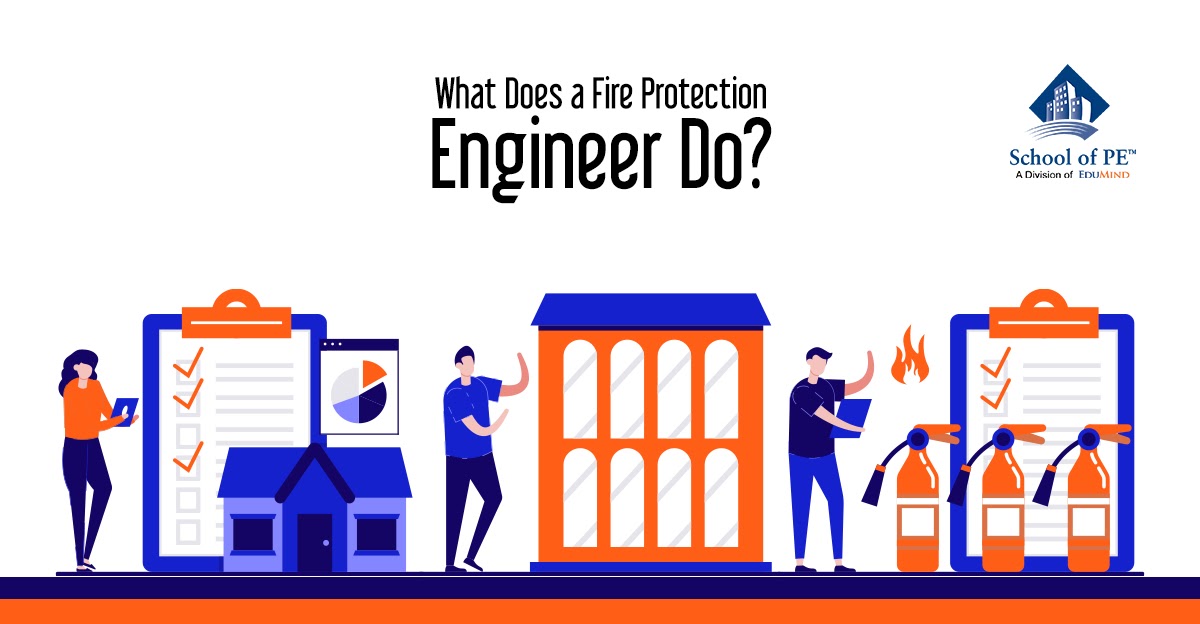
What does a fire protection engineer do?

I often get this question from inquisitive building owners and contractors, as well as nosy family members. Most people who ask about this profession are usually surprised at the depth of knowledge required of fire protection engineers. The short answer is that fire protection engineers are responsible for applying scientific theories and engineering practices to prevent death, injury, and reduce damage from fires and explosions. The longer answer requires a blog to flesh out some of the roles and responsibilities of a fire protection engineer.
Fire protection engineers typically operate in the built environment. They study the characteristics of fire and apply lessons learned to minimize the effects of fire. They work alongside architects, civil and structural engineers, and even mathematicians when producing fire prediction models. Fire protection engineers are essential in bringing safety to modern construction designs.
What does a fire protection engineer do?
One of the most common and recognizable purviews of the fire protection engineer involves the design of fire sprinkler systems. A fire protection engineer must understand the area hazards and ensure the fire sprinkler system is appropriate. For instance, a fire sprinkler system that protects an office space will not be sufficient in a tire storage facility, since tires present a significantly greater fuel load than items found in a typical office environment. Fire sprinkler systems fall under the general category active protection systems which means that an action occurs to influence the outcome of a fire. A common myth about active protection systems is that they are designed to extinguish the fire, but the truth is active protection systems are engineered to control the spread and contain the fire long enough for first responders to arrive. Other active protection systems include the use of carbon dioxide and foam to control fires from unique hazards. Fire protection engineers can also help create smoke control systems, which remove smoke from important areas such as atriums to make sure people can get out of the building safely.
Another active protection system that fire protection engineers design are fire alarm systems which provide an early warning to occupants to exit the building. Some common items in a fire alarm system include strobes that flash and horns that emit a loud pulsating sound. The fire protection engineer must ensure that these signals are able to reach all the people in the building and that the system will function correctly in the event of an emergency or power loss. Early detection saves lives by providing extra time for people to get away from the danger.
Fire protection engineers also work on passive protection systems, which aim to compartmentalize and prevent the spread of fire. These include fire rated walls that will resist fires for a certain amount of time and protect important areas, like exit corridors and high-hazard storage rooms. Passive protection systems provide additional time for occupants to exit and can limit the damage of a fire. Fire protection engineers collaborate with architects and other engineers to ensure that the building itself is appropriate for its intended function. Both active and passive protection systems are necessary for the safety of a building and the fire protection engineer is responsible to ensure both types of systems work together to save lives and property.
While recognizable and the subject of countless movies and TV shows, firefighters are the last resort against fires, whereas fire protection engineers are the first line of defense in the safety of lives and property. Fire protection engineers help reduce the severity of fires, allowing people more time to escape and minimizing the danger to heroic firefighters. Often overlooked, fire protection engineers are vital to the built environment and a safer society.

About the Author: Nick Tran

Nick Tran is a licensed Mechanical and Fire Protection Engineer in California. He has an Associates degree in Computer Aided Design from De Anza College, a Bachelor of Science degree in Mechanical Engineering from San Jose State, and a Master of Science degree in Fire Protection Engineering from Cal Poly SLO. He is currently on the UL Standards Technical Panel for UL 38 and was president of the Alameda County Fire Prevention Officers Association.

Friday, 22 October 2021

How Do I Acquire My PE Civil License in the United States?

Applying for and acquiring your PE Civil license in the United States is no simple task. There are multiple requirements that need to be fulfilled before you can receive your license, and each one takes some time and energy to ensure they are properly addressed. One of the benefits about the modern application process is that it is clearly laid out and streamlined. This blog will detail the steps necessary to achieve this advanced milestone of your engineering career!
1. Check Your State's Board Licensing Requirements
The first place to start when verifying what you need to achieve PE Civil licensure is your local state's Board of Professional Engineers and Land Surveyors. Although there are some similarities in requirements between various states, many states can have more specific requirements that need to be addressed. For instance, some states not only require you to pass the national PE Civil exam, but also state specific examinations such as surveying and seismic exams before licensure can be presented. The main items that will be required include:
  • A passing grade on both the FE and PE Civil exam.
  • A bachelor's degree in engineering from an EAC/ABET accredited program (or other equivalent degree combinations).
  • Engineering work experience.
  • References from other engineers.
Assuming you have the proper education requirements and work experience requirements, the next major step towards licensure is taking the national exam.
How Do I Acquire My PE Civil License in the United States?
2. The PE Civil Exam
The PE Civil Exam is the hardest part of getting licensed. It is an 8-hour, 80-question exam that is broken up into two parts: a morning session and an afternoon session. The morning session covers all the civil engineering fundamentals one will have learned through their educational experiences with an EAC/ABET-accredited program. The afternoon session is specific to your chosen discipline and delves deeper into the coverage of those specific topics and subjects. Applying for the exam can be completed through the NCEES website (https://ncees.org/). With proper effort, and with the help of a leading exam review course provider like School of PE, you should be able to pass the exam and move onto the state-specific application process itself.
3. The Application
Once you reach the application process for your state licensing board, you will first need to verify your states' preferred method of application submission. Some states will utilize what is known as an NCEES record-where the application can be electronically uploaded-which can help shorten application process times when trying to apply for additional licenses in other states. Other states utilize more traditional processes that involve mailing all pertinent documentation directly to the state licensing board. No matter which process your state uses, references from colleagues and peers will be a necessary component of your application. References need to be other professional engineers and individuals who can vouch for your work and provide insight on your relevant experience for the Board's review. Be sure to keep an eye out for state-specific reference requirements, such as all references needing to be provided from engineers licensed in the same state in which you are applying.
4. Conclusion
Once you have passed the national exam and added all the education, work experience, and reference requirements, you are ready to finally submit your application! Make sure to do one last review of the application and submittal requirements to make sure nothing is left out. There are plenty of stories of engineers getting applications rejected because of minor mistakes in the submittal process.
After a final review is complete, the last thing that will be needed is payment of the application fee which can be found on your state's licensing board website. Once the fee has been paid and all appropriate documents are sent in, you can finally kick back, relax, and wait for your licensure results! Soon, you'll be using your own seal!
About the Author: Eric Lawrence

Eric is a professional engineer with over 5 years of experience in the civil and stormwater industry. Prior to obtaining his master's degree from Colorado School of Mines, Eric attended Georgia State University where he played on the men's soccer team for four years. When Eric is not practicing engineering, he still enjoys kicking the soccer ball as well as hiking and traveling.

Wednesday, 13 October 2021

3 Steps to Passing the PE Civil Exam

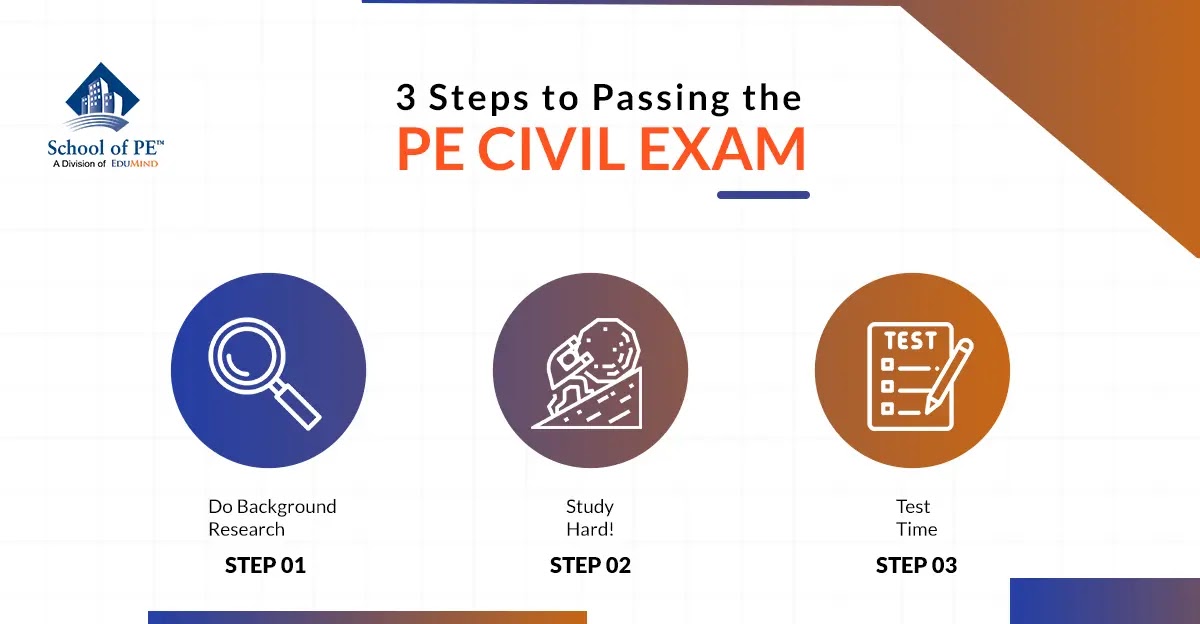
When trying to get ready to take the PE Civil exam, it is often tough to figure out where to start. Do you study old college textbooks hoping the material will match what will be presented on the exam? Do you purchase practice exams and review them repeatedly until the questions are seared into your brain? Or do you perform countless Google searches on exam study tips until your computer battery is completely drained? Oddly enough, elements of all the above are conducive efforts to try and prepare yourself for the PE Civil exam. I have simplified my own exam preparation experience into three steps below that should help provide some guidance on where and how to start your own studies!
3 Steps to Passing the PE Civil Exam

Step 1: Do Background Research
The PE Civil exam is a national exam that many individuals have successfully passed before you. If you have any friends or colleagues who have previously taken the exam (passed or not), reach out to them! Often, the way most people pass is by learning from the successes-and mistakes-of others' previous attempts. Next, go to NCEES' website and research the specific discipline you will be taking. Not only is this website where you will schedule your exam, but it is also full of useful resources for exam preparation. You will be able to find valuable information about many different elements of the exam like the format, which is one of the most important things to be ready for when taking the exam. Like tests in college, question formats and the allotted test time is something you will want to be aware of. The NCEES website, as well as others, will have useful information on the exact layout and format of the exam.
Step 2: Study Hard!
It is a long road ahead in terms of the study hours needed to pass the exam. You'll likely have to devote anywhere from 100-125 hours to exam preparation, if not more. You will want to spend your study time effectively; for instance, DON'T read a textbook cover to cover for hours on end analyzing every single word. Utilize the NCEES website to zero in on key concepts that will likely be covered in the exam and make those your focal point as you study. You can even take prep classes, like what School of PE offers, for the exam-which are well worth the money. Perhaps the best method of hands-on preparation for your exam will consist of solving practice problems. Practicing what you've learned is essential for memory retention. Some of the most effective study resources will allow you to not only solve practice problems, but also provide detailed solutions for the problems so you can cross check your work and pinpoint any errors you may have made.
Because this is the last time the PE Civil exam will be offered in the pencil-and-paper format, you will still be allowed to bring in your open book resources to the exam. You will need to organize these materials per NCEES standards. Utilize some of your study hours to create a reference system that you'll easily be able to sift through come test day. Using post-it tabs is a very popular method for quickly locating items in your textbook. After the October 2021 exam, however, the PE Civil will transition to CBT, in which case you will not be allowed any additional resources than the corresponding NCEES Reference Handbook.
Step 3: Test Time
The time has come. It's test day. Get as much sleep as you can the night before. Remember, this October 2021 is the last time the exam will be offered in the pencil-and-paper format. When you head to the test facility, be sure to bring all your reference materials organized per NCEES standards. This is the last time you will have the opportunity to bring any other reference material than the NCEES Reference Handbook.
The test will be broken down into two four-hour portions which will amount to 80 total questions. You'll take the first, more generalized "Breadth" portion in the morning and the second, more discipline- specific "Depth" portion in the afternoon. Not only will it be important to manage your time well during the test, but also to pace yourself and not be afraid to skip questions you don't feel confident answering. The morning portion is mentally taxing-you can wear yourself out before the afternoon portion begins if you're not careful. As you go through each question, make sure to read the problem statement carefully, as there can be some curve balls thrown in.
After those 8 hours are up, it's time to reap the rewards of all your hard work and effort over the past few months. You will be glad you spent the necessary time to prepare when you receive a passing grade!

About the Author: Eric Lawrence

Eric is a professional engineer with over 5 years of experience in the civil and stormwater industry. Prior to obtaining his master's degree from Colorado School of Mines, Eric attended Georgia State University where he played on the men's soccer team for four years. When Eric is not practicing engineering, he still enjoys kicking the soccer ball as well as hiking and traveling.

Friday, 8 October 2021

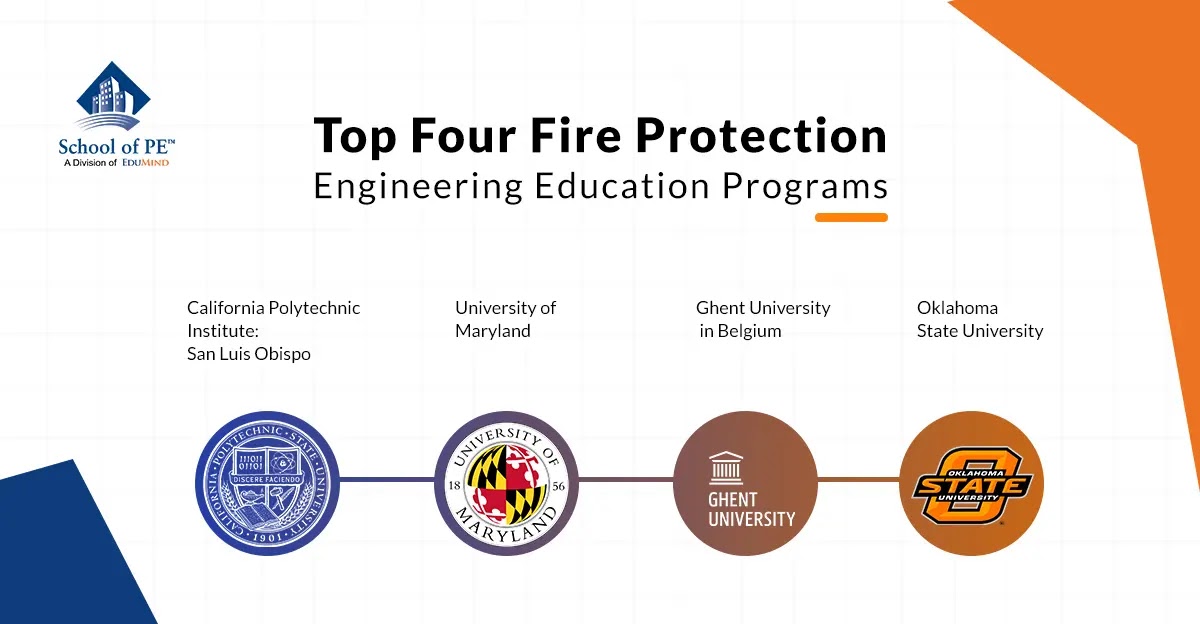
Top Four Fire Protection Engineering Education Programs

If you are interested in becoming a fire protection engineer, you will need to receive the proper education in the field before you begin the exam process. Here is a rundown of some of the fire protection engineering degree programs that I am personally familiar with. This blog is by no means exhaustive, and a more extensive list can be found here:
I graduated from California Polytechnic Institute: San Luis Obispo with a master's degree in fire protection engineering.
  1. The program was completely online and was very convenient to attend classes either live or recorded.
  2. I preferred to attend the classes live so I could ask questions as I went along and then watch the recordings for parts that I needed to review.
  3. All the instructors were extremely responsive, as I could expect an email response from them within the hour during the day and no longer than 24 hours, even on the weekends.
  4. They did offer in-person classes at the actual campus and a few students attended that way.
  5. The only negative about the program would be that some of the concepts would have been more easily understood in person, but that can be easily overcome by asking questions or attending in-person classes, and this issue is universal for all online programs.
  6. Overall, I would highly recommend getting your master's degree in fire protection engineering, and when you do sign up at https://fpe.calpoly.edu/, let them know that I sent you!
Another program I am familiar with is the bachelor's and master's program at the University of Maryland.
  1. They are the gold standard when it comes to fire protection engineering programs because they have significant research resources and outstanding faculty.
  2. Many of their professors are considered top tier in the fire protection industry and have many years of experience and knowledge.
  3. Most people with a degree in fire protection engineering are graduates of the University of Maryland and the alumni are very active post-graduation, so networking opportunities are likely to abound.
  4. If you are interviewing at a fire protection engineering consulting firm, chances are high that the interviewer is from the University of Maryland, and they will be familiar with your background.
  5. The University of Maryland boasts the only bachelor's degree program that is ABET accredited.
  6. You can find more information here: https://fireprotection.umd.edu/.
Top Four Fire Protection Engineering Education Programs
If you are interested in studying abroad, consider Ghent University in Belgium and their master's degree program for fire safety engineering.
  1. This is an English-speaking program that offers a unique European perspective on fire protection engineering, as they emphasize performance-based solutions rather than code-driven requirements.
  2. Ghent University is also part of a larger network of other world-renowned universities including the University of Edinburgh, Lund University, University of Queensland, ETH Zurich, and University of Maryland, so their program is able to provide resources from a multitude of top institutions. To find out more, visit https://studiekiezer.ugent.be/international-master-of-science-in-fire-safety-engineering-en/2021.
Another well-known program is at Oklahoma State University and their offering of a bachelor's and master's degree program in fire protection and safety engineering technology.
  1. Because they offer a degree in engineering technology, you should first check with your state's engineering licensing board to see if that qualifies you to take the professional engineering exam.
  2. Oklahoma State University offers a more hands-on approach to fire protection engineering in which students will actually don firefighting equipment and learn practical approaches to fire prevention. Learn more about this program here https://ceat.okstate.edu/det/fpset/.
There are many other excellent programs that provide college degrees in fire protection engineering. I would suggest you investigate all of them to see which one is right for you, but they will all undoubtedly lead to great outcomes for your career as a fire protection engineer!
About the Author: Nick Tran

Nick Tran is a licensed Mechanical and Fire Protection Engineer in California. He has an Associates degree in Computer Aided Design from De Anza College, a Bachelor of Science degree in Mechanical Engineering from San Jose State, and a Master of Science degree in Fire Protection Engineering from Cal Poly SLO. He is currently on the UL Standards Technical Panel for UL 38 and was president of the Alameda County Fire Prevention Officers Association.