Monday, 8 February 2021

How to become a Petroleum Engineer?

One might look at this question and assume the answer is obvious. Surely the way to become a petroleum engineer is by earning a petroleum engineering degree, right? That is one path to becoming a petroleum engineer, but it certainly isn't the only path.
I'll start by explaining that some people have become a petroleum engineer without actually earning an engineering degree. The petroleum field is extremely broad and people with a variety of educational backgrounds and experiences can achieve success in the industry. Geology is a core science to the petroleum field, so people with a geology degree can become a petroleum engineer if their education is paired with the right industry experience. That being said, lacking an engineering degree can become a hurdle for career development depending on career objectives. In particular, it can be a hurdle for those seeking licensure as a professional engineer. If licensure is a goal, earning an ABET-accredited engineering degree is the best option. I'll briefly describe the three most common educational backgrounds that lead to a career in petroleum engineering.
1. Petroleum Engineering Undergraduate Degree
We'll start with the most obvious path. A degree in petroleum engineering is excellent preparation for an individual looking to have a career as a petroleum engineer. A typical curriculum will include coursework in geology, reservoir engineering, drilling engineering, and production engineering. Many programs include additional courses that are very beneficial to the modern petroleum engineer. These additional courses cover subjects such as finance, economics, and chemistry. In recent years, data analysis has become an essential skill for most petroleum engineers and, therefore, some curricula are beginning to include related courses either as required or as an elective. The typical curriculum is tailored specifically to a career in the petroleum field and offers aspiring petroleum engineers an excellent opportunity to develop relevant and valuable skills.
How to become a petroleum engineer
2. Mechanical Engineering Undergraduate Degree
The petroleum industry is filled with engineers who hold a degree in mechanical engineering. It is often regarded as the broadest of all engineering disciplines. Students enrolled in mechanical engineering programs typically develop a deep understanding of fundamental engineering principles. It is this thorough understanding of engineering fundamentals that gives them great potential as a petroleum engineer. Although a mechanical engineering program does not typically cover petroleum-specific concepts, it provides a strong foundation upon which an individual can learn the relevant concepts through on the job training or additional education. It just so happens that the oilfield is full of machines such as pumps, compressors, generators, and engines. Naturally, mechanical engineers are well suited to design and repair these machines. It is because of this that you often find mechanical engineers working in the petroleum industry for service companies. The experience gained with these service companies and suppliers is just the type of experience that can help a mechanical engineer become a great petroleum engineer.
3. Chemical Engineering Undergraduate Degree
Chemical engineers find their way into all aspects of the petroleum industry, and for good reason. They go through a rigorous set of courses while in school and develop many skills directly related to the industry. For starters, much of a chemical engineer's education focuses on the downstream refinement of crude oil. The economic extraction of crude oil from the earth is the most fundamental objective of petroleum engineers. Thermodynamics and fluid mechanics are two subjects central to the petroleum engineering discipline. Chemical engineers happen to spend a great deal of their schooling focused on an in-depth understanding of these same subjects. Considering how much overlap there is, both in education and application, it only makes sense that some chemical engineers would retool themselves as petroleum engineers.
For anyone interested in becoming a petroleum engineer, these three degrees offer excellent preparation for a long and prosperous career. Which of the three is right for any one person will depend on a number of variables such as personal interest and level of career path certainty. While a petroleum engineering degree offers a most direct route to becoming a petroleum engineer, it is a niche degree. For an aspiring engineer not yet sure which discipline they want to focus their career on, both mechanical and chemical engineering offer the opportunity to work in the petroleum industry as well as many other industries.


Thursday, 4 February 2021

Are you ready to pass the Electrical PE exam? Here is what it takes

Work until You no longer have to introduce yourself. - Harvey Spector
The key element in building a successful career path is a continuous thirst for knowledge.
Your investment in time and resources for continuous education, certification, and license programs can lead to provide recognition to your specialized knowledge or skill set.
Let's talk about PE exams in detail. The majority of the engineers who take the PE exams are working a full-time job and wish to expand their career prospects by getting licensed. It takes a lot of effort to get licensed as a Professional Engineer and the outcome is always fruitful. Passing their PE exam is the first step to be able to get licensed. One needs to have an ABET-accredited 4-year degree, pass the FE, PE exams, and satisfy the minimum experience requirement set by the particular state.
Sounds like a long journey? Believe me, it gets better with each step towards the goal.
The Obstacles and their Solutions
The moment one decides to take the PE exam, they have to sacrifice something to achieve this feat. The majority of the Engineers take their FE exam right after graduation to redeem the knowledge and skills they have recently learned.
A longer period away from school or continuous learning can lead to fading knowledge.
One of the biggest hurdles while preparing for the PE exam is the fact that one has to work their 8-hour day shift and return home to engage the mind for a few hours again. I had my share of mental exhaustion, regardless, I realized sooner that the key to passing the PE Electrical exam, no matter which discipline you take is sticking to a schedule and building the knowledge for a couple of months before taking the exam.
A couple of months of sacrificing those weekend getaways, Friday night hangouts, and daily Netflix after dinner. Does that sound a lot? I have done it all. Stay assured, it will be worth it.
Are you ready to pass the Electrical PE exam? Here is what it takes
Key Points to Remember
PE Electrical exam is an 8-hour long exam that tests your knowledge on a variety of topics in depth. Hence, it's not a sprint but a marathon. It's very difficult to clear such an exam by cramming for a few days and requires dedicated effort every day until the day of the exam.
Depending on the discipline that one decides to take the PE electrical exam, the preparation can vary. NCEES offers the PE Electrical exam in Computer Engineering and Power. The majority of the test takes are in the Power industry as the PE license is highly valued and Engineering projects are often signed by a licensed PE.
The best way to start preparing for either of the PE Electrical exams is to be adamant about your vision and invest time regardless. Don't forget to give yourself a day off every now & then so as not to burn out. Remember, it's a marathon!
It's easy to get off-track but one must try to cover up when that happens. It is also a good idea to take a refresher course too. The majority of the companies intend to invest in their employees and are willing to pay for the refresher courses and the exam fees. Take advantage of that if your employer is offering this. The major advantage of the course is that it will keep you on track with your preparation. School of PE offers these refresher courses that have helped hundreds of Engineers pass the exam on their first attempt.
The last vital preparation tip is to take timed mock tests in an environment that would be similar to the test. This exposes your weaknesses and helps you work on them. There is no room for escape and denials. I remember practicing with one eye on the clock to track my pace. I must confess, I had my share of escapes and frustration. It didn't disappoint me though. It made me better in every next attempt.
Lastly, don't go for the exam with the attitude of "Giving it a shot". There is no harm in over-preparing but a lot to lose in under preparing. Repeating the entire journey is difficult when you choose to take shortcuts to reach the goal. Take your time at each stop to research, prepare, learn, and proceed. The light at the end of that tunnel is constant, you just have to choose the right path and keep moving forward.

Monday, 1 February 2021

Why Should A Petroleum Engineer Become A Licensed Professional Engineer?

Licensed professional engineers can be found in all engineering disciplines. However, it is far more common in some disciplines than in others. Civil engineers, for example, routinely pursue a P.E. license. Aside from prestige and increased credibility, civil engineers often pursue licensure because failing to do so can be very limiting to their career development. At its core, a professional engineering license is a mechanism to protect the public by ensuring that licensed engineers have a minimum standard of experience, education, and competency. Compared to other engineering disciplines, civil engineering projects more often involve projects that directly impact the health and safety of people. It is because of this that civil engineers so often pursue licensure.
Petroleum engineers, on the other hand, have historically worked on projects that do not directly impact public health and safety. Therefore, it is not all that common for petroleum engineers to pursue licensure. One may ask, why should a petroleum engineer become a licensed P.E.? There are several reasons, a few of which are described below.
Why Should A Petroleum Engineer Become A Licensed Professional Engineer?
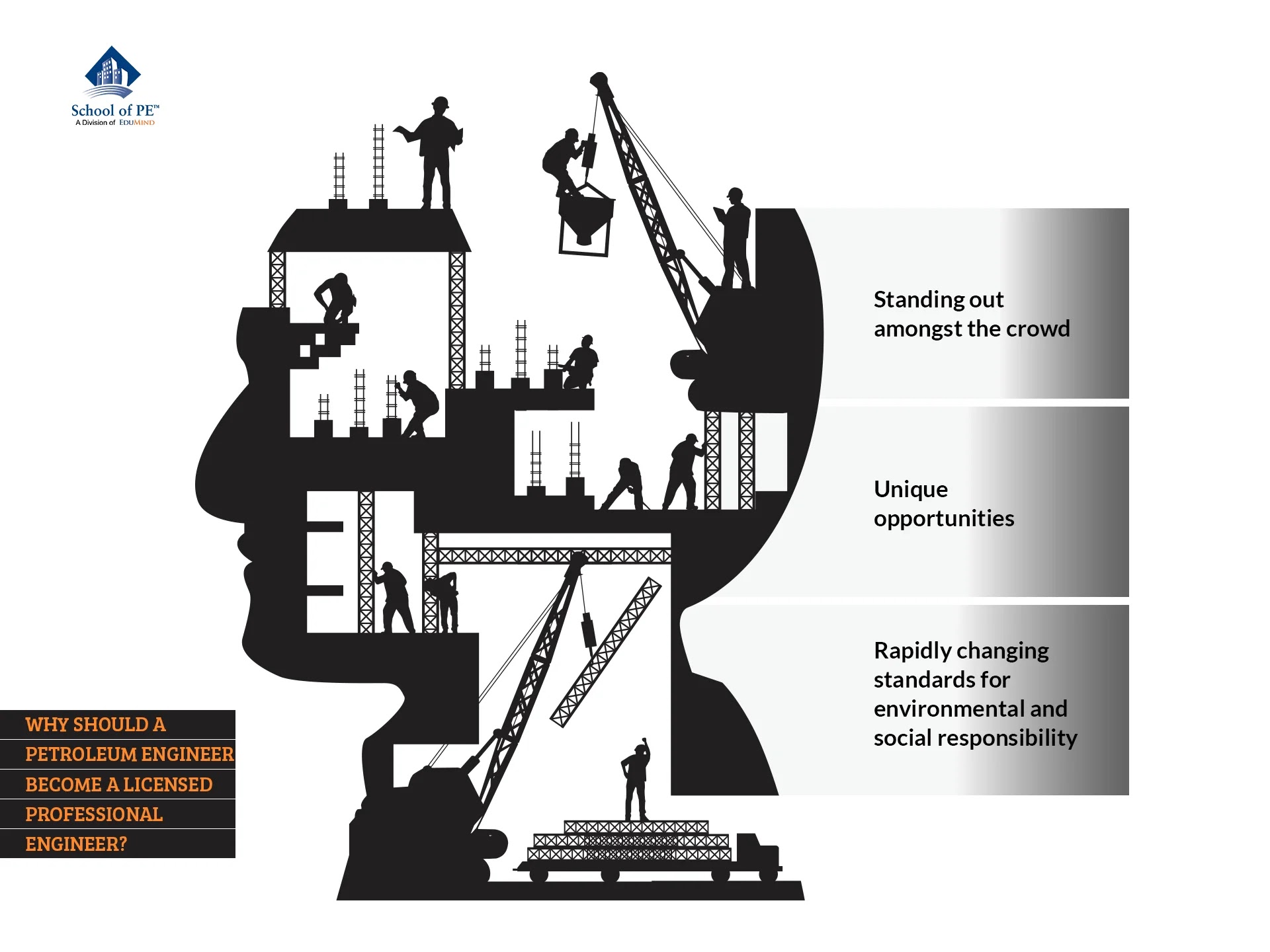
1. Standing out amongst the crowd
The very fact that most petroleum engineers do not pursue licensure makes for a unique opportunity. In a field that is often saturated with experienced engineers, it can be difficult to differentiate yourself from the crowd. By becoming a licensed professional engineer, you can quickly demonstrate your value. The professional engineering license provides a level of instant credibility that sets you apart from unlicensed petroleum engineers who have comparable education and experience. In a tight job market, it can be the difference between a job offer and failing to even get an interview. For those already employed, it can lead to accelerated career progression.
2. Unique opportunities
A career in petroleum engineering can be very dynamic and offer opportunities to perform a variety of tasks and job functions. For those interested in offering engineering services as a consultant or planning to consult as an expert-witness, gaining professional engineering licensure should be a top priority.
3. Rapidly changing standards for environmental and social responsibility
It was previously mentioned that petroleum engineers historically do not work on projects that directly impact public health and safety. While the scope of petroleum projects hasn't changed much, the perception of the petroleum industry has changed drastically in the past decade. With growing concern for topics such as global warming, there is an increasing movement towards reducing/eliminating emissions from oil wells and oil storage facilities. Controlling emissions is a complicated task that requires a great deal of engineering and operational expertise. In addition to emissions, the protection of groundwater aquifers is another top priority. Whether justified or not, the public perception that hydraulic fracturing contaminates groundwater is a very real concern that the petroleum industry must address. Both controlling emissions and protecting groundwater are rapidly becoming issues that most believe impact public health and safety. Although not yet required, increased scrutiny of the petroleum industry may one day make a professional engineering license every bit as valuable for a petroleum engineer as it already is for a civil engineer. The petroleum engineers who proactively seek licensure will not only raise the standard of quality for their non-licensed colleagues but will also position themselves for career advancement opportunities as scrutiny of the petroleum industry continues to gain momentum.

Thursday, 28 January 2021

Which PE Civil Exam Is the Easiest to Pass?

Almost without fail, the first questions I get from EIT's who are interested in taking the PE Exam is "How hard is it?" or "Which is the easiest to pass?" The latter typically comes from engineers early in their career who are in between professions, or whose profession doesn't perfectly line up with their studies in undergrad/graduate school. Maybe you have degree in civil and did a lot of design type work at the college level, but found yourself in a more application-based field, like construction or fabrication. Or you are working for a design firm that is in a different field than that of your studies in school, i.e., you majored in structural engineering and found yourself working for a mechanical design firm, or in the aerospace industry. You can look up exam pass rates in your jurisdiction, however, that doesn't tell you which exam is easiest. If you majored in civil engineering, focused on geotechnical engineering and foundation design, and are working for a local utility company doing site layout design of their power substations, you likely should be taking the Civil/Geotechnical Exam. I don't need to tell you that. If you majored in civil engineering and now design educational or industrial facilities for a small private design firm, take the Civil/Structural Exam. 
Which PE Civil Exam Is the Easiest to Pass?
If I'm being honest, when I began seriously looking into signing up for the exam, I had the same question. I majored in structural engineering, focusing on seismic design of civil structures. Out of college I worked for a design firm but soon ended up working for a steel fabrication company who did complex fabrication in the commercial transportation, hydro power, nuclear and marine industries. I wasn't designing buildings or bridges, I was figuring out how to build them. I wasn't doing structural analysis, load take offs, or sizing and spacing rebar in concrete shear walls. I was designing temporary structures and fabrication processes so massive bridge girders or dam bulkheads could be safely and economically constructed. I was doing material take-offs, contract submittals, scheduling and resource planning. When I began researching the different topics, I would need to know for the PE Exam, I realized I fell somewhere between the Civil/Structural Exam and the Civil/Construction Exam. I had a lot of basic design experience in school and was fairly familiar with most of the structural design codes I would need to know for the Civil/Structural Exam. But I also had a lot of practical experience in a construction-like industry that would be required for the Civil/Construction Exam. 
Ultimately, I took the Civil/Structural Exam. I felt I had a bigger base of knowledge of the topics on that exam. I had been exposed to or had a working knowledge of all of the topics on the Structural Exam. There were quite a few topics on the Construction Exam I had never been exposed to and would have to learn from scratch. I determined the Civil/Structural Exam would be easier for me. The exam that is easier for you may be different. Do what I did and look at the list of topics provided on the NCEES website for each exam. If you are reading through the list of topics for a particular exam and are familiar with all or most of them, it is likely the exam for you. If you were not exposed in school, or work specifically in a field related to the topics on an exam, find another exam. 
The reality is that none of the exams are easy. I have never spoken to a licensed Professional Engineer in any field who described their experience taking the exam as easy. However, the amount of preparation needed to pass an exam is completely dependent on your own personal circumstances. Could I take and pass the Civil/Construction, or any of the other exams? Sure. And you can too. But do you have the time to dedicate learning new topics you likely won't use in your career? Or do you already have a foundation of knowledge specific to a certain exam that you have gained through professional experience and schooling? Take that exam. Studying for it will be easier than studying for an exam with unfamiliar topics.
About the Author: Alex Berlin

Mr. Berlin has worked in both the design and fabrication industries for 10 years. He has worked at Vigor (previously OIW) for 9 years. Previous experience includes work in commercial fabrication for the solar renewable energy sector, structural design for the commercial and power sectors and seismic analysis and rehabilitation. He holds a Bachelor's Degree in Structural Engineering from The University of California, San Diego. He holds a PE License in the State of Oregon.

Monday, 25 January 2021

Strategies for Passing the PE Civil Exam

The PE Civil Exam really is unlike any other exam you have taken throughout your collegiate and professional career. It is comparable to the FE Exam in that it is an eight hour exam. What is challenging about it is the volume of material and the number of problems to complete in eight hours. Here are some strategies to think about that have helped me and others I know pass the exam. 
1. Take a review course. Whether it's in person, virtually, live or OnDemand, it helps by creating the outline for studying and focusing you on the specific material you will need to know. It's one thing to know steel construction because you work in the field, it's another to understand what types of problems will be on the exam and how to use the steel manual to answer them. I personally did virtual OnDemand classes. It allowed me to do 1-3-hour classes at a time so that I could spread out my studying. There was an option to do twelve live classes each weekend, six weeks prior to the exam, however I was not in a position to dedicate six weekends. However, I have no doubt they would have been just as effective. 
2. Buy the PE Civil Exam Review Guide: Breadth (CERG). Buy the right edition for the exam you are taking. It's about a $240-dollar investment but it is absolutely necessary. It is a concise and essential resource for your morning breadth exam. It has all the information and plenty of examples and problems that will help prepare you for the breadth portion of the exam. You will likely use it in your career after the exam because it is a one stop shop for so many topics and you will become comfortable navigating it. If the price tag scares you (it scared me), see if your company will reimburse you for it. Most companies will pay for at least a portion of professional development training or licensing costs. 
Strategies for Passing the PE Civil Exam
3. Use tabs. Or sticky notes. The PE Exam is open book, which actually makes things much more difficult. The Civil/Structural Exam has nine code books to bring, plus the CERG, plus any other bound reference material you think you'll need. If you are constantly using the indexes or table of contents to find pages with formulas or tables, you are wasting precious time. Tab everything out before sitting for the exam. It's easy to do as you study and as you do practice problems. 
4. Take timed practice exams. Along with doing timed problems as you study, it's important to take a full practice exam or two. I personally did them in four-hour chunks, taking only the morning breadth or afternoon depth exams in a given day. If you have the time and mental bandwidth to do a couple eight hour days, more power to you. What's important is you time yourself and treat it like a real exam. I had my wife time me and come in with 30 minutes remaining, 10 minutes, 5 minutes, and 1 minute. I had all of my reference material available and open. My cell phone was in the other room. The key is to get to a place where 60-75% of the problems you can do comfortably without scouring through reference material to find an answer or a formula. I either could solve the problem quickly, knew the answer instantly, or I knew what table or formula I needed and could flip quickly to the tabbed section of my code books. 
5. Use an approved calculator from the start. Be sure to buy an approved calculator (remember to see if your company will reimburse you) and do practice problems and exams with it. You'd be surprised how awkward it is at first trying to find the square root or exponential function on a new calculator. Make sure you are comfortable prior to sitting for the exam.
About the Author: Alex Berlin

Mr. Berlin has worked in both the design and fabrication industries for 10 years. He has worked at Vigor (previously OIW) for 9 years. Previous experience includes work in commercial fabrication for the solar renewable energy sector, structural design for the commercial and power sectors and seismic analysis and rehabilitation. He holds a Bachelor's Degree in Structural Engineering from The University of California, San Diego. He holds a PE License in the State of Oregon.

Thursday, 21 January 2021

My Experience in Taking the PE Civil Exam

Taking the PE Civil Exam is a big step in the career of any engineer. The experience will vary for each person depending on their timing, motivation, and experience as an engineer. I will share my experience here in hopes that it helps you prepare for the exam. 
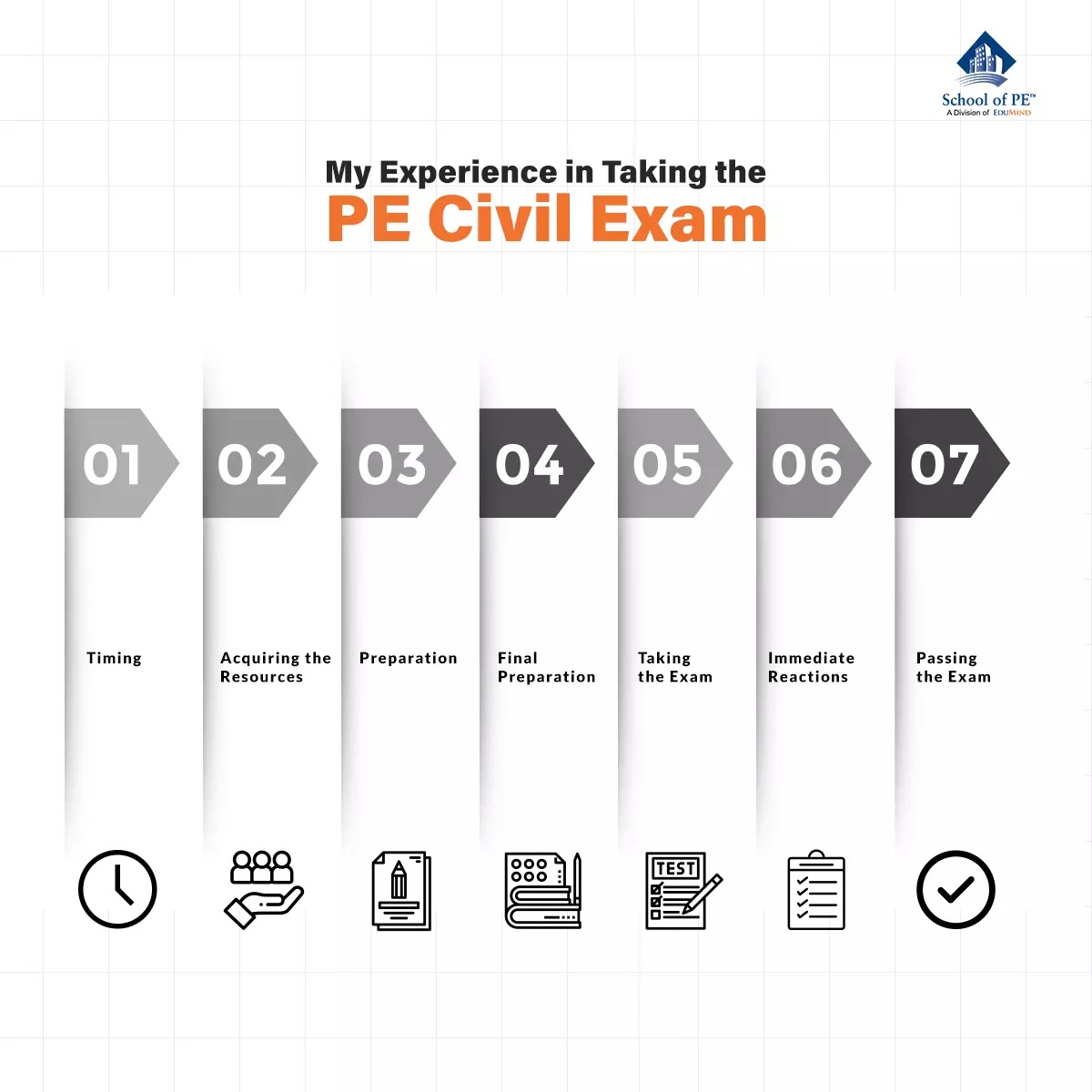
1. Timing
I took the PE Civil Exam in New York State, which requires (I believe) three years of professional experience in addition to a master's degree prior to application. As soon as I was eligible, I started working on the application. I will go into this more in another blog post, but I highly recommend taking the test as soon as you are able, so be sure to find out when that is in the state in which you are seeking licensure. 
2. Acquiring the Resources 
A major step in preparing for the exam is acquiring all the resources you need. This includes both the PE Civil Exam Review Guide: Breadth (CERG) and all the codes you can get your hands on. A list of codes required can be found online. 
3. Preparation 
First things first - make a schedule! I decided to study for the test for three months straight, so I made a schedule that included weekends designated to studying material in the CERM and two nights per week of doing problems on my own. I stuck to my schedule fairly rigidly, but I will say not all topics required the same amount of time studying, so I would adjust topics on each day as needed. 
The three most important things I did were 1) problems, problems, problems. Do as many as you can! 2) tabbing my resources. Make sure all the info you need is handy during the test. 3) stopping studying new material two weeks before the test. This allows for your brain to recover so you can go into the exam feeling rested, and also for you to have time to do timed practice tests. 
4. Final Preparation 
As I mentioned above, in the last two weeks I took it semi-easy. I took a timed practice test two weeks before the test day. I actually went into my office on a Saturday and sat in a conference room and took a full eight-hour exam. I highly recommend doing this! That Sunday I reviewed my test. To be honest, I didn't pass with soaring colors, so if you too struggle on the practice test, don't fret! The experience is still worth it, and you probably learned some things from making those errors. The final weekend before the test, I packed my suitcase (yes, I took a suitcase to the test with all my resources) and got some rest. 
My Experience in Taking the PE Civil Exam
5. Taking the Exam 
The exam in New York City was in a part of Brooklyn that I had never been to before. I've seen several guides say to do a test drive to the exam location, etc. I will be honest, I did not. The morning of the exam I woke up, called an Uber, and headed out. It was raining when I arrived at the test site and the people running the exam room couldn't let us in early, so we all waited outside in the rain with our suitcases of books. Luckily, the rain dried up shortly, and we went in to take the test. 
Now, here comes my horror story. I took the morning part of the exam and all went well. I turned in my answer sheet and left the room about thirty minutes early. I remember reading on the answer sheet to NOT sign the form until the VERY END. The signature validates that you answered everything without cheating or something, so you were supposed to wait. BUT, if you don't sign it, you won't pass. I didn't realize we would get a new answer sheet in the afternoon, so you had to sign it at the end of each session, not just the end of the day. When I went back after lunch, they handed out a new answer sheet and the blood drained out of my face. I was 99% sure that I had not signed that morning one. I called the proctor over and she said she couldn't remember if I had signed it, but she would go check. Next thing I know, someone was telling me that all the answer sheets had been boxed up and shipped to wherever they were going so they couldn't tell me if I had signed it, but assured me that if I didn't, I would fail. I almost threw in the towel right there. Tears formed in my eyes as I thought about the three months of studying I had put in to get to this point. I still to this day don't know if I signed it, but either I did or they made an exception because (spoiler alert) I passed. 
I took the afternoon part of the exam and finished right before they said pencils down. 
6. Immediate Reactions 
After the exam, I met up with a coworker and a grad school friend who had both taken it that day. We decided to take an Uber back to Manhattan together. In the taxi, we all said that was a lot harder than we thought it would be, but that we didn't know how we could have prepared any better to do it again. I say this to let you know that it's ok to find the test really challenging. We all found it difficult and we all passed in the end. 
The next morning, I was off on a plane to take a weeklong vacation in Florida. I worked for a company at the time who graciously gave us two days off for the PE. One day for the exam and one day to either study the day before or to recover the Monday after. I took the time after, and it was much needed after all those months of studying. 
7. Passing the Exam 
The day the results were released there was a buzz around the office. I knew a lot of people who had taken it and amazingly we all passed! I remember checking my results at the desk and FREAKING OUT!! I couldn't believe it! A few coworker friends and I went out for lunch to celebrate. It was such a relief. 
I hope this story was helpful! Taking the PE is a journey I'll never forget.

Monday, 18 January 2021

The Path to Passing PE Civil Exam

The PE exam is one of the most important milestones in an engineer's career. It also usually takes place at least four years after you've been done with school. Because of this, intentional preparation is key to passing the PE exam. 
Your preparation should start at least a year before your desired exam date. Find out when you can apply and what the requirements are for your application. You will need a complete engineering work history between when you earned your Civil Engineering degree and the application submittal date. You will also need contact information for all your current and past supervisors (ideally your supervisors are professional engineers who have had direct responsible charge of you). Start your application early and get your current and past supervisors to complete the reference forms early. Submit the completed application as soon as possible. 
Once your application is approved and you register for your PE exam, look for a review course that fits your schedule and learning style. Many great courses are offered through the School of PE, including virtual OnDemand, virtual live, and in-person courses. With my work schedule and family life I chose a virtual OnDemand course. 
Make a list of all the reference material that is applicable to the exam. Comprehensive lists are available on the exam website but will likely include reference books you may not need. I recommend a general civil engineering reference guide such as the PE Civil Exam Review Guide: Breadth book, but there are many good choices out there. Your review course will also be able to recommend books to take into the exam and may even provide material you can print out and bind to make it authorized to take into the exam. 
As you begin your review course make sure you can study in a quiet place free from the distractions of work and life. Block out enough time each week to get through the course several weeks before the exam date. This will allow you to take practice exams prior to the exam and give you time to go back to your review course and reference material in between practice exams. Use page tabs and highlighters to mark key information in the reference material you will be taking into the exam. This will save you a lot of time. Remember, you will only have a few minutes to answer each question. 
As you take practice exams, find a quiet place that is as much like the real test environment as possible. I found a quiet conference room with a single table. I only took into the practice exam what I would have with me for the PE exam: my reference books, an approved watch, two approved calculators, scratch paper, and a pencil (the exam proctors will provide scratch paper and pencils). Treat the practice exams as if they were the real exam. Score your practice exam and use the results to figure out what topics need more study. 
The Path to Passing PE Civil Exam
As the exam date gets closer, gather all of the things you plan to take into the exam in one place. This should include all the reference material (and could be anywhere from 2 or 3 books to 10 or 20 books), two approved calculators (you don't want to have a calculator not work on exam day and be without a backup), an approved watch (you may not be able to see a clock during the exam), ear plugs (when I took the exam it was a windy day and the large room we were in had a lot of noise from the environment), a water bottle, your exam registration if required, approved identification, and a way to get all this to the table where you'll sit for the day. I had over 12 reference books for my PE exam and used a hand cart with milk crates strapped to it to move everything.
Many people take the exam in a location that is several hours away from where they live. Because the exam starts early and you will need to arrive well before the exam begins, you may want to find a hotel room near the exam site for the night before. This will allow you to (hopefully) get a good night's sleep and not be distracted by work or family. If at all possible, don't work or study the day before! You have already spent months preparing for the exam so studying the day before won't be beneficial and may just add stress. Also, you don't want to be thinking about all the tasks you have waiting for you at work. 
Wake up early on the morning of the exam. Make sure you know when you need to check in and get to the exam site even earlier. Hopefully, you've had time for a cup of coffee as you probably can't bring any in with you. Get to the exam site in plenty of time to find the site, find a parking spot, and walk everything to the test site. I remember getting up more than two hours before check-in time, getting to the test site at least an hour before check-in, and having to walk my books across a gravel parking lot. Plan accordingly! 
Follow this advice, take advantage of your learning style when studying, and plan out your journey to earning your PE license. When you sit down to take the exam, feel confident. You have worked hard to earn it and you are prepared.