Thursday, 14 January 2021
Five Tips for Passing the PE Civil Exam
Table of Contents
1 - Apply for the exam as soon as you can
I firmly believe that the closer you take the exam to your undergrad/grad school education the more bearable it will be. You'll not only remember more from that one fluid dynamics class you took junior year and never used again, but you're also more trained to study for exams at that stage in your life. You likely have less commitments to kids, spouses, etc. and maybe less responsibility at work. Finally, you may be holding yourself back from higher pay and more responsibility at work if you hesitate to take the exam. Preparing and taking the exam will never be easy but it's worth starting the process as early as you can.
2 - Make a Thoughtful Study Schedule
Make a study schedule that includes time for reading and taking notes on CERGPE Civil Exam Review Guide: Breadth (CERG) and PE Civil Exam Review Guide Depth and also spending time doing practice problems, taking a practice test (or two), and enjoying some intentional down time! A weekend off here or there can be great for mental health or the realistic possibility that you may not stick to the schedule as much as you should. For me this looked like studying for 3 months, with 1 weekend off each month. On the weekends, I would study and take notes from the CERG, and I dedicated two weeknights per week to practice problems. This really helped me to get it all done, while not burning myself out. Doing problems is so very important, so don't skimp on that part!
3 - Use tabs to access information quickly
Use tabs on your notes, codes, and CERG (or whatever references you have). The exam is really broad (not to mention long), so you're not going to memorize everything. You need to be able to find info you need quickly and the best way I've found to do this is to use tabs. Some people print out the index of the CERG so that you're not flipping back and forth a ton, but I found tabs to be the most effective tool for me.
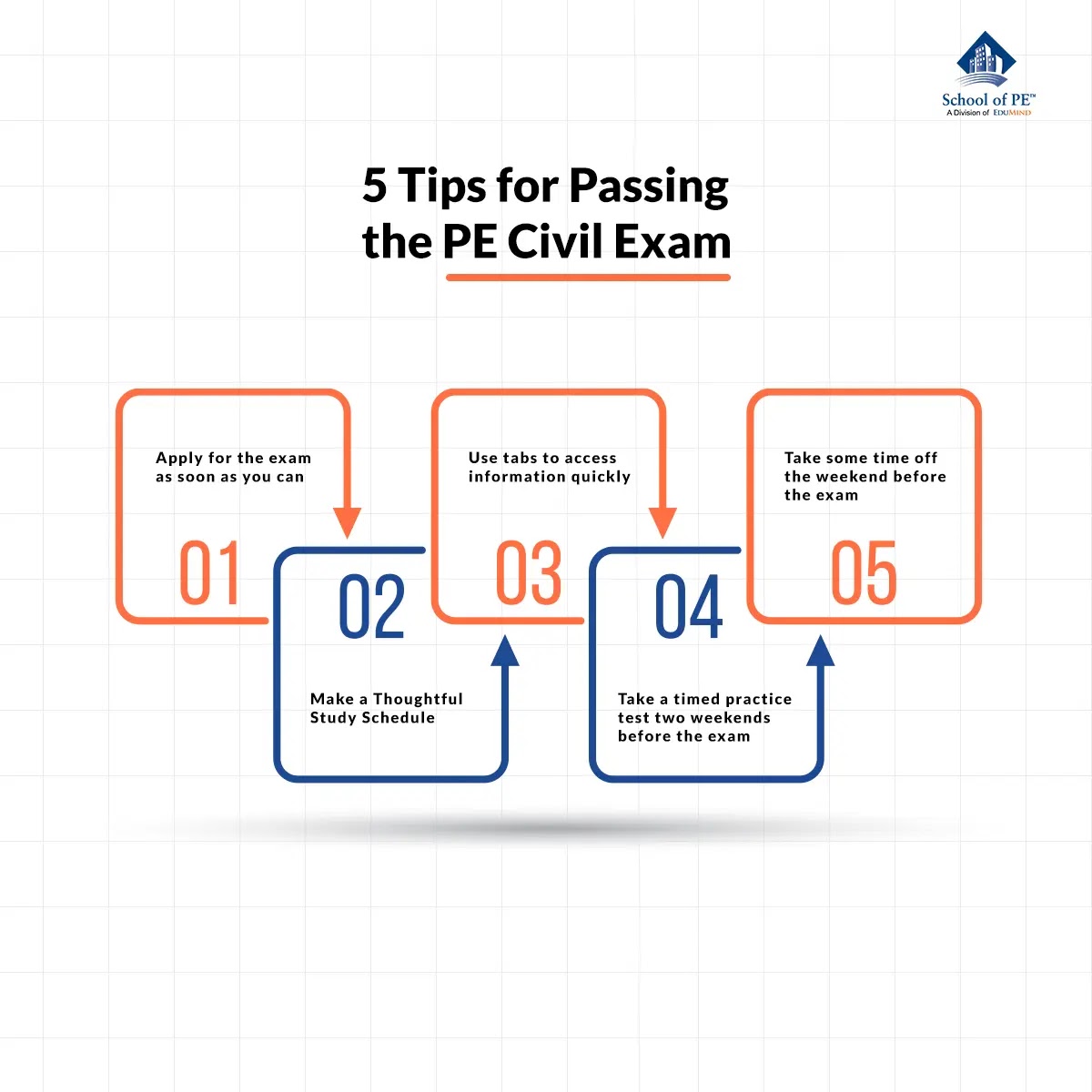
4 - Take a timed practice test two weekends before the exam
I highly recommend doing this. It's a great way to check where you are with the material, while still giving you a few weeks to study areas you may discover you struggle with. It also helps you make sure you have all the resources you want to have and simulates the test environment. I went into my office and sat in a conference room for an entire Saturday before I took the exam. It was helpful to be out of my apartment and only use my phone as a timer.
5 - Take some time off the weekend before the exam
The test is challenging in itself but one of the most overlooked challenges is the endurance and energy it takes to get through an eight-hour engineering exam. If you've followed the tips above, my #1 pre-exam tip is to go in well rested. Eat good food the week before, get good night sleeps the week before, and rest assured that you don't need to cram. You got this!
Monday, 11 January 2021
What Is Structural Engineering and What Do Structural Engineers Do?
According to the Structural Engineering Association of California (SEAOC), "structural engineers create drawings and specifications, perform calculations, review the work of other engineers, write reports and evaluations, and observe construction sites." That's a long explanation and, to me, it means that there are a lot of opportunities within this specialized field.
Structural Engineering is typical considered to be a subset of civil engineering, with a focus on structures. Structures can be buildings or bridges, but they can also be a little more out-of-the-box, so to speak. Many sculptures, monuments, billboards, and rollercoasters need to be structural engineered!
It's easier to understand the many paths of structural engineering if you consider the lifecycle of a structure. For the case of this blog post, I'll use buildings as our primary structures of discussion.

1. New Design
Every new building (with the exception of small family homes in most states...) needs to be structurally engineered. Typically, the owner hires an architect, and the architect will begin to set up his team. He'll need a structural engineer to produce structural drawings and calculations to give to the city for approval and then the contractor for construction. The freedom of the engineer in this role varies widely, but typically the architect will supply the structural engineer with architectural drawings and the engineer will design a structural system that works within the bounds set by the architect. This doesn't always move smoothly, so be prepared for many conversations discussing options and solutions! If you are a good problem solver, this is an ideal role. There is a lot of creativity in devising these solutions.
2. Renewal/Retrofit/Restoration
During the lifespan of a building, it's likely that the building will change hands and the new owner will want to upgrade some systems. Or the original owner may just want to bring the building up to current code, potentially for seismic safety, but for many other reasons too. A structural engineer is commonly involved in these situations. These upgrades can be as small as installing new roof mechanical units and making sure the current roof can support the new load, or it may involve adding or removing existing elements of the structural system. Working with existing buildings also will appeal to problem solvers since you are frequently working within a strict set of existing conditions.
3. Forensics
And then, there are times when buildings don't work as they should. The media programs us to automatically think of building collapses, but this type of work ranges from bouncy floor systems that make tenants uncomfortable to, yep, building collapses. This type of work requires a lot of out-of-the-box thinking because you typically go into the assignment with limited information and will need to use your detective skills to figure out what went wrong. This work is typically performed for lawyers or insurance companies who are seeking to understand the allocation of compensation for the damage. This type of work is good for those who are interested in putting all the pieces together. It typically requires a person who is willing to respond quickly to emergencies and potentially travel to the sites of the failure.
As you can see there are many paths to take in structural engineering and they all involve problem solving, creativity, strong technical abilities, and communication skills. It can be a very fulfilling career for the right candidate! I've certainly enjoyed my career so far in this field.
Thursday, 7 January 2021
Are you ready to pass the Civil PE Exam? Here's what it takes
If you are reading this, you are probably starting to think about the next steps in your career and if becoming a licensed Professional Engineer is a pursuit worth endeavoring. If this is you, I'm sure you know the basic pre-requisites that you can find on the NCEES website: you essentially need to be a working Engineer In Training (EIT) having passed the Fundamentals of Engineering Exam (FE) with four years of experience under a Professional Engineer (PE). But these are just boxes to check on your application and just because you meet the basic pre-requisites, does not mean you are ready to pass the exam.
First, you need to understand that passing the exam and becoming licensed are two separate steps. You must first pass the exam, then apply for license in your state. In some states, you are able to take the exam prior to having four years of experience, but then would need to wait until you meet your state's experience requirements on your application. I know people who have done this for one simple reason. The PE exam is a multiple-choice exam. For me, preparing for and taking it felt like I was back in college. You need to know the material, yes, but you also need to know how to take an exam. The average time to solve each problem is six minutes, which means there will be some slam dunk thirty-second problems and there will be one or two, ten-minute problems. There will be at least a few questions you have to flat out guess on, but with strategy, can eliminate at least one, possibly two answers. Exam time management and strategy is a skill that you get really good at in college but start to lose as you get into the professional working world. If you don't have a good feel for testing exam management, maybe exploring the option of taking the exam early is for you so you do not further deteriorate those skills learned in college.

Being ready to pass the exam, regardless of whether or not you wait to have four years of experience, also depends on your preparation. The morning breadth exam will undoubtedly have topics you have either never been exposed to in your work, or barely touched in an early undergraduate class. You likely will not be proficient in all topics. You need to study these topics and become proficient for the exam. For your afternoon depth exam (for me it was Structural), you need to be proficient in your code books. I knew steel, concrete and masonry, as well as ASCE 7 design codes. But I had never worked with NDS Timber Code or AASHTO. I had to study these and gain proficiency. I took a guided review course and studied three nights a week for four months. It helped me organize and schedule out my time. I was working full time and had a new baby at home so I had to spread it out. I did "homework" that was assigned out of the review courses which were problems representative of what I would see on the exam. I began timing myself on each problem. If I couldn't solve it, I would at least take an educated guess at the answer before looking at the solution. I took two FULL practice exams (yes the full eight hours) when I was three and two weeks out. What I did may not work perfectly for you, but you have to get immersed in the material in some way. Maybe you cram a few weeks out. Maybe you spread it out like me. Maybe you don't have a strenuous work schedule or kids and can casually study throughout the day. Whatever it is, if you want to pass this exam the first time, you have to take your preparation seriously. You have to understand which topics you are already comfortable with and which ones you aren't and study accordingly. You have to be comfortable in your code books, even if it's just knowing the chapters so you can look information up on the fly. If it sounds daunting, plan ahead and create a schedule that is manageable. You can do this if you prepare.
About the Author: Alex Berlin
Mr. Berlin has worked in both the design and fabrication industries for 10 years. He has worked at Vigor (previously OIW) for 9 years. Previous experience includes work in commercial fabrication for the solar renewable energy sector, structural design for the commercial and power sectors and seismic analysis and rehabilitation. He holds a Bachelor's Degree in Structural Engineering from The University of California, San Diego. He holds a PE License in the State of Oregon.
Monday, 4 January 2021
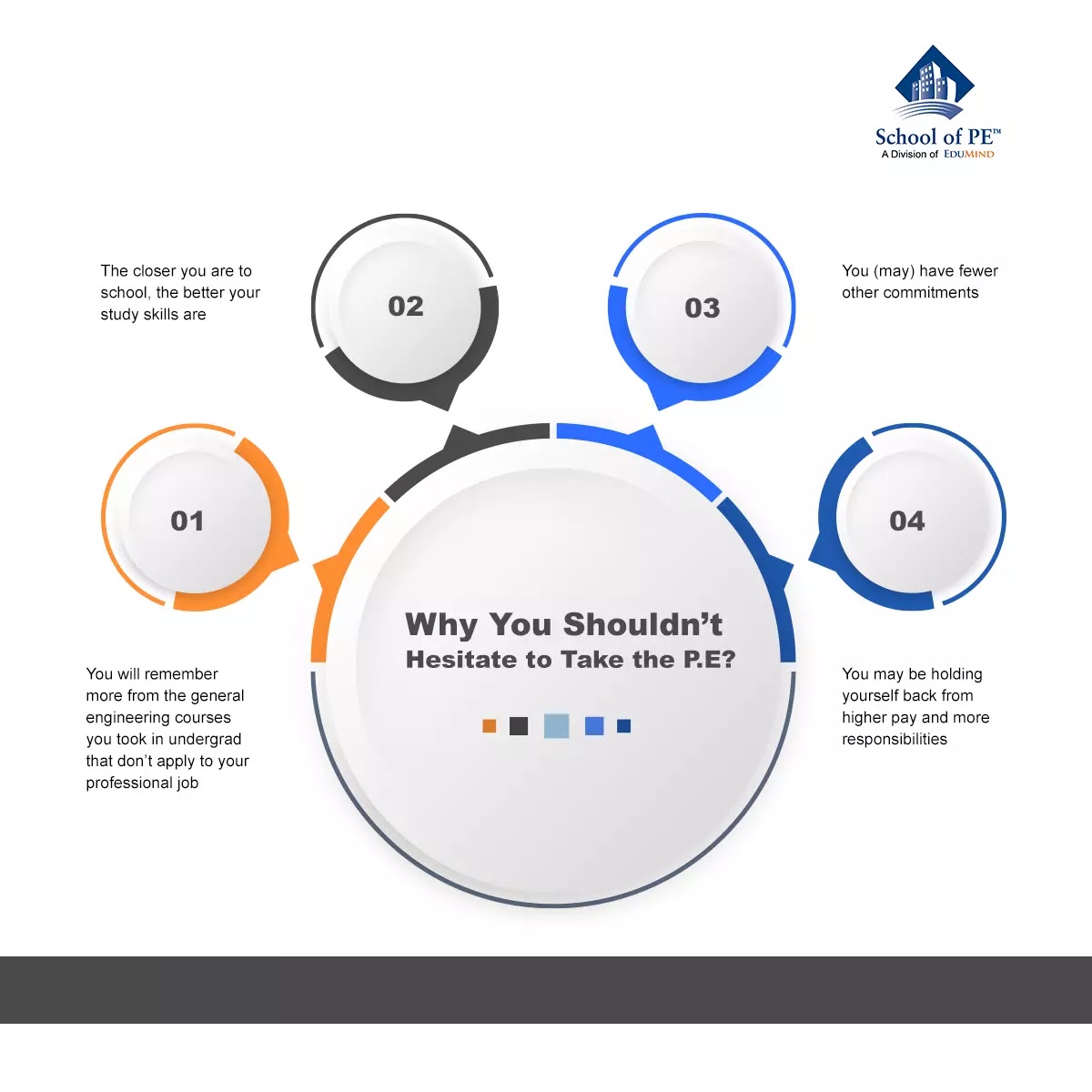
Why You Shouldn't Hesitate to Take the P.E?
If you are reading this and considering taking the P.E., the best time to get started is NOW! While the amount of engineering experience you will need in each state varies, if you have hit the marker in the state you are applying to be licensed in, I strongly urge you not to hesitate on taking the exam.
I hear from a lot of young engineers that there's "no point" because, if you work at a large engineering company, you will not be stamping your own drawings for at least ten years, maybe ever. While that may be true, here are some of the reasons you should not hesitate to take the exam as soon as you are eligible:
1. You will remember more from the general engineering courses you took in undergrad that don't apply to your professional job
The P.E. exam is an extremely broad exam - covering things from all areas of engineering. There are thermodynamics, transportation engineering, fluid dynamics, and structural questions as well. Just to name a few. My point here is that while you may not have studied all these topics in undergrad, you probably studied some and that general recall you still have from undergrad will help you during the exam. Trust me, it is a much better feeling to say to yourself, "oh, I remember Bernoulli's equation!", than "oh gosh, I haven't thought about that in ten, fifteen, twenty years."
2. The closer you are to school, the better your study skills are
This is something you may currently take for granted, but if you have made it this far through an engineering program, you have some good study skills. The way we focus and succeed into our professional work is so different than how we focused and succeeded in school. It is more collaborative and a whole lot less focused. When you are stuck on something at work, you can immediately ask a coworker for help. And how many times, when you are working through something at work, do you check your email or phone or get a call from a client? The more we get into our professional lives, the further we stray from those study skills. Can you get them back? 100%, but it will be a lot more frustrating and annoying as you get started and realize you have not studied for anything in a long time.

3. You (may) have fewer other commitments
Kids, spouses, and other responsibilities can take up a lot of time and energy as we get older! As full as your life may be at this moment, it is almost certainly going to become fuller as you get older. You may also have more responsibilities at work as you get older and may not have all of your nights and weekends available for studying due to project demands. Whatever it is, the best time to do it is now. Then, in the future, you can take on whatever you want without needing to schedule in night/weekend study time. 😊
4. You may be holding yourself back from higher pay and more responsibilities
Immediate benefits from passing the P.E. vary, but it is unquestionable that you will have more opportunities for raises and promotions if you pass the P.E. I have heard of some people immediately getting a bonus and a promotion, but even if this does not happen to you, trust that your bosses are noticing the initiative it took the prepare for and pass this exam, and the skills that it implies you have. Don't hold yourself back from those opportunities!
Monday, 16 November 2020
Enhance Your Exam Preparation with Our New Question Bank
School of PE is pleased to share new upgrades to our popular Question Bank feature, which helps students approach exam day with the confidence needed to pass!
The new Question Bank takes traditional practice problem and solution sheets to an entirely new level with an immersive experience that mimics the topics, question formats, and other specifications that students will encounter on the official NCEES exam.

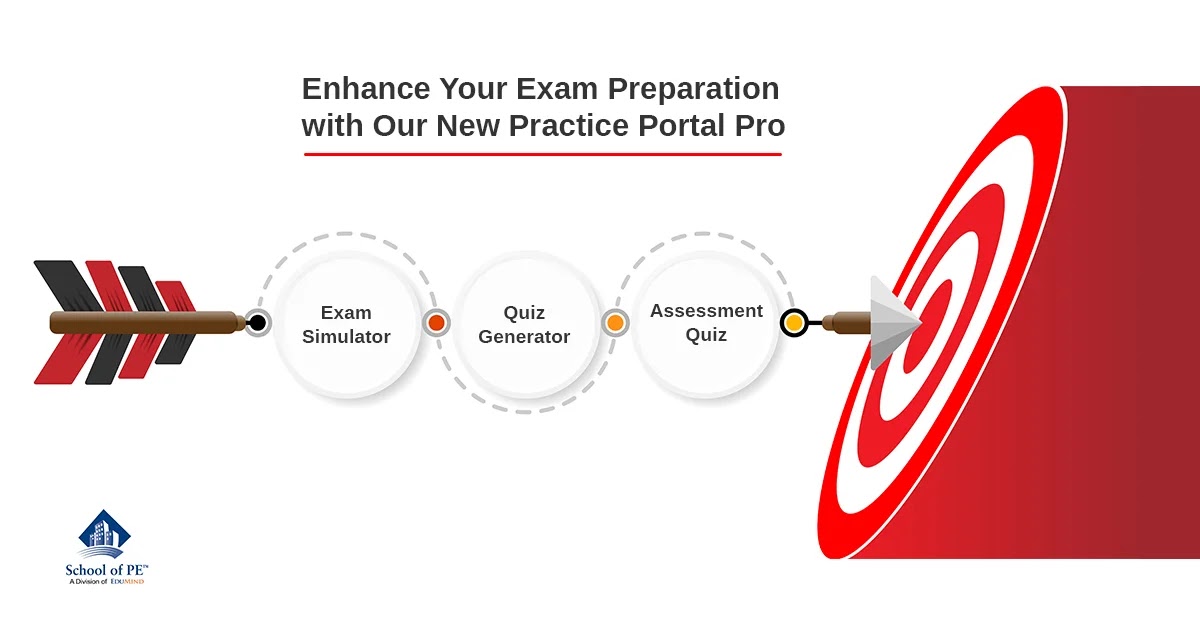
Features of the Question Bank include our Exam Simulator which is as close to the real exam as you can get! This section includes full-length, timed exams to help students not only put their skills to the test but practice their timing and pacing as well.
Next, students can zero in on specific exam topics with our Quiz Generator. This feature allows students to handpick the subjects, number of questions, difficulty, and more to create a practice test that is customized to their needs.
Then, students can receive valuable insights about their progress with our Diagnostic Exams feature. Each one of these quizzes focuses on a different topic to help students identify areas where they may need some extra study time.
The new Question Bank is included in the cost of your FE exam review course, and select PE exam review courses, at no additional charge*. Register today to prepare, practice, and pass your exam with confidence with School of PE!
*Features may vary due to the uniqueness of each course.
Monday, 9 November 2020
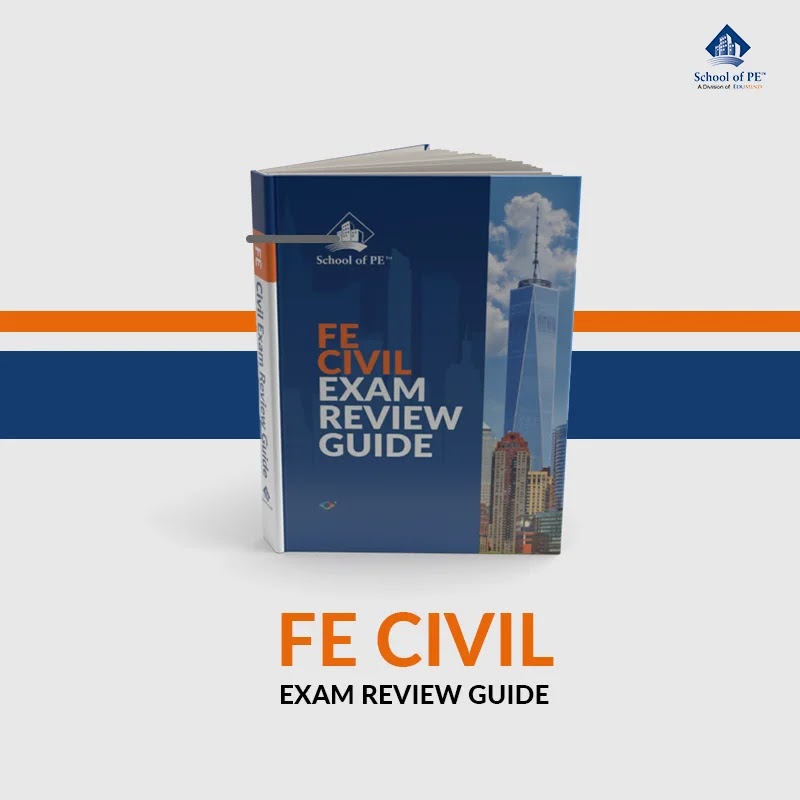
Introducing the New FE Civil Exam Review Guide from School of PE
The expert instructors at School of PE created a concise learning tool to provide the most essential information students need to be successful on the FE Civil exam. Our new FE Civil Exam Review Guide is the definitive resource to help you prepare, practice, and pass the exam to earn your licensure.
At School of PE, we know that studying for the FE Civil exam is no easy task! Our goal with the FE Civil Exam Review Guide is to equip students with the resources needed to pass-nothing more and nothing less. Developed by our highly acclaimed instructors, this book serves as an inclusive, yet concise, guide offering an array of expertise in the field of civil engineering.
One of the aspects that makes School of PE unique is that we use multiple instructors for our exam review courses who teach only in their specific subject matter expertise to ensure the highest quality material. Having this advantage helped our team put together an exam review guide that offers a streamlined approach to make the most of your study time.
Our FE Civil Exam Review Guide focuses your efforts on understanding the necessary content, instead of poring over information that may end up being irrelevant on exam day. This review guide follows the official NCEES exam specifications and will transform the challenging FE Civil material into logical, easy-to-understand segments.

The FE Civil Exam Review Guide teaches civil engineering definitions, examples, and practice problems to help you confidently prepare for the exam. Bring the review guide material to life with unique Augmented Reality (AR) features that enhance your ability to navigate, comprehend, and retain key concepts. With our mobile quizzes and interactive flash cards, you will begin to truly understand the material-not just memorize it!
School of PE strives to provide as much help as possible to lead students to success. That is why we have also included features such as colored tabs for easy navigation between chapters, wide margins for notetaking, and on-the-go eBook access through our Study Hub mobile app (internet connection required).
To supplement your studies, School of PE has created additional premium content that is unlockable from your smartphone or tablet to help each examinee match his or her learning style. These premium features are available for each chapter and can be very helpful when preparing for the FE Civil exam! The features include the ability to ask subject-matter experts any questions you have about the material, schedule live online tutoring sessions, and watch video lectures to help you delve deeper into each topic. Simply scan the applicable code in your book with your QR code reader to access these exciting premium features.
Order your copy of the new FE Civil Exam Review Guide today and take advantage of our bundle deal! The bundle includes both the paperback book and eBook, so you will have access anywhere, anytime, and on any device with an internet connection.
It's time to prepare, practice, and pass the FE Civil exam with School of PE. We take your education very seriously, and when we say "Your Success is Our Success," we truly mean it!
Thursday, 22 October 2020
Introducing the Reimagined Study Hub from School of PE
We are excited to announce the launch of our redesigned Study Hub that will improve the way engineers prepare for their professional licensure exams.
When you choose School of PE for your exam preparation, you are choosing 16 years of experience backed by exam pass rates that are higher than the national average. With this expertise, we have revamped our popular Study Hub feature to give students a brand-new study experience that meets all of their needs in one place.
The new Study Hub combines a sleek new design, engaging video content, detailed course notes, comprehensive practice tests, interactive flash cards, and more all in one location.

This synchronization is especially helpful for our new, interactive Flash Cards feature. Simply select the topic and quiz yourself on important definitions whenever, wherever with our Study Hub mobile app (internet access required).
Another new feature of our reimagined Study Hub is the ability to watch, pause, and resume lecture videos. You can even make timestamped annotations on the lecture videos, and bookmark them to easily review at a later date.
Along with the new video features, you can also submit questions to the instructor and interact with your classmates in a discussion forum. This gives you the chance to communicate any doubts you may have about the material, receive detailed responses from fellow students and your instructor, and help answer the questions of others.
Through the Study Hub, students are able to download, review, and annotate the thorough lecture notes that are provided by your instructor, easily access your eBooks, and test your knowledge using different test formats in our Question Bank.
The Study Hub is included in the cost of your FE or PE exam review course at no additional charge*. Register for a course today to prepare, practice, and pass your exam with confidence!
*Features may vary due to the uniqueness of each course.
Subscribe to:
Posts
(
Atom
)