Wednesday, 3 October 2018

Idaho Board Changes PE Exam Requirements: Exam Applicants May Take the PE Exam Early

Just a few months ago, Idaho implemented a new exam policy to allow exam applicants to take the PE exam before obtaining the required four years of engineering field experience. Various other states have a similar policy already in place. These states include Arizona, California, Illinois, Kentucky, Louisiana, Nevada, New Mexico, North Carolina, Oklahoma, Oregon, South Carolina, Texas, Utah, and Wyoming. 
So why is this policy being implemented by multiple state boards? Having a policy that allows applicants to take the PE exam before gaining four years of field experience may actually benefit exam applicants. By taking the PE exam sooner, applicants may have concepts they studied when preparing for the FE exam fresh in their mind. They also can avoid the long process of waiting to get approval to take the exam. Of course, the field experience, passing the PE exam (odds of passing the PE exam can be increased by taking a PE exam review course), and board approval must be completed and obtained before a professional engineering license is administered. 
In a recent report on the matter, the National Society of Professional Engineers (NSPE) stated the following: 
NSPE is in favor of state licensing boards allowing candidates to take the PE exam early, as long as they have met the educational requirements for licensure and passed the FE exam. The Society also believes that the four years of progressive engineering experience indicated in the NCEES Model Law should remain unchanged, and licensure candidates who pass the PE exam early need to obtain the requisite number of years of engineering before becoming licensed.
As safety is a big concern for engineering state boards, other state boards are likely to monitor the success of this new policy for states that have implemented it. If this new policy proves to be effective, all 50 states may end up implementing it as well.


Tuesday, 2 October 2018

Employee Education Benefits: The Importance of Professional Development in the Workplace

Throughout the last few years, more and more companies have added continued education for their employees as part of their employee benefits. Although the cost of paying for education for employees may seem daunting, there are numerous benefits for allowing employees to further their professional skills and knowledge. 
A great, and somewhat obvious, reason to provide educational opportunities to employees as part of a company's benefit package is to increase knowledge and technical skills. For instance, an engineering firm providing its interns with the opportunity to take a class to prepare them for the PE exam would help the employee become a licensed engineer. Having professional, licensed engineers would significantly increase employee talent and would expand the company's overall resources, as professional engineers are needed to carry out specific tasks. According to a study performed by SHRM, 72% of companies in the United States offer professional development opportunities to their employees.i
Providing educational benefits for employees will also increase employee retention. When it comes to generational differences, 87% of millennials have been reported as listing "professional or career growth and development opportunities" as an important factor when choosing to stay long-term with a company. 69% of non-millennials agree that professional growth and education is an important aspect to have in a company.ii Even when an individual is looking for a new job, continued education opportunities are often viewed as an important factor when evaluating a job offer. The main reason in this is that continued education makes the employee feel appreciated, valued, and increases overall happiness in the workplace. "Many employees value the personal enhancement that continued education provides... Fulfilled employees are happier employees who perform better and have increased loyalty to the employer who made this enrichment possible."iii 
For companies that want to provide education opportunities for their employees, an optimal solution is to find an educational provider that offers corporate packages. Among the reasons listed above for providing employees educational opportunities, continued education will significantly benefit your employee as well as the company as a whole.
Employee Education Benefits: The Importance of Professional Development in the Workplace
References 
ii. Gallup, Inc. Millennials Want Jobs to Be Development Opportunities. Retrieved from https://www.gallup.com/ workplace/236438/ millennials-jobs development-opportunities.aspx
iii. Furthering Your Employees' Education is Good for Business. (n.d.). Retrieved from https://www.wolterskluwer.com/en/expert-insights/furthering-your-employees-education-is-good-for-business

Thursday, 27 September 2018

Monthly Subscriptions: Providing Flexible FE Exam Prep

As the Fundamentals of Engineering (FE) exam is computer based, exam applicants are able to schedule their exam year-round. Because of the flexibility computer-based exams present, it is sometimes easy to avoid making a study schedule. However, that doesn't mean that studying is not required for the FE exam.
The FE exam, whether it is the Civil, Mechanical, or Electrical exam, covers a wide spectrum of knowledge areas, more so than the Principles and Practice of Engineering (PE exam). Below shows a comparison of topics that are covered on the FE Environmental and PE Environmental exams: 
FE Environmental
  1. Mathematics
  2. Probability and Statistics
  3. Ethics and Professional Practice
  4. Engineering Economics
  5. Materials Science
  6. Environmental Science and Chemistry
  7. Risk Assessment
  8. Fluid Mechanics
  9. Thermodynamics
  10. Water Resources
  11. Water and Wastewater
  12. Air Quality
  13. Solid and Hazardous Waste
  14. Groundwater and Soils
PE Environmental
  1. Water
  2. Air
  3. Solid and Hazardous Waste
  4. Site Assessment and Remediation
  5. Environmental Health and Safety
  6. Associated Engineering Principles
Although many past FE examinees have reported taking an average of four months to prepare for the FE exam, we understand that not everybody is the same when it comes to studying. Our students can choose our four-month, six-month, or eight-month OnDemand options, but for those who are unsure of how long they need to study for the FE exam, we have built an OnDemand Monthly Subscription review course. 
Our OnDemand Monthly Subscription option allows students to choose how long they want to study. When you sign up for an OnDemand Monthly Subscription, you will gain immediate access to your class materials and recordings. You may study for just a month or two for a quick refresher or study for nine months if you feel the need to. The possibilities are endless! Simply cancel your subscription when you believe you are done studying and are ready to take your exam. 
To learn more about our OnDemand Monthly Subscription option, visit the OnDemand tab on your corresponding course page.
  1. FE Chemical
  2. FE Civil
  3. FE Electrical
  4. FE Environmental
  5. FE Industrial and Systems
  6. FE Mechanical
  7. FE Other (General)

Wednesday, 26 September 2018

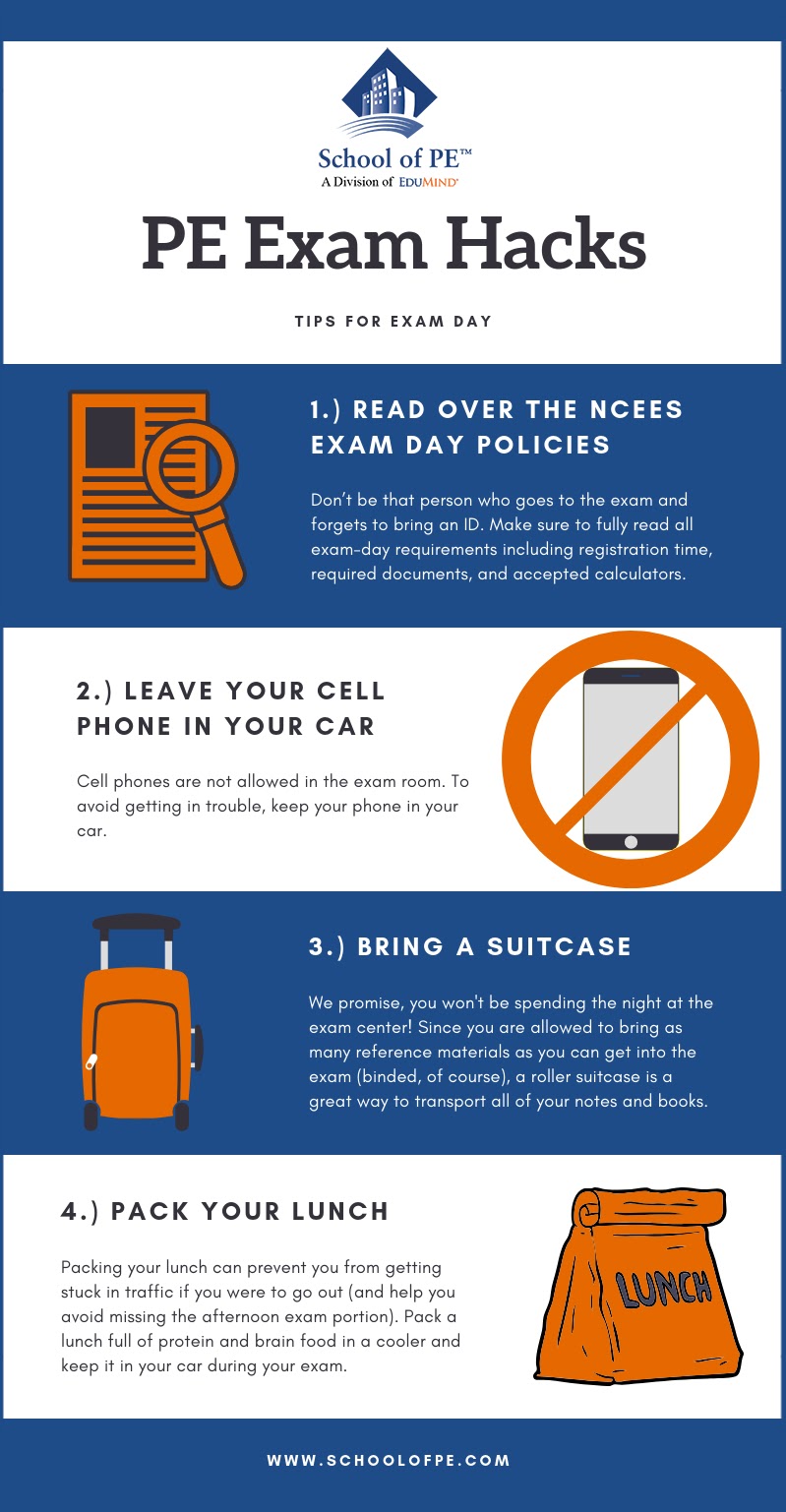
PE Exam Day Hacks

The PE exam is right around the corner, and we want you to be fully prepared. Although School of PE focuses on preparing you for the exam itself, we also thought it would be helpful to give you some PE tips and tricks for exam day to make sure your experience is as stress free as possible. 
Check out the tips below:
PE Exam Day HacksWe hope you find these PE exam day tips helpful! If you are currently taking a PE prep course with School of PE, we know you'll do great on your exam! Late to the study-game? You can still sign up for our OnDemand Lite course for last-minute review. Good luck on your PE exam!
Prepare, Practice, Pass
Anytime, Anywhere
It's that easy!

Sunday, 23 September 2018

FE Exam Prep Tips and Tricks: Preparing and Practicing for CBT Exams

Passing an NCEES FE exam is an essential step in an engineer's career, as it is typically required before taking the Principles and Practice of Engineering (PE) licensing exam. As many of our students report that the FE exam is more challenging than the PE exam, preparing for the FE computer-based test (CBT) can be overwhelming. In fact, many FE examinees have reported studying up to 300 hours for the difficult exam. To help reduce stress and the amount of time used to study, we have created a list of tips to help you get the most out of studying and to help you pass your chosen FE exam.
1. Review the FE Reference Handbook 
The FE Reference Handbook by NCEES is the only reference material that you are able to use during your exam. Before you take your exam, you can download it for free from NCEES' website. We recommend going through the reference handbook a few times so you have a good grasp of where everything is located. 
2. Look over the FE Exam Requirements and Specifications 
Don't be that person who goes to the exam and forgets to bring an ID. Make sure you fully read all exam-day requirements including registration time, required documents, and accepted calculators. Also, read over your exam's specifications before beginning to study, as the specifications lay out the ratio of subjects that will be covered on an exam. NCEES' FE exam specifications and resources can be found here.
3. Strategically Schedule Your Exam 
When you are scheduling your exam, try not to schedule it around holidays or any other events that may distract you from studying for long periods of time. We recommend preparing for the FE exam at least four months before you take your exam.
4. Practice, Practice, Practice 
How do you know when you've fully grasped a subject? By practicing! Whether you are taking the FE Mechanical, FE Electrical, or FE Civil exam, practice problems are a great way to prepare for your exam. After studying a subject, test your knowledge by practicing 10-15 problems in that subject area. If you can answer the practice problems correctly, you can confirm that you are prepared for that given subject. If you struggle with the practice problems, consider setting some extra time aside to revisit the subject. Finding a way to practice for your FE exam that closely mimics the NCEES CBT experience is probably the most effective way to practice problems. 
5. Attend an FE Exam Prep Course 
Registering for an FE exam prep course is another helpful way to prepare for the FE exam. School of PE offers FE Chemical, FE Civil, FE Electrical, FE Environmental, FE Industrial, FE Mechanical, and FE Other (General) exam prep courses. Because of School of PE's Prepare, Practice, Pass initiative, student pass rates continue to be much higher than the national rates. School of PE provides comprehensive lectures, instructor-led practice problem sessions, a Question Bank, which allows students to independently practice problems that mimic the NCEES CBT exam-taking experience, and organized refresher notes that are perfect for helping students grasp even the most difficult topics. School of PE also designs its courses around NCEES' exam specifications, so students know that they are studying the topics that are likely to appear on the actual exam.

Friday, 21 September 2018

PE Environmental Engineers Make the World Cleaner with Solar Panels

Solar panels have increasingly become more powerful within the past decade as well as increasingly popular. One of the main reasons solar panels have become so popular is because of their environmental friendliness. By using solar panels, CO2 emissions and any other waste product emissions are significantly reduced, which contributes to a more stable environment.i 
Another reason solar panels have become so popular is because of their increased efficiency. "In 2012, solar cells could convert 15% of the energy hitting them from the sun into power. As of 2018, the efficiency of the most advanced solar cells is closer to 23%, while average solar cells for residential use are around 18.7% efficient," an article about solar power reported.ii Because of the increased efficiency, thanks to PE Environmental engineers, users of solar panels can save a significant amount of money on energy bills. We break down why in an infographic below:
PE Environmental Engineers Make the World Cleaner with Solar Panels
Interested in developing solar panels? Become a Professional Environmental engineer! To become a licensed environmental engineer, one must take and pass both the FE Environmental and PE Environmental exams. School of PE provides both FE and PE Environmental exam review courses to assist those who are interested in becoming licensed. 
Through years of experience preparing exam review courses and obtaining student feedback, School of PE has formulated and strategized what really makes the best review course, and we believe School of PE provides the right tools and expertise to help students pass their exams. 
If you are interested in pursuing a career in environmental engineering and want to prepare for the FE and PE Environmental exams, check out School of PE!
References 
i. Tsoutsos T, Frantzeskaki N, Gekas V. Environmental impacts from the solar energy technologies. Energy Policy 2005;33:289-96.
ii. Zientara, B. How much electricity does a solar panel produce? Retrieved from https://www.solarpowerrocks.com/ solar-basics/how-much electricity-does-a solar-panel-produce/
iii. NREL. Solar Maps. Retrieved from https://www.nrel.gov/gis/solar.html

Wednesday, 19 September 2018

Industrial Engineering Job and PE Exam Trends

Interested in becoming a professional industrial engineer? The field of industrial engineering is rapidly growing, offering many stable jobs. To become a licensed industrial engineer, one must pass both the Fundamentals of Engineering (FE) exam and the Principles and Practice of Engineering (PE) exam. Check out some industrial engineering statistics regarding the PE Industrial exam and job trends below:Industrial Engineering Job and PE Exam Trends